
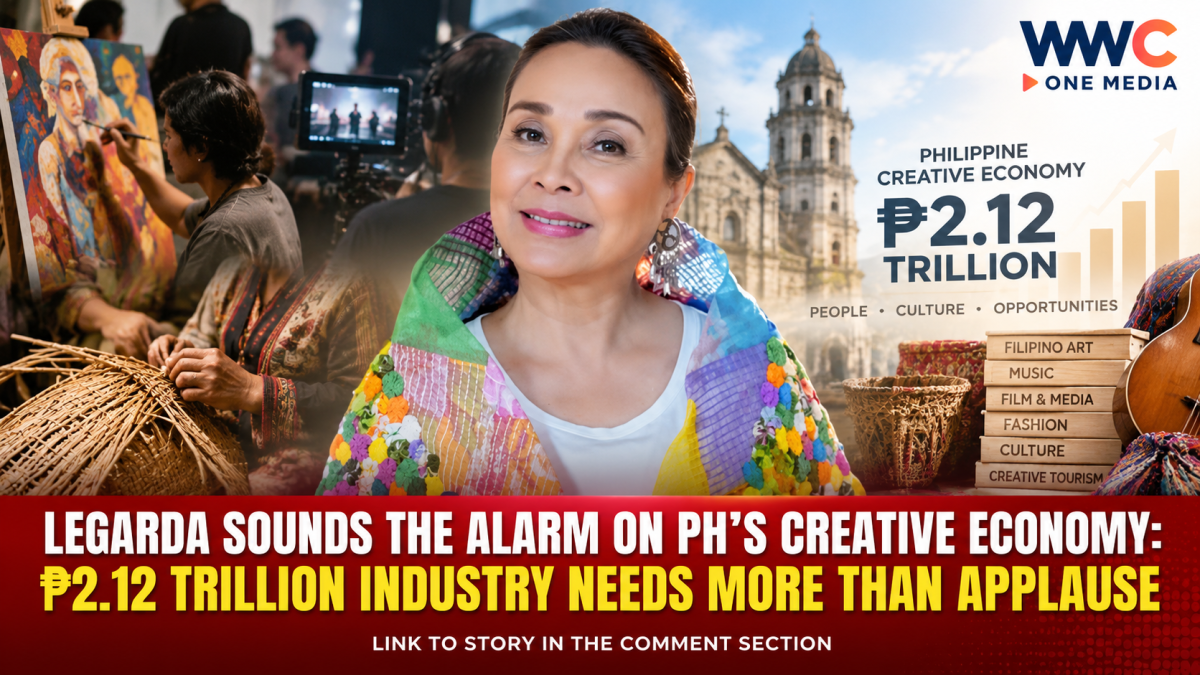
MANILA, Philippines — Filipino creativity is no longer just a source of cultural pride—it is becoming a major economic force, and Sen. Loren Legarda is calling for stronger government support to ensure that the people behind the country’s music, films, crafts, designs, stories, food and traditions benefit from the industry’s growth.
As the Philippines observes Philippine Creative Industries Month this September under the theme “We Are a Creative Nation,” Legarda said the country must go beyond celebrating Filipino talent and build an ecosystem that gives artists, artisans, cultural workers and creative entrepreneurs sustainable livelihoods and access to bigger markets.
The celebration is mandated under Republic Act No. 11904, or the Philippine Creative Industries Development Act, which Legarda authored. The law recognizes creative industries as contributors to nation-building and socioeconomic development.
PH creative economy reaches ₱2.12 trillion
The push comes as the Philippine creative economy continues to expand.
According to the latest Philippine Statistics Authority (PSA) data, the sector generated ₱2.12 trillion in 2025, up 6.9 percent from ₱1.98 trillion in 2024. It accounted for 7.6 percent of the country’s GDP.
Creative industries also supported 8.71 million jobs, equivalent to 17.8 percent of total Philippine employment.
The sector covers a broad range of activities, including audiovisual media, digital interactive products and services, advertising, publishing, music and entertainment, visual arts, traditional cultural expressions, museums, galleries and related creative activities.
But Legarda said the headline economic figures should prompt a deeper question: Are the millions of Filipinos creating these products and experiences actually receiving a sustainable share of the value they generate?
She pointed to Filipino weavers, musicians, filmmakers, designers, artists and young creatives who may possess world-class talent but still struggle to turn that talent into stable careers and businesses.
“Filipino creativity is more than talent to be admired. For many of our fellow Filipinos, it is a job and a livelihood,” Legarda said.
From cultural preservation to real livelihoods
Legarda, who chairs the Senate Committee on Culture and the Arts, has argued that protecting Filipino heritage and developing the creative economy should go hand in hand.
One of her long-running initiatives is the National Arts and Crafts Fair, which she initiated in 2016 to provide artisans and cultural communities with a platform to showcase their work, connect with consumers and reach wider markets. The Department of Trade and Industry has likewise recognized the fair’s role in expanding opportunities for Filipino artisans, MSMEs and indigenous communities.
The senator has also filed a package of measures in the 20th Congress targeting different parts of the cultural and creative ecosystem.
These include proposals for a Department of Culture, a Philippine Culinary Heritage Act, a Philippine Indigenous Writing Systems Act, a Philippine Music Industry Act, and a Philippine Rondalla Training Program Act.
Legarda has also pushed for stronger support for Schools of Living Traditions, which help transmit indigenous knowledge, skills, practices and cultural expressions from one generation to another.
The next challenge: Filipino-owned intellectual property
The growth of the creative economy, however, comes with another challenge—making sure Filipino creators actually own and commercialize the intellectual property they produce.
A 2026 diagnostic report from the World Intellectual Property Organization (WIPO), DTI, IPOPHL and PSA found that the Philippines has a growing and globally competitive creative economy but needs to significantly strengthen Filipino-owned intellectual property and creative brands.
The report said the country needs to move beyond simply providing creative services for foreign companies and increase the creation, ownership and commercialization of Filipino intellectual property.
It also identified financing, talent development, infrastructure, market access and commercialization as important issues that need attention.
The country’s intellectual-property system has made progress. IPOPHL reported that copyright registrations reached a record 6,552 filings in 2025, nearly 75 percent higher than in 2022.
Yet the report warned that commercialization remains a major weakness, with the Philippines still a net importer of intellectual-property services.
Government wants a globally competitive creative sector
The push to make creativity an economic growth engine is not new.
DTI’s long-term creative economy strategy has envisioned the Philippines becoming the top creative economy in ASEAN by 2030 in terms of the size and value of its creative industries, as well as the competitiveness of Filipino talent and content in international markets.
Government programs have increasingly focused on creative hubs, entrepreneurship, digital technology, market access, skills development and international partnerships.
DTI, for example, has worked with industry groups to strengthen sectors such as animation, while its broader Malikhaing Pinoy program aims to promote Filipino talent, cultural heritage and creativity in domestic and global markets.
The department has also emphasized the importance of technology and creative innovation. At the 2024 Creative Nation Summit, discussions included artificial intelligence, virtual reality, augmented reality, digital tools and creative entrepreneurship as part of the country’s strategy to build a stronger creative ecosystem.
The real test is whether creatives can make a living
For Legarda, the ultimate measure of success cannot simply be the size of the industry’s contribution to GDP.
The bigger question is whether an artisan in a remote community can earn a decent income from a traditional craft, whether a musician can build a sustainable career from original compositions, or whether a young filmmaker, designer or digital creator can develop and monetize original Filipino work.
The PSA numbers show the enormous economic footprint already created by Filipino creativity. But they also reveal why stronger policies matter: despite the ₱2.12-trillion contribution, creative-industry employment actually declined slightly from 8.74 million in 2024 to 8.71 million in 2025.
Legarda said government support should therefore encompass training, intellectual-property protection, financing, market access, institutional support and opportunities to scale creative businesses.
The goal, she stressed, is not merely to preserve Filipino traditions in museums or cultural programs—but to keep them alive by ensuring that the people who carry those traditions can continue making a living from them.
As the Philippines celebrates its creative identity, the message from Legarda is clear: Filipino creativity has already proven its economic value. The next challenge is making sure Filipino creators capture more of that value—and that the culture behind their creativity survives for generations to come.
WWC ONE MEDIA J.M.D



Leave a Reply