
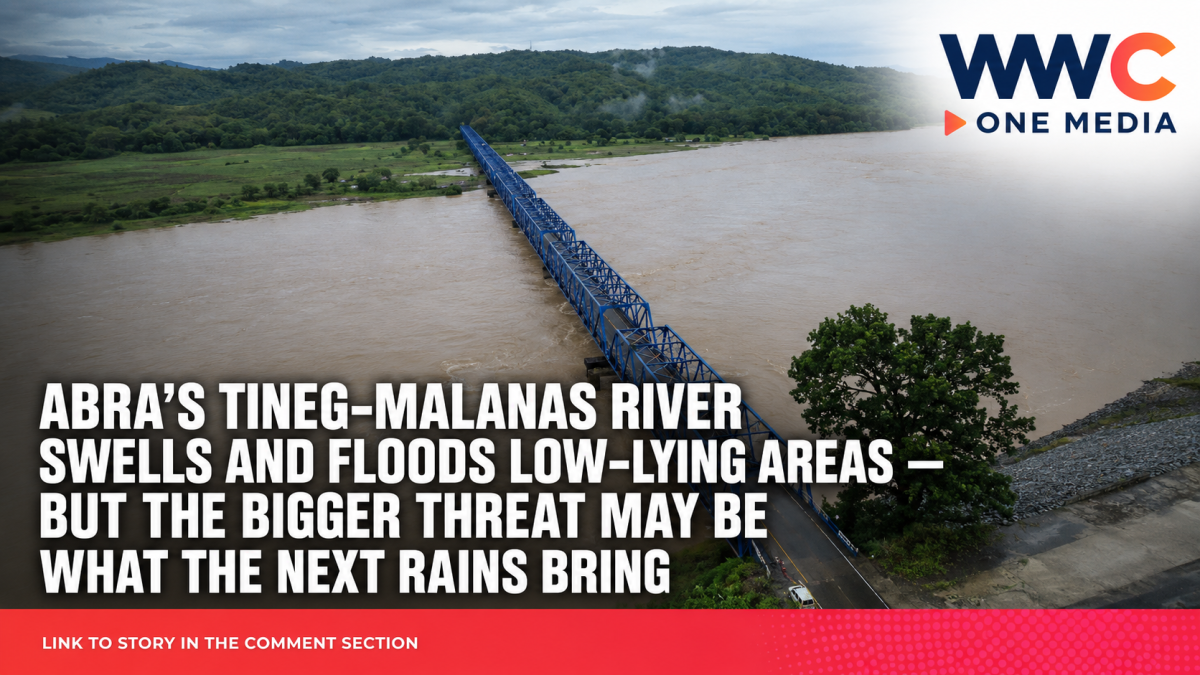
DOLORES, Abra — Residents in flood-prone parts of Abra are being urged to remain alert after the Tineg-Malanas River swelled under days of monsoon rain, inundating low-lying areas and pushing the province’s major river system closer to potentially dangerous levels.
The river continued rising in Dolores on Monday, Aug. 31, as persistent rains from the southwest monsoon, or habagat, soaked Northern Luzon. According to the Abra River Basin Flood Forecasting and Warning Center, the entire stretch of the Abra River and its tributaries was approaching alert level, raising concerns that additional rain could quickly worsen flooding near waterways and downstream communities.
The immediate concern was not simply how high the Tineg-Malanas River had already climbed, but how much more water could still enter the system.
PAGASA had forecast heavy to intense rainfall of roughly 100 to 200 millimeters over Abra and several other Luzon provinces on Aug. 31 as Tropical Depression Pilandok helped strengthen the southwest monsoon. The weather bureau warned that numerous flooding incidents were possible, particularly in low-lying communities and places close to rivers.
Pilandok is far away — but its indirect effect matters
Tropical Depression Pilandok itself remained far from the Philippine landmass and was not expected to directly strike the country.
As of PAGASA’s 5 a.m. bulletin on Tuesday, Sept. 1, Pilandok was about 1,050 kilometers east of Extreme Northern Luzon, packing maximum sustained winds of 55 kilometers per hour and gusts of up to 70 kph. No tropical cyclone wind signal was raised anywhere in the Philippines.
But distance does not mean the system is harmless.
PAGASA said Pilandok was helping influence conditions associated with the southwest monsoon, which continued to drive rain across Luzon and western sections of the Visayas. For Sept. 1, the weather bureau projected another 50 to 100 mm of rain over Abra, Ilocos Norte, Ilocos Sur, La Union, Pangasinan, Batanes, Benguet, Zambales and Bataan.
That means already saturated ground and swollen waterways in Abra could remain vulnerable even without Pilandok making landfall.
Why the Tineg-Malanas River is closely watched
The Tineg-Malanas system is not an obscure waterway that authorities only began monitoring during the latest rains.
The Philippine Information Agency reported in 2024 that the Tineg-Malanas rivers passing near the Legacy Bridge in Dolores are among Abra’s major waterways regularly monitored when severe weather threatens the province. Flood simulations cited by disaster officials at the time identified portions of Dolores, San Juan, Tayum, Bangued, Lagaya, Pidigan and San Quintin as potentially high-risk areas when the Abra River rises during periods of heavy rainfall.
Abra has seen the danger play out before. During Typhoon Julian in 2024, rising water along the Tineg River contributed to evacuations in Dolores. Across Abra, more than 1,100 people from 421 families were evacuated, while over 30,000 individuals were reported affected by that storm.
Those past incidents explain why another sharp rise in the river is being treated seriously.
A much wider monsoon emergency
Abra’s flooding is also unfolding against a broader stretch of destructive weather across the Philippines.
The Office of Civil Defense said on Aug. 31 that the combined effects of recent tropical cyclones and the southwest monsoon had affected about 8.8 million people nationwide, with 33 reported deaths, 19 injuries and three people missing at the time of its update. Abra accounted for two of the reported injuries, according to national disaster figures cited by other news organizations.
The figures underline a critical reality for communities along the Abra River: even when the center of a tropical cyclone stays hundreds of kilometers away, the moisture it helps pull into the southwest monsoon can still generate dangerous rainfall, flash floods and landslides.
What residents should watch next
Authorities have advised people living near rivers, on mountain slopes and in low-lying communities to closely monitor official warnings as long as rainfall continues.
Flash flooding can develop rapidly when upstream rain pours into tributaries, while prolonged rainfall can destabilize already saturated slopes. Residents should therefore rely on evacuation instructions and river advisories from PAGASA, provincial and municipal disaster offices rather than waiting for floodwater to reach homes before moving to safer ground.
For Abra, the crucial question now is no longer whether the Tineg-Malanas River has risen.
It is how much more rain the watershed can absorb before another surge pushes water into communities already living beside one of Northern Luzon’s most closely watched river systems.




Leave a Reply