
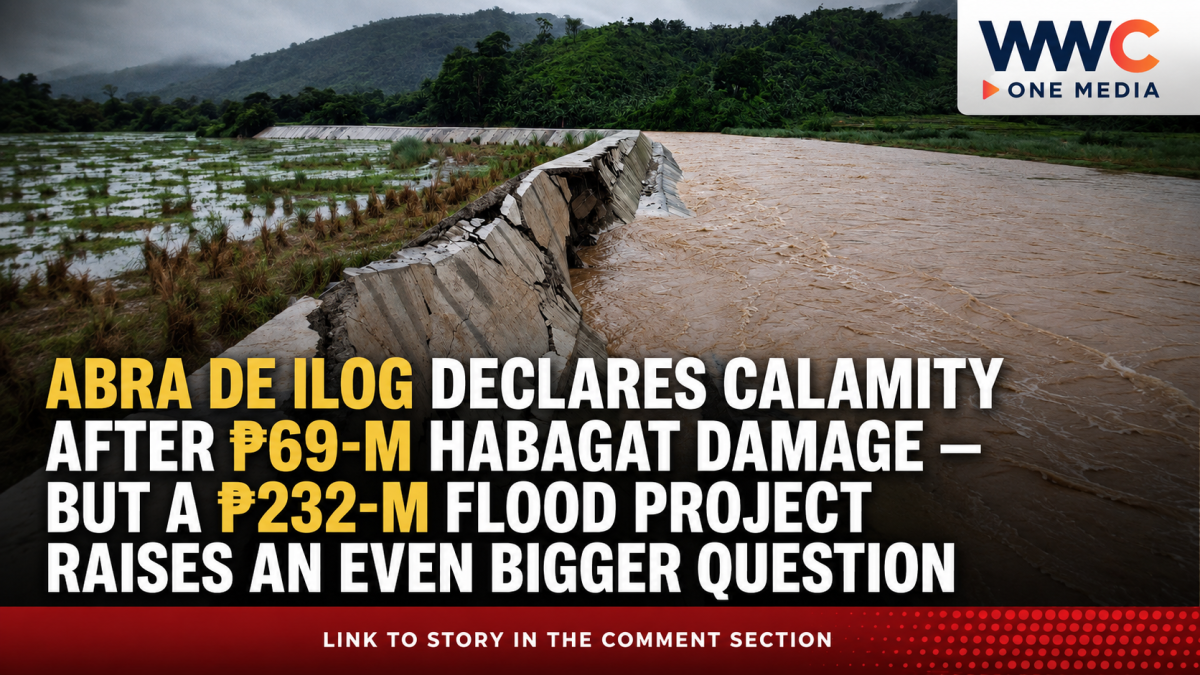
ABRA DE ILOG, OCCIDENTAL MINDORO — The northernmost municipality of Occidental Mindoro is facing a massive recovery effort after days of intense southwest monsoon rains left more than ₱69 million in estimated damage, affected tens of thousands of residents and disrupted roads, farms, homes and water systems.
The Philippine Information Agency reported that the Abra de Ilog local government declared a state of calamity on August 24, allowing local officials to mobilize emergency resources and tap the municipality’s Quick Response Fund. An Inquirer report published the following day said the Municipal Disaster Risk Reduction and Management Council had formally recommended the declaration through Resolution No. 2026-02 dated August 24.
Damage climbs dramatically after new assessments
The scale of destruction became clearer as assessment teams reached more affected communities.
As of August 21, estimated damage had climbed to approximately ₱69.07 million, according to the municipal government figures cited by PIA.
Agriculture suffered the heaviest losses at around ₱27.9 million, while infrastructure damage reached approximately ₱25.34 million. Damaged homes accounted for another ₱8.4 million, while losses involving water systems were estimated at ₱7.44 million.
The updated figure represents a sharp rise from an earlier assessment released on August 20, when authorities initially estimated only around ₱15 million in agriculture and infrastructure losses.
That preliminary report placed infrastructure damage at ₱12 million and agricultural losses at ₱3 million, showing how rapidly the financial impact grew as officials completed inspections in more communities.
More than 46,000 people affected
The disaster affected an estimated 9,574 families, or 46,360 individuals, according to the municipal assessment.
Around 7,000 families were listed as affected by flooding, while 1,724 fisherfolk were also impacted. Another 850 families were recorded as internally displaced.
Flooding was documented in 10 barangays, with Cabacao recording 8,315 affected residents, followed by Udalo with 6,239 and Balao with 5,650.
The figures underscore how the calamity has moved beyond damaged roads and buildings. Farmers have lost crops, fisherfolk have seen livelihoods disrupted, families have been displaced and several communities are now confronting the cost of rebuilding.
Around 300 millimeters of rain overwhelmed the town
One of the clearest explanations for the destruction came from rainfall measurements recorded during the height of the Habagat.
Abra de Ilog received roughly 300 millimeters of rain on August 17. PIA earlier reported that the massive volume fell within roughly six hours, while another report described it as an amount of rain the municipality would normally receive over a much longer period.
The downpour rapidly raised river levels, triggered flooding and increased the threat of landslides.
In Barangay Wawa, floodwaters washed away a bamboo footbridge used by around 300 families, forcing residents to rely on a longer alternative route.
Elsewhere, the Lawaan River became particularly dangerous after logs carried downstream reportedly accumulated and obstructed the waterway. The resulting shift in the river current swept away four homes in Zone 1, Barangay Poblacion. Authorities reported no deaths or injuries from that incident.
Roads and communities remain vulnerable
The consequences did not end when the heaviest rainfall subsided.
As of August 27, the Abra de Ilog–Puerto Galera Road remained closed in an affected section as the Department of Public Works and Highways continued clearing a major rockfall near Sitio Lucotan in Barangay Udalo.
Authorities warned that continuing rockfall made the area dangerous for motorists as well as personnel conducting clearing and restoration work.
In Barangay Wawa, the municipal government also began constructing an emergency earth dike as a temporary defense against further flooding.
The local government supplied 2,000 sacks and sand, while private groups contributed 125 large tonner bags. Officials said the temporary barrier was intended to provide immediate protection while funding for a more permanent solution is pursued.
₱232-million flood-control project raises another major question
Adding to concerns over Abra de Ilog’s flood defenses, GMA News separately reported that a ₱232-million flood-control project intended to protect residents gave way during the Habagat rains.
Citing government documents and the BetterGov.ph transparency portal, GMA reported that the project was worth ₱232 million. The report said Abra de Ilog municipal documents identified the contractor as Anore Construction.
According to GMA, the LGU found issues including the absence of a project billboard and local permit payments, while officials and residents raised questions about visible cracks and elements of the project’s construction.
These findings and allegations should be treated separately from the municipality’s ₱69.07-million general damage assessment unless authorities formally establish how much of the failed project is included in that figure.
The flood-control issue nevertheless adds another layer to Abra de Ilog’s recovery: residents are not only asking how quickly damaged communities can be rebuilt, but whether the infrastructure designed to protect them was strong enough in the first place.
State of calamity unlocks emergency funds
Municipal Disaster Risk Reduction and Management Officer Geoffrey Panganiban said the calamity declaration allows Abra de Ilog to access the 30-percent Quick Response Fund intended for immediate disaster response.
The money can be used to augment food assistance, emergency relief and recovery programs for residents who lost homes, farms, fishing equipment and other sources of income.
The crisis is also part of a much larger disaster affecting Occidental Mindoro. By August 27, ABS-CBN News reported that Habagat-related damage across the province had reached approximately ₱2 billion, as provincial officials considered broader calamity measures.
For Abra de Ilog, however, the immediate numbers are already staggering: more than 46,000 people affected, tens of millions of pesos in verified municipal losses, damaged transport links and communities still relying on temporary defenses against powerful rivers.
The state of calamity may unlock the money needed for the first stage of recovery.
The bigger question is whether the infrastructure rebuilt after the floods will be able to withstand the next one.

Leave a Reply