
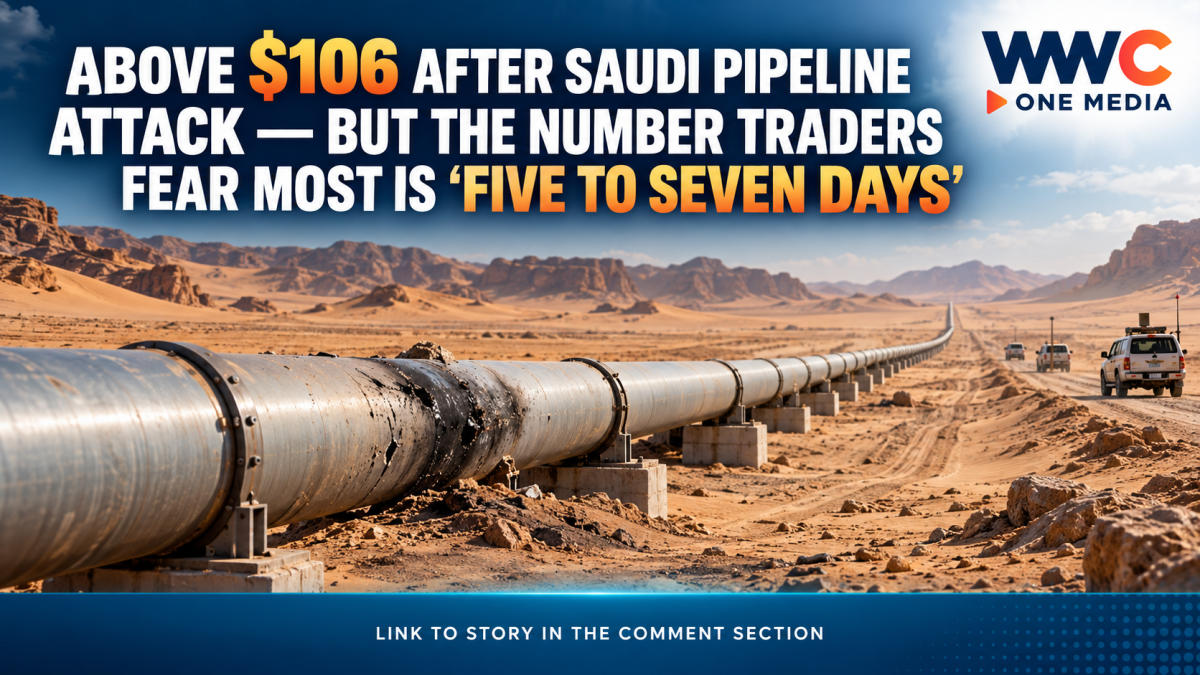
SINGAPORE/RIYADH — Oil prices pushed higher again on Tuesday as traders confronted an increasingly dangerous question for the global energy market:
What happens if Saudi Arabia loses its most important route around the Strait of Hormuz for weeks rather than days?
Brent crude futures climbed US$1.24, or 1.18%, to US$106.93 a barrel in early Asian trading on September 15, while U.S. West Texas Intermediate crude rose US$1.29, or 1.24%, to US$102.65.
The gains followed renewed attacks in Saudi Arabia and growing uncertainty over the kingdom’s East-West Pipeline, a 1,200-kilometre oil artery that has become critical to keeping Saudi exports flowing while shipping through the Strait of Hormuz remains severely constrained.
The pipeline was knocked offline after a September 11 attack that Riyadh blamed on Iran-backed fighters operating from Iraq.
Its shutdown matters far beyond Saudi Arabia.
In recent months, the kingdom has been using the line to send roughly 4 million barrels of crude a day across the Arabian Peninsula to the Red Sea port of Yanbu — equivalent to about 4% of global oil supply.
Saudi Arabia’s oil escape route is suddenly unavailable
The East-West Pipeline, also known as Petroline, was constructed in the 1980s partly so Saudi Arabia could move crude from its oil-producing eastern region to the Red Sea without relying on the Strait of Hormuz.
That strategic purpose has become extraordinarily important in 2026.
The pipeline connects eastern Saudi oil facilities with Yanbu on the kingdom’s western coast, allowing crude to bypass Hormuz entirely.
Saudi Aramco said earlier this year that it had ramped the system to its maximum capacity of 7 million barrels per day during the first quarter as regional disruptions intensified.
The U.S. Energy Information Administration has historically described the system as having about 5 million barrels a day of normal installed capacity, with the ability to expand temporarily to approximately 7 million barrels a day.
Before last week’s attack, Reuters says around 4 million barrels a day were actually being rerouted through it to Yanbu.
Now that flow is under threat.
The most worrying number may be five to seven days
Saudi Arabia can continue loading some crude from inventories already stored at export terminals.
But that buffer may be limited.
Industry sources told Reuters that Yanbu currently has enough oil stocks to sustain exports for only around five to seven days without new supplies arriving through the East-West Pipeline.
Saudi Arabia also holds oil at Egyptian ports including Ain Sukhna and Sidi Kerir, providing additional flexibility, but those inventories would eventually be depleted as well if pipeline operations do not resume.
Reuters reported varying estimates for the repairs. One source said full work could require as long as five to six weeks, while another suggested the pipeline might restart partially sooner.
Saudi authorities have not announced an official timetable.
Associated Press subsequently reported, citing two regional officials briefed on the damage, that repairing the pipeline and a major pumping facility could take roughly three to five weeks. Partial operations may be possible during that period.
That makes the duration of the outage the number oil traders are watching most closely.
Then came another wave of attacks
The pipeline strike was not the end of the escalation.
Yemen’s Iran-aligned Houthis said they launched dozens of missiles and drones at the King Khalid Air Base in Khamis Mushait, southern Saudi Arabia, targeting aircraft hangars, radar installations, runways and ammunition facilities.
Reuters reported that 13 civilians were wounded, according to the Saudi-led coalition.
The attacks followed Saudi and Yemeni strikes against Houthi positions as fighting in Yemen intensified again.
For oil markets, the concern is not simply that one piece of infrastructure has been damaged.
It is that Saudi Arabia is facing growing threats on both sides of the country.
To the east sits the Strait of Hormuz.
To the west sits the Red Sea and Bab el-Mandeb.
And the pipeline designed to connect those two worlds without requiring ships to use Hormuz is now itself damaged.
Why Hormuz makes this crisis much more dangerous
Under normal conditions, the Strait of Hormuz is one of the most important pieces of infrastructure in the global economy.
The International Energy Agency says roughly 20 million barrels of oil and petroleum products per day passed through the strait in 2025 — around one-quarter of the world’s seaborne oil trade.
China, India and other Asian markets are particularly dependent on those flows.
But the situation changed dramatically after the U.S.-Israeli war with Iran began on February 28, 2026.
EIA data show average oil flows through Hormuz collapsing from about 21.6 million barrels a day in the fourth quarter of 2025 to just 4.9 million barrels a day in the second quarter of 2026.
More recently, industry sources cited by Reuters estimated flows at roughly 6 million to 9 million barrels per day, still dramatically below pre-war levels.
Weekend traffic deteriorated again.
Reuters reported fewer than 10 commodity-vessel transits per day through Hormuz over the weekend, compared with a recent 10-day average of 14.
That is why losing the East-West Pipeline now is far more consequential than it would be during normal conditions.
Saudi Arabia’s backup route has effectively become a frontline route.
The Red Sea isn’t looking much safer
Even if Saudi crude reaches Yanbu, getting it to customers is becoming more complicated.
The Houthis have expanded their territorial control along Yemen’s Red Sea coast and recently seized strategically important islands close to the Bab el-Mandeb Strait, another major maritime chokepoint.
Associated Press reported that Houthi forces took Greater and Lesser Hanish islands after earlier seizing Mayun Island and the port city of Mokha.
The developments increase the group’s ability to threaten shipping between the Red Sea and the Gulf of Aden.
Some Saudi oil leaving Yanbu has consequently had to travel north through the Red Sea, toward the Suez Canal or Egypt’s pipeline system, rather than south through Bab el-Mandeb toward major Asian buyers.
That alternative adds both time and cost.
For Saudi Arabia, the geography is becoming brutally complicated:
The route east through Hormuz is heavily disrupted.
The route south through the Red Sea faces Houthi threats.
And the overland pipeline designed to avoid Hormuz has been hit.
Saudi oil production has already fallen sharply
The kingdom was already producing substantially less crude before this latest pipeline shutdown.
Saudi Arabia told OPEC that production fell to around 6.2 million barrels per day in August, compared with approximately 10.9 million barrels per day in February, before the current war began, Reuters reported.
That drop forms part of a much wider global supply shock.
The International Energy Agency’s September Oil Market Report estimates that worldwide oil production fell by another 1.6 million barrels per day in August to 100.1 million barrels per day.
More than 10 million barrels a day of Gulf production remained shut in because of security risks.
The IEA now forecasts total global oil supply to decline by 5.7 million barrels per day in 2026, with a full recovery in Middle Eastern supply pushed into 2027.
That is a dramatic reversal for an oil market that only months earlier had far more spare capacity.
Oil inventories are disappearing too
The supply problem is being compounded by declining inventories.
According to the IEA, observed global oil stocks dropped by another 95 million barrels in August.
Since the conflict began in February, inventories have fallen by a cumulative 507 million barrels — equivalent to an average draw of around 2.8 million barrels a day.
That matters because inventories act as the world’s shock absorber during interruptions.
The less oil sitting in tanks and aboard ships, the harder it becomes to cushion the market against another major disruption.
And the latest Saudi attack has damaged one of the pieces of infrastructure that had been helping compensate for the loss of normal Gulf shipping.
Brent had already surged toward $110
Monday offered a preview of how nervous traders have become.
Associated Press reported Brent crude reaching around US$109 a barrel as markets absorbed news that the pipeline could remain substantially impaired for weeks.
The market subsequently pulled back, but crude remained above US$100 as Tuesday trading began.
That volatility illustrates the dilemma facing traders.
If the East-West Pipeline resumes quickly, some of the current geopolitical premium could unwind.
If it stays offline for weeks and Saudi inventories start running down, supply could tighten sharply.
And if another major export facility, tanker route or refinery is hit before then, the pressure could escalate much faster.
This isn’t just an oil-price story anymore
The consequences extend well beyond energy traders.
Higher crude prices eventually feed into gasoline, diesel, jet fuel, shipping and manufacturing costs.
Diesel is particularly important because it powers trucks, agricultural machinery and a large share of commercial transport.
The IEA says global refining margins have already reached exceptionally high levels, with supplies of diesel, jet fuel and other middle distillates under significant pressure.
Net diesel and gasoil exports from Gulf producers were running at only about one-quarter of their pre-war level in August, according to its latest report.
That can translate into higher transportation and food costs — precisely the type of inflation policymakers have been struggling to contain.
Higher oil prices can also complicate central-bank decisions by keeping inflation elevated even when economic growth is weakening.
So every additional missile, pipeline outage or shipping incident now carries consequences stretching from Riyadh and Tehran to fuel pumps, airline tickets and interest-rate expectations around the world.
Diplomacy is struggling at the worst possible moment
Markets had hoped negotiations might lower the risk surrounding Hormuz.
Instead, Gulf Arab states postponed planned discussions with Iran, according to Reuters, adding uncertainty over prospects for reopening shipping routes more fully.
At the same time, fighting between the Houthis and Saudi-backed forces in Yemen has intensified.
That means the two maritime corridors most important to Gulf producers — Hormuz and the Red Sea — remain exposed to the same broader regional confrontation.
The danger is no longer simply that one chokepoint closes.
It is that attempts to bypass one vulnerable route push more oil toward another vulnerable route.
Why the next few days could matter more than Tuesday’s oil price
Brent at US$106 or US$109 makes an attention-grabbing headline.
But traders may be watching something much more important:
whether oil begins flowing through the East-West Pipeline again before Saudi Arabia’s readily available export stocks start running down.
If partial operations resume quickly, Riyadh could continue using Yanbu as a pressure valve while the region attempts to stabilise Hormuz.
If repairs really take three to five weeks and pipeline flows remain severely restricted, however, Saudi Arabia may have to make much harder choices over production, storage and customer deliveries.
A route moving roughly 4 million barrels a day represents only a fraction of the world’s approximately 100-million-barrel-a-day market.
But in an oil system already suffering extraordinary Middle East disruptions, falling inventories and constrained shipping lanes, losing another 4% is anything but marginal.
For months, Saudi Arabia’s East-West Pipeline helped the oil market work around one of the world’s most dangerous maritime chokepoints.
Now the market has discovered the uncomfortable truth:
the bypass itself can be attacked.




Leave a Reply