
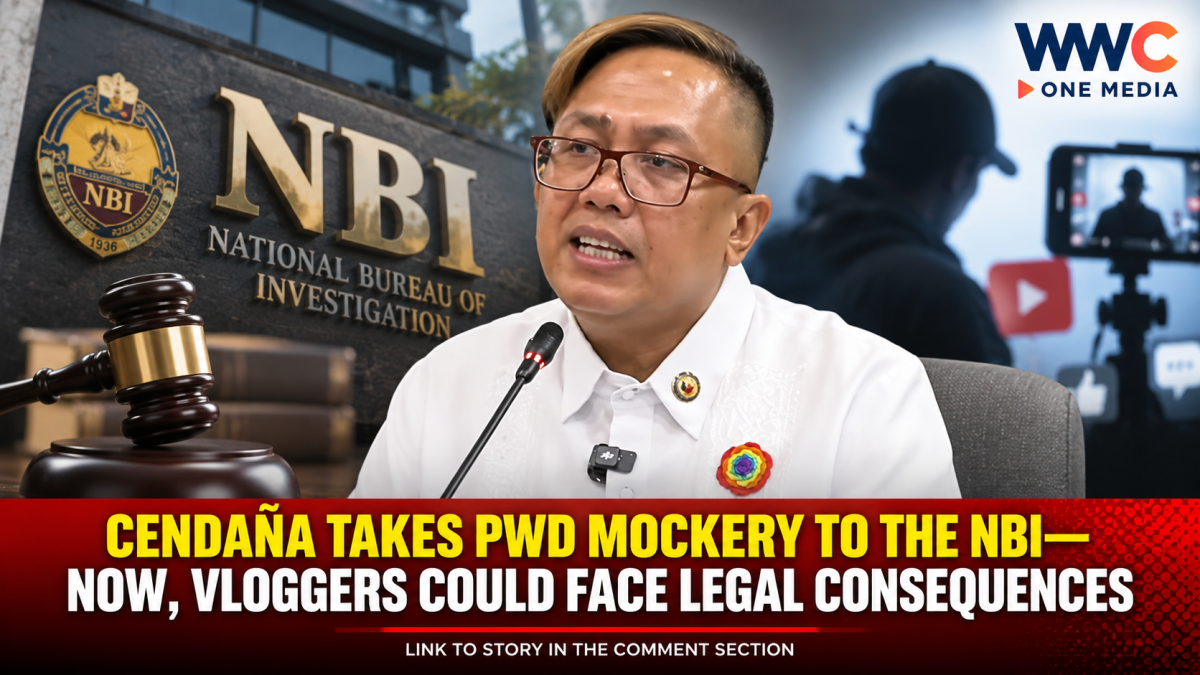
MANILA, Philippines — What began as online ridicule targeting the medical condition of Akbayan Party-list Rep. Perci Cendaña has escalated into a legal battle, with the lawmaker filing a complaint before the National Bureau of Investigation (NBI) against vloggers accused of mocking persons with disabilities (PWDs).
The complaint puts a larger issue under the spotlight: Where does political criticism end and prohibited ridicule of disability begin?
Cendaña, a stroke survivor, has repeatedly drawn the line between legitimate criticism of a public official and attacks that use a person’s medical condition or disability as an object of humiliation.
In a statement cited in recent reporting, Cendaña said public officials should expect scrutiny and criticism, but argued that using a medical condition to shame, demean or dehumanize someone goes beyond legitimate political discourse.
He warned online pages, influencers and individuals who publish or amplify such material that legal action could follow.
Cendaña: Criticism Is Part of Politics—But Disability Is Different
Cendaña’s position is that being a public official does not mean surrendering basic protections against discrimination and humiliation.
A recent Pilipino Star Ngayon column likewise highlighted the distinction between political satire and ridicule directed at a person’s disability. The column noted that political cartoons, memes, jokes and other forms of commentary can be legitimate forms of criticism when they address political conduct or public issues—but argued that mocking someone’s physical condition is fundamentally different.
That distinction could become central as authorities assess Cendaña’s complaint.
The lawmaker has also framed the matter as bigger than his own case, saying that the issue concerns other PWDs who are subjected to similar degrading treatment online.
The Law Already Prohibits Public Ridicule of PWDs
The legal issue is not simply about hurt feelings or offensive speech.
Republic Act No. 9442, which amended the Magna Carta for Persons with Disability, specifically established protections against verbal and non-verbal ridicule and vilification.
Under Section 39, public ridicule includes making fun of, contemptuously imitating or mocking a person with a disability because of their impairment. Section 40 further prohibits such acts when they could intimidate a PWD or result in the loss of the person’s self-esteem.
The implementing rules provide additional examples, including making degrading jokes about a person’s disability, mocking a PWD verbally or in writing, and offensive imitation of a person with a disability in public or entertainment settings.
The law also contains a penal provision. For a first violation, the law provides for a fine of P50,000 to P100,000, imprisonment of six months to two years, or both, at the court’s discretion. Subsequent violations carry heavier penalties.
This Is Not the First Time PWD Mockery Has Triggered Legal Concerns
The National Council on Disability Affairs (NCDA) has previously taken a strong position against online content that ridicules people with disabilities.
In a 2025 statement, the NCDA condemned a viral social-media video involving the degrading portrayal of a person with a disability, stressing that such behavior can violate RA 9442.
In another case involving an elderly woman with a disability in Antipolo, the NCDA described public ridicule as a violation of the law and emphasized that mocking PWDs is not merely offensive but can carry legal consequences.
That history gives added significance to Cendaña’s complaint.
The Bigger Question: Can Political Satire Cross the Line?
The case could ultimately test how Philippine authorities distinguish protected criticism, satire and political commentary from discrimination and prohibited ridicule based on disability.
Cendaña himself has acknowledged that public officials are expected to face criticism. His objection centers on attacks that allegedly shift the focus away from his policies, political actions or public record and instead target his medical condition.
That distinction is particularly relevant in the age of viral videos, memes and influencer-driven political commentary, where offensive material can spread rapidly across multiple platforms.
The NBI complaint therefore goes beyond one politician and several online personalities.
It raises a question increasingly relevant to Philippine social media: When does a viral joke stop being political commentary—and become unlawful humiliation of a person because of a disability?
For now, Cendaña’s complaint is an allegation requiring investigation and appropriate legal proceedings. The filing itself does not establish the guilt of the vloggers involved.
But one thing is clear: Cendaña is signaling that the alleged mockery of disability will no longer be treated as just another online political fight.
And the next move now rests with investigators and prosecutors.




Leave a Reply