
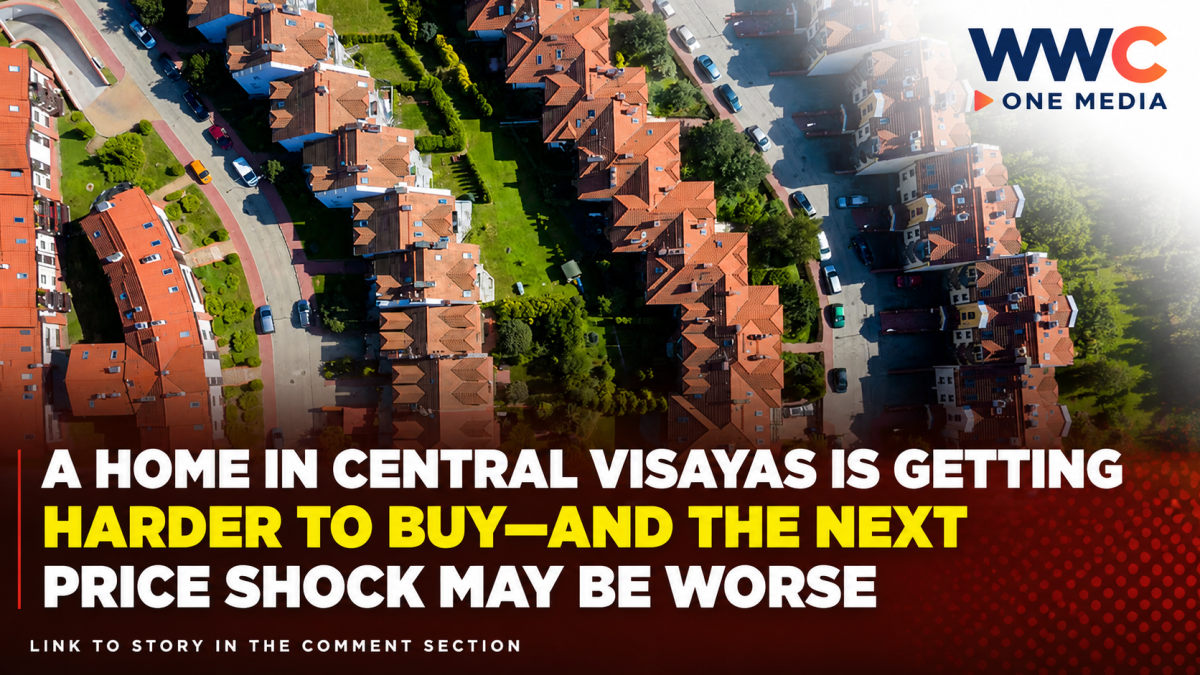
CEBU CITY, Philippines — For many families dreaming of owning a home in Central Visayas, the biggest challenge is no longer simply finding the right property. It is finding one they can still afford.
Rising land values, expensive construction inputs and broader economic pressures are steadily pushing the cost of housing higher, widening the gap between property prices and what ordinary Filipino households can realistically pay.
The affordability crunch is particularly visible in Metro Cebu, one of the country’s fastest-growing urban centers, where rapid development and limited land have intensified competition for residential space.
Recent government data underscore the scale of the challenge. The Bangko Sentral ng Pilipinas (BSP) reported that the median price of all residential property types in Metro Cebu reached about ₱3.8 million in the fourth quarter of 2025, while the median price of houses stood at roughly ₱4.34 million. Across the Philippines, the median price for all housing types was about ₱3.44 million.
While national property price growth slowed significantly toward the end of 2025, slower increases do not necessarily mean homes have become cheap. BSP data showed residential property prices nationwide rose by 1.6 percent year-on-year in the fourth quarter of 2025—the slowest pace since 2019—while prices outside Metro Manila still increased by 1 percent. Condominium prices, meanwhile, continued to rise faster than house prices.
The problem isn’t just financing—it’s the price of the home itself
For many prospective buyers, larger loan limits may offer more borrowing power, but they do not solve the underlying affordability problem.
Economist Fernando “Perry” Fajardo previously told Cebu Daily News that the real challenge for most Filipino families is not whether they can borrow millions of pesos, but whether homes are being built at prices that match their incomes. He pointed to the limited availability of decent housing in the roughly ₱500,000 to ₱1.5 million range, where demand from ordinary households is greatest.
That distinction matters. A higher loan ceiling can help buyers finance more expensive properties, but it can also leave families facing decades of larger monthly payments if household incomes fail to keep pace with housing costs.
The government has sought to ease the burden through subsidized financing. Under the Expanded Pambansang Pabahay para sa Pilipino program, Pag-IBIG Fund has maintained a 3 percent annual interest rate for qualified socialized housing borrowers and has also rolled out promotional housing loan rates aimed at expanding access to homeownership.
But financing assistance alone cannot erase the rising cost of land and construction.
Land is expensive—and building isn’t getting any easier
Developers across Central Visayas continue to operate in an environment shaped by higher material costs, fuel expenses and logistics pressures.
Philippine Statistics Authority data showed that the average construction cost of approved residential buildings in Central Visayas was about ₱12,393 per square meter in May 2026. Residential condominiums posted the highest average cost among major residential building categories at nearly ₱17,794 per square meter.
Separate reports from The Freeman also showed that construction activity in Central Visayas faced pressure in early 2026. While approved building permits increased, the total value of approved construction projects fell 12.8 percent in the first quarter as developers navigated higher material and fuel costs, logistics expenses and global uncertainty.
For buyers, these costs eventually find their way into the final selling price.
And the pressure on household budgets extends beyond real estate. Central Visayas recorded an 8.7 percent inflation rate in July 2026, even after easing from higher levels earlier in the year. Rising prices for everyday necessities can make it even harder for families to save for a down payment or qualify for a mortgage.
A supply problem could make affordability even worse
Housing affordability is also tied to supply: when fewer homes reach the market while demand remains strong, prices can face additional upward pressure.
The issue has become more complicated in Cebu amid concerns over delays in the approval of Licenses to Sell, which developers need before they can legally market subdivision lots and condominium units.
Industry officials and property analysts have warned that prolonged regulatory bottlenecks could restrict the number of new projects entering the market. Colliers Philippines research head Joey Roi Bondoc said tighter supply could add pressure to prices, especially as developers already contend with rising land and construction costs.
However, the issue has been disputed by the Department of Human Settlements and Urban Development in Central Visayas, which previously said it had only a limited number of pending applications and that non-compliance or incomplete requirements—not blanket regulatory delays—were behind some stalled projects.
The conflicting accounts highlight a bigger concern: Central Visayas needs more housing supply, but getting homes built, approved and delivered remains a complex process.
A regional development report also identified housing affordability and price escalation as a major challenge, noting that Metro Cebu’s housing prices had risen faster than the national average and that the supply of socialized housing remained inadequate relative to the needs of a rapidly urbanizing region.
The dream of homeownership is moving farther away
Central Visayas remains an attractive real estate market, supported by urban growth, infrastructure development, business expansion and strong demand from local buyers and overseas Filipino workers. Cebu Daily News previously reported strong residential take-up rates across the Visayas and Mindanao, reflecting continued appetite for property despite affordability concerns.
But strong demand can be a double-edged sword.
As developable land becomes scarcer in key urban areas and the cost of building remains high, the market risks producing more homes that are technically available—but financially beyond the reach of the people who need them most.
For families, the question is becoming increasingly urgent: How much longer can they wait before the home they hope to buy costs even more?
The answer may depend on whether government and the private sector can move beyond bigger loans and focus on the more difficult challenge—expanding the supply of safe, decent and genuinely affordable homes.
Because for a growing number of Cebuanos and Central Visayans, the dream of owning a home is not disappearing overnight.
It’s simply getting more expensive with every passing year—and that may be the most alarming part.

Leave a Reply