
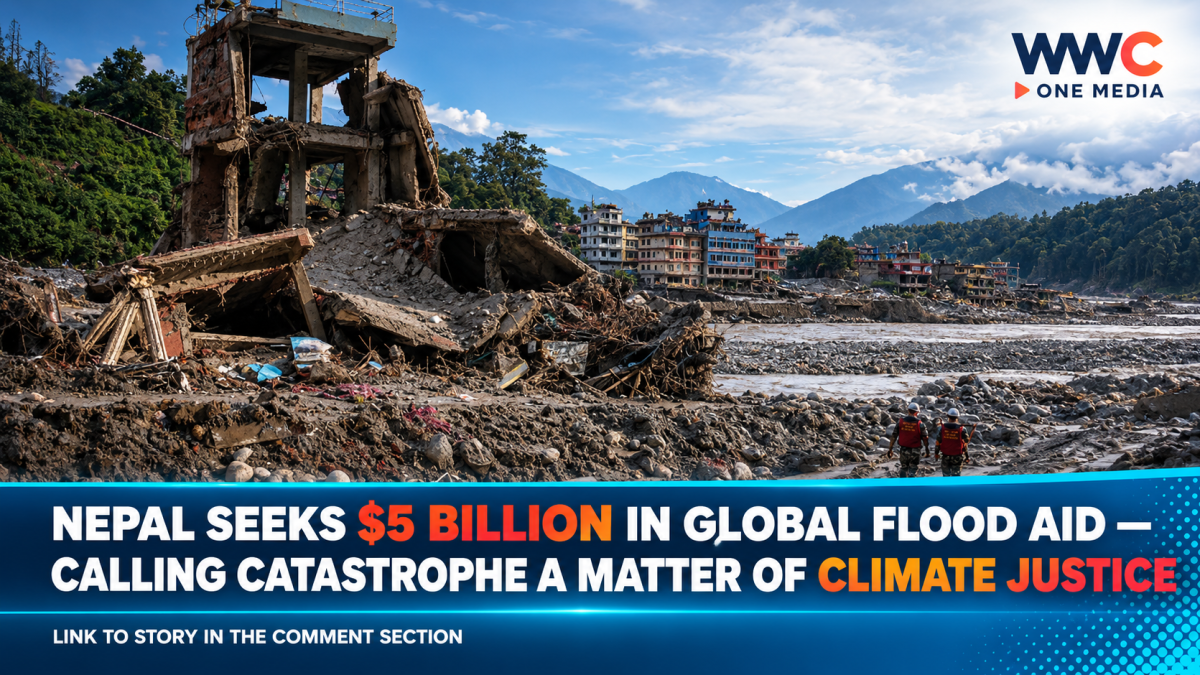
KATHMANDU — Nepal is taking its appeal for international flood aid to the world with a powerful new message: this is not simply a natural disaster — it is a matter of climate justice.
After catastrophic flooding triggered by the collapse of a Himalayan glacier in late August, Nepal is seeking an estimated US$5 billion for the first phase of rebuilding and recovery.
But officials are framing the appeal differently from a traditional humanitarian aid request.
Nepal argues that poorer countries suffering devastating consequences from climate change should not be left to bear the cost alone — particularly when they have contributed relatively little to the global emissions driving the crisis.
More Than 1,300 Dead as Disaster Ravages Nepal
The disaster unleashed a torrent through valleys along the Nepal-China border, causing widespread destruction across Nepal and China’s Tibet region.
At least 1,300 people have been confirmed dead, while more than 5,300 others remain missing across the affected areas, according to the latest figures reported by Reuters.
Nepal bore the brunt of the destruction, with the disaster sweeping away homes, roads, bridges, cross-border trade routes and critical infrastructure.
More than a dozen hydropower plants were also damaged or destroyed, dealing another major blow to a country where hydropower is central to the economy and electricity supply.
Nepal’s New Message: Climate Change Is a Shared Responsibility
Nepali officials are now putting climate justice at the centre of their international appeal.
The government plans to present its initial US$5 billion rebuilding estimate to major international institutions, including the World Bank and Asian Development Bank, as well as diplomatic missions representing the United States, Britain, India, China, Japan and the European Union.
The funding estimate covers the first phase of recovery over the next five months.
Officials argue that countries which have contributed most to global greenhouse gas emissions have a shared responsibility to help vulnerable nations cope with climate-related disasters.
A Country That Emits Little but Faces Enormous Risks
Nepal has repeatedly pointed out that its contribution to global greenhouse gas emissions is negligible.
Yet its geography makes it highly vulnerable to the effects of a warming climate.
The Himalayas contain some of the world’s most important glaciers, and rising temperatures can increase the risks associated with glacier melt, unstable mountain slopes and glacial lakes.
For Nepal, the latest disaster has become a powerful example of what officials describe as an unfair reality: countries that contribute the least to climate change can suffer some of its most devastating consequences.
The $5 Billion Question: Will the World Pay?
Getting international promises is one challenge.
Getting the money quickly is another.
Pakistan’s experience after its devastating 2022 floods has become a warning for Nepal.
International partners pledged billions of dollars following that disaster, but funding was slow to arrive and a significant portion was directed toward other forms of support rather than direct reconstruction.
Nepal is now preparing a detailed assessment of the damage, losses and funding needed for temporary shelters, schools and other essential infrastructure in an effort to make its case to international donors.
The government wants reconstruction funding to arrive quickly enough to make a real difference for communities still struggling in the aftermath of the disaster.
Aid Efforts Face Major Challenges
Even as Nepal prepares its long-term recovery plan, immediate relief operations remain difficult.
Destroyed roads and bridges have left some communities isolated, forcing emergency responders to find alternative ways of delivering food, medicine and other essential supplies.
The Nepali army has turned to cargo drones to reach areas where conventional transport has become difficult or impossible, while helicopters remain heavily involved in rescue and emergency operations.
Nepal Takes Its Climate Fight to the World
The disaster is expected to become a major part of Nepal’s diplomatic agenda in the coming weeks.
Prime Minister Balendra Shah is expected to highlight the need for greater international support for climate-vulnerable developing countries during an address to the United Nations on September 24.
Nepal’s appeal could also intensify debate over the international loss and damage system, which was created to help vulnerable countries deal with the consequences of climate-related disasters.
However, the gap between what countries need and what international funds can provide remains enormous.
More Than Aid — A Demand for Accountability
Nepal’s strategy marks a significant shift in how it is presenting its recovery needs.
Instead of asking the world to view the funding simply as charity, officials are arguing that the disaster should force a broader conversation about accountability.
The message is simple:
Climate change may be a global problem, but its consequences are not being shared equally.
And Nepal wants the international community to recognise that reality when deciding who pays for rebuilding after catastrophe strikes.
The Bottom Line
Nepal is seeking US$5 billion to rebuild after one of the country’s most devastating disasters — but it is asking the world to see the crisis as something much bigger than a flood.
With more than 1,300 people confirmed dead and thousands still missing across Nepal and Tibet, the Himalayan nation is putting climate justice at the heart of its global appeal.
Nepal contributes relatively little to the emissions driving climate change.
Yet it is now facing billions of dollars in damage, destroyed infrastructure and communities struggling to recover.
The world may be willing to offer sympathy — but Nepal is now asking a far more difficult question: Who should pay when the countries least responsible for climate change suffer some of its worst consequences?
WWC ONE MEDIA J.M.D




Leave a Reply