
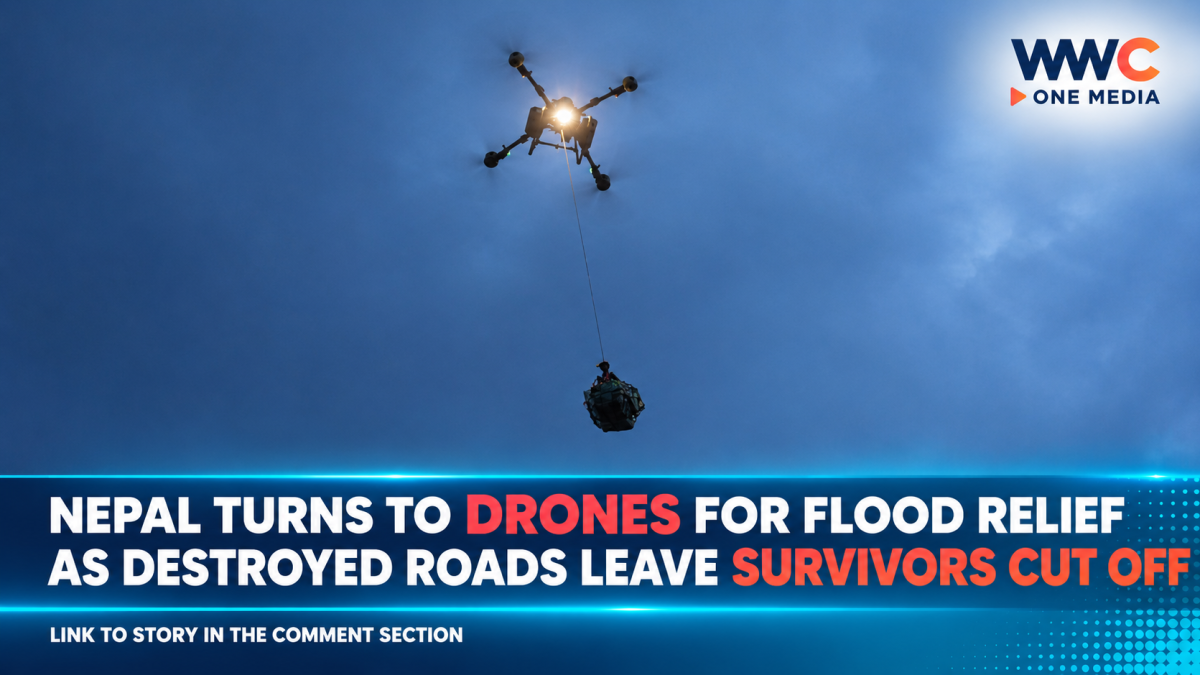
DEVIGHAT, Nepal — With roads and bridges washed away and helicopters already stretched by search-and-rescue missions, Nepal is turning to an unlikely lifeline from the sky: heavy-duty drones carrying food, medicine, fuel and emergency supplies to flood survivors.
The Nepal Army has deployed drones to reach communities cut off by devastating floods triggered after a Himalayan glacier broke away near the Nepal-China border in late August.
At least 1,367 people have been confirmed dead, while more than 5,000 remain missing, according to the latest figures reported by Reuters.
When Roads Disappear, Help Takes to the Sky
The catastrophic flooding destroyed vital infrastructure across affected areas, leaving many communities isolated.
With helicopters heavily committed to searching for survivors and reaching people trapped in disaster zones, drone operators say unmanned aircraft have become one of the fastest ways to deliver essential supplies.
The drones are carrying:
- Food
- Drinking water and essential supplies
- Medicine
- Fuel
- Other emergency relief items
Santosh Budhathoki, a contract drone pilot working with the Nepal Army, said drones had become a crucial option as conventional transport routes remained severely disrupted.
Each Drone Can Carry Up to 60kg
Nepal’s relief drones are not ordinary consumer drones.
The Army is using a fleet of four DJI FlyCart 100 cargo drones, which were donated by China as part of a recent aid package.
Each drone can reportedly carry up to 60kg of supplies and operate across distances of around 3km to 4km, allowing emergency workers to reach communities separated by destroyed roads, rivers and landslides.
The Army is currently making around 10 to 16 relief deliveries a day.
More Than Just Delivering Food
The drones are also being used for other difficult and sensitive missions.
In some flood-hit areas, cargo drones have been used to transport the bodies of victims where ground access is impossible or extremely dangerous.
Reconnaissance drones are also playing a major role in the continuing search for survivors, helping rescuers survey damaged terrain and identify areas that may otherwise be difficult to reach.
Nepal’s Mountains Make Drones a Powerful Tool
Nepal’s rugged Himalayan terrain has always presented major logistical challenges.
After the floods, those challenges became even more severe.
Drone operators say the technology is particularly suited to Nepal because aircraft can bypass washed-out roads, unstable slopes and damaged bridges.
Milan Pandey of drone operating company Airlift Technology said Nepal’s geography makes drones a potentially faster, more efficient and less costly way to reach isolated areas.
A Disaster That Changed the Landscape
The floods were triggered after a glacier broke away near the Nepal-China border in late August, unleashing devastating flooding downstream.
Entire communities have been damaged or destroyed, while roads, bridges and hydropower infrastructure have suffered severe losses.
The disaster has also complicated one of the largest search-and-rescue operations Nepal has faced in years, with international teams joining local authorities to search for survivors and recover victims.
Technology Becomes a Lifeline
The use of cargo drones highlights how disaster response is increasingly changing.
In places where trucks cannot drive and helicopters cannot be spared, unmanned aircraft can deliver smaller but potentially life-saving shipments directly to isolated communities.
For Nepal’s flood survivors, that could mean the difference between waiting days for help and receiving medicine or food within hours.
The technology cannot replace large-scale relief operations.
But as the disaster continues to leave communities cut off, every successful flight is becoming another connection between survivors and the outside world.
The Bottom Line
With roads gone, bridges destroyed and helicopters busy searching for survivors, Nepal is now sending help through the sky.
The Nepal Army’s fleet of cargo drones is delivering food, medicine, fuel and essential supplies to communities that may otherwise be unreachable.
Each drone can carry up to 60kg — and with 10 to 16 deliveries being made every day, the technology is quickly becoming a critical part of Nepal’s emergency response.
In one of Nepal’s darkest disasters, the roads may have disappeared — but help is still finding a way through.
And for thousands of people cut off by floodwaters and destroyed infrastructure, that lifeline is now coming from above.
WWC ONE MEDIA J.M.D


Leave a Reply