
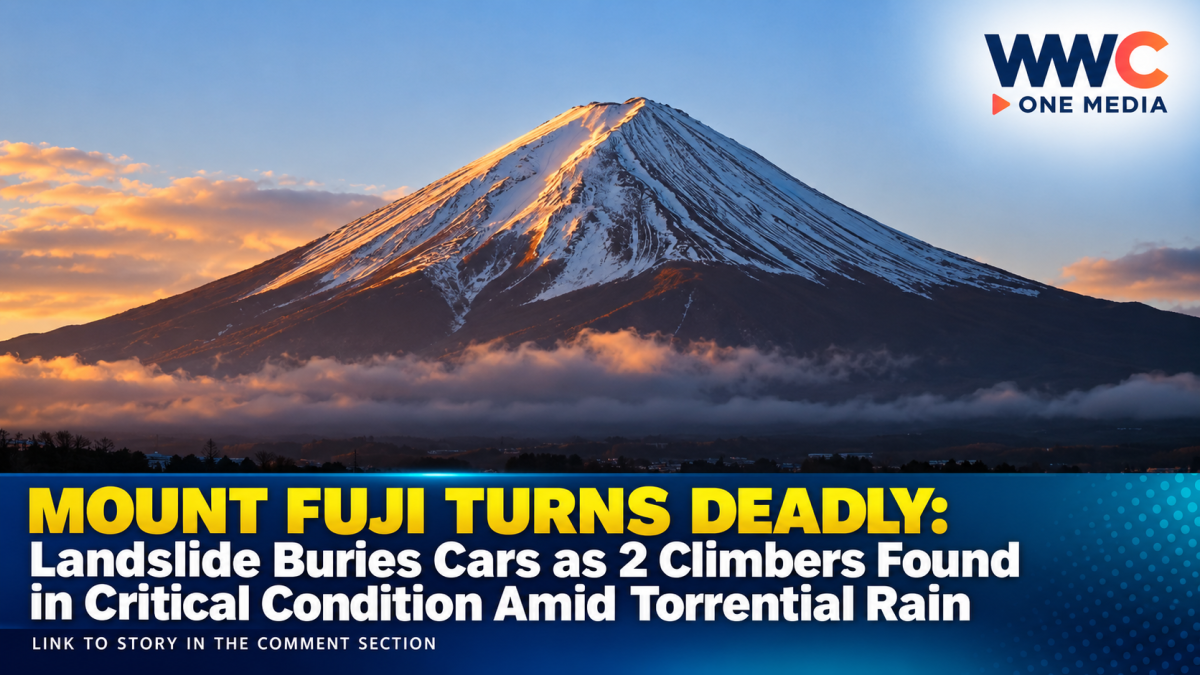
TOKYO — Mount Fuji was battered by torrential rain and dangerous conditions just as Japan’s 2026 climbing season was set to close, with a landslide covering three vehicles and two climbers found in cardiopulmonary arrest on the mountain.
The severe weather struck Shizuoka Prefecture on Wednesday, September 9, triggering landslides, road closures and difficult rescue operations around Japan’s highest mountain.
At the Fujinomiya Trail’s fifth station, one of the principal starting points for climbers, mud and debris swept into a parking area and covered three vehicles. Japanese authorities said the vehicles were unoccupied and no injuries were reported in the landslide itself.
But conditions farther up the mountain were far more serious.
TWO CLIMBERS FOUND UNRESPONSIVE
Shizuoka Prefectural Police reported that two male climbers were found collapsed at separate locations along the Fujinomiya route early Wednesday.
One man, believed to be in his 30s or 40s, was found near the summit shortly after 5:30 a.m. after mountain-hut staff alerted authorities.
Another man, believed to be around 60, was discovered near the New Seventh Station at about 7 a.m.
Japanese reports later described both men as being in cardiopulmonary arrest when rescue personnel reached them. Rescue efforts were complicated by the severe weather conditions on the mountain.
Authorities have not established that the two incidents were directly caused by the landslide, and the cases occurred at separate locations on the mountain.
EXTREME RAIN AND WIND HAMMERED THE MOUNTAIN
The rescue emergency unfolded after exceptionally harsh weather swept through the region.
FNN/TV Shizuoka reported that temperatures on Mount Fuji dropped below 10°C overnight, while the city of Fujinomiya recorded 67.5 millimeters of rain in one hour at Shiraito. Climbers descending the mountain described powerful winds, heavy rain and severely reduced visibility.
One climber interviewed by Japanese media described conditions as resembling a typhoon, saying the rain and wind made visibility extremely poor and the trail difficult to negotiate.
The weather also created major transportation problems.
The Fuji Subaru Line, a key road leading to Mount Fuji’s fifth station on the Yamanashi side, was closed because of heavy rain and runoff. FNN reported that about 1,600 people had passed through the fifth-station gate on September 8, leaving authorities to use buses to help transport descending climbers while the road remained closed.
MOUNT FUJI’S CLIMBING SEASON WAS ALREADY ENDING
The timing made the situation particularly alarming.
Japan’s official Mount Fuji climbing season for 2026 was scheduled to end on September 10. The Yoshida and Subashiri routes opened July 1, while the Fujinomiya and Gotemba routes opened July 10.
Officials have repeatedly warned that Mount Fuji should not be treated as an ordinary tourist hike.
The mountain rises to 3,776 meters, and Japan’s National Tourism Organization warns that altitude sickness, rapidly changing temperatures and challenging volcanic terrain can make the climb dangerous without proper preparation.
The official climbing authorities also retain the power to close trails when heavy rain or other conditions make them unsafe.
AUTHORITIES URGE CLIMBERS TO STOP IF CONDITIONS DETERIORATE
Japanese authorities urged climbers to reconsider their plans when weather or physical conditions become dangerous.
FNN reported that Shizuoka authorities publicly warned people to prioritize their safety and called for climbing to be stopped amid the severe weather.
The latest emergency is also a reminder of why Japan has tightened Mount Fuji climbing regulations in recent years.
On the Yoshida Trail, authorities have introduced a ¥4,000 climbing fee, a daily limit of 4,000 climbers, and restrictions on entry during overnight hours unless climbers have mountain-hut reservations.
Japan’s tourism authorities say these measures are intended to reduce overcrowding and improve safety on the increasingly popular mountain.
THE BIGGER WARNING BEYOND THIS INCIDENT
The Mount Fuji emergency comes amid growing concerns about mountain safety in Japan.
A report by the South China Morning Post, citing National Police Agency data, said Japan recorded 3,623 mountain emergencies and 332 deaths in 2025, highlighting the wider challenge faced by rescue teams as hiking and mountaineering remain popular.
The latest events on Mount Fuji underscore a crucial reality: even during the official climbing season, weather can rapidly turn a popular tourist attraction into a life-threatening environment.
And with the official 2026 climbing season reaching its scheduled end on September 10, authorities are once again emphasizing that climbers should not underestimate the mountain—or attempt to push through dangerous conditions simply to reach the summit.
For Mount Fuji, the message from authorities is becoming increasingly clear: when the mountain says stop, turning back may be the difference between a difficult hike and a rescue emergency.




Leave a Reply