
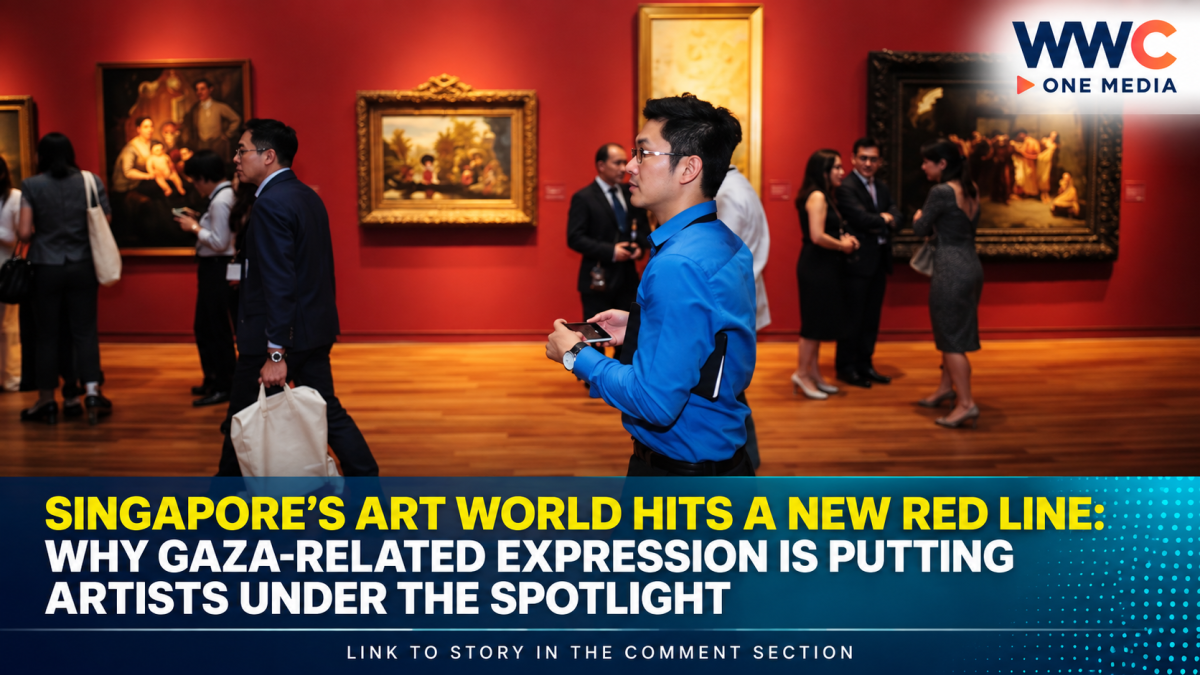
SINGAPORE — The debate over artistic freedom, political expression and public order in Singapore is taking on new urgency as artists and cultural practitioners navigate increasingly sensitive boundaries surrounding the Israel-Gaza conflict.
Singapore has maintained strict rules governing public assemblies, political expression and displays connected to foreign political causes. The issue has become particularly visible as artists, performers and activists have used cultural spaces and public platforms to express concern over the humanitarian situation in Gaza.
The tension is not simply about whether artists can discuss international events. It is about where, how and in what form those views can be expressed without crossing Singapore’s public-order and social-harmony rules.
Why Gaza has become a sensitive issue in Singapore
Singapore’s government has repeatedly said that it is deeply concerned about the humanitarian situation in Gaza while also warning against importing the Israel-Gaza conflict into Singapore’s domestic social environment.
Foreign Minister Vivian Balakrishnan has said Singapore supports an immediate humanitarian ceasefire, the release of hostages and unhindered humanitarian assistance, while also stressing that Singapore must protect its own racial and religious harmony.
That balancing act has shaped the government’s approach to public demonstrations and political expression linked to the conflict.
The Ministry of Home Affairs says Singapore’s public-order framework is intended to balance freedom of speech, assembly and political expression with the need to preserve public order and social stability.
Artists have increasingly found themselves in the middle
The debate became especially prominent in July when British trip-hop group Massive Attack displayed a Palestinian flag during its Singapore concert and expressed support for Palestinians.
Singapore authorities subsequently investigated two members of the group. Police said they were issued stern warnings for offences under the Foreign National Emblems (Control of Display) Act and the Public Order Act, and both were barred from re-entering Singapore. IMDA also said it would not approve future performance applications from the band.
The incident underscored a crucial point for international performers: a concert or artistic performance does not automatically place political expression outside Singapore’s laws.
CNA reported that the band shouted “Free Palestine” during the performance and that members displayed a Palestinian flag on stage. Singapore law restricts the public display of foreign national emblems without the required permit or exemption.
The rules go beyond concerts
The latest developments show that the issue extends well beyond the entertainment industry.
On Sept. 9, six people were charged over a series of alleged unlawful public assemblies and processions. Some of the cases involved activities connected to the Palestinian cause and the Gaza conflict.
According to Singapore Police, two women allegedly took part in a procession near the perimeter of the Istana in February 2024 while carrying umbrellas bearing watermelon imagery associated with Palestinian solidarity. Other allegations involved gatherings and activities related to opposition to institutional ties with Israel.
One defendant also faces a charge under the Penal Code relating to a chant made during an event, with authorities alleging that it was prejudicial to racial harmony.
The Straits Times separately reported that the six women faced charges arising from Gaza-related events and other demonstrations.
A legal line artists need to understand
Singapore’s authorities have repeatedly emphasized that the restrictions are not intended to prohibit people from having views about the Middle East conflict.
Instead, the government’s position is that public gatherings, demonstrations, foreign political causes and potentially divisive symbols can create risks to Singapore’s racial and religious harmony.
In April, police issued an advisory concerning an event at Speakers’ Corner, warning organizers and participants against introducing issues related to the Israel-Hamas conflict and against coordinated displays of Israeli- or Palestinian-related symbols and paraphernalia.
That distinction is important.
An artist may hold personal views about Gaza, Israel or Palestine. But once those views are expressed publicly through a demonstration, procession, political display or other regulated activity, additional laws may apply.
Singapore’s position is more complicated than a simple “pro-Israel” or “pro-Palestine” label
Singapore’s official position has consistently attempted to separate its foreign-policy stance from domestic political mobilization.
The government has condemned attacks on Israeli civilians, while also expressing alarm over the humanitarian suffering in Gaza and calling for compliance with international humanitarian law. Singapore has also stated its support for a negotiated two-state solution and said it is prepared in principle to recognize a Palestinian state at an appropriate time.
This helps explain why Singapore’s policy cannot accurately be reduced to simply supporting one side of the conflict.
The government’s central concern domestically is that the conflict does not deepen existing racial or religious divisions inside Singapore.
The bigger question for Singapore’s arts community
The controversy raises a much broader question for the cultural sector:
Can artists engage with global humanitarian crises without crossing the boundaries Singapore has established around public order and foreign political causes?
Recent developments suggest that the answer depends heavily on the context.
Singapore has continued to expand and regulate spaces for artistic expression. CNA’s recent reporting on street art found that murals, busking and other forms of public art have become more common, while artists still describe a highly managed environment in which sensitive subjects — including politics — can require careful consideration.
For artists, musicians and international performers, the lesson is increasingly clear: creative freedom does not operate independently of Singapore’s public-order framework.
And as the Gaza conflict continues to resonate around the world, that boundary is likely to remain one of the most closely watched fault lines between artistic expression, political advocacy and Singapore’s determination to preserve social harmony.
Leave a Reply