
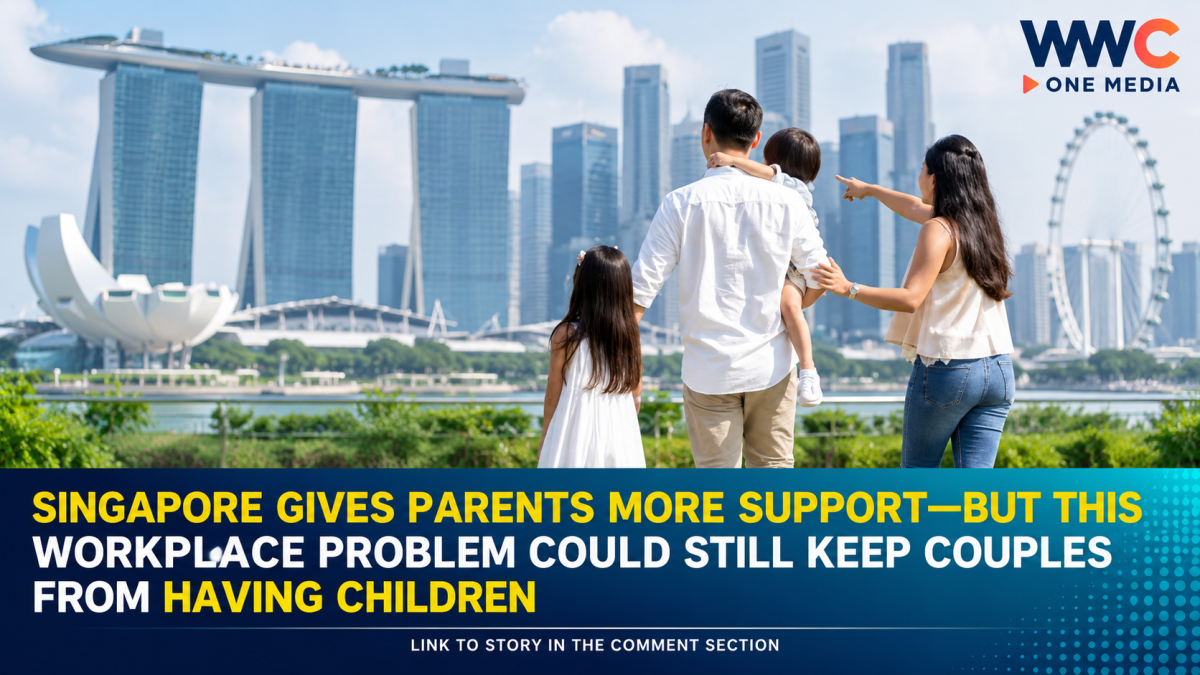
SINGAPORE — Singapore is spending more to support families and giving working parents greater access to childcare leave, but experts and workers say one problem may be much harder to fix: the culture inside the workplace.
The warning comes as Singapore confronts an unprecedented fertility challenge. The country’s total fertility rate (TFR) fell to a record-low 0.87 in 2025, down from 0.97 the previous year.
The latest debate suggests that financial assistance alone may not be enough if workers continue to believe that having children could slow their careers, reduce their income or make them appear less committed to their employers.
MORE FAMILY SUPPORT—BUT A BIGGER WORKPLACE QUESTION
Prime Minister Lawrence Wong announced a new package of marriage and parenthood measures during the 2026 National Day Rally, including expanded childcare leave, financial assistance, preschool support and housing measures.
Under the new childcare-leave arrangement, each working parent will eventually receive 8, 10 or 12 days of childcare leave per year, depending on whether they have one, two, or three or more Singapore Citizen children aged 12 and below.
The Government also said it will reimburse employers for the full duration of statutory child-related leave, subject to the applicable reimbursement cap, reducing the financial burden on companies when employees take leave to care for their children.
Wong also sent a direct message to employers: becoming a parent should never put an employee at a disadvantage in his or her career.
But workplace realities may be harder to change than government policy.
WHEN “FAMILY-FRIENDLY” POLICIES DON’T FEEL FAMILY-FRIENDLY
Workers interviewed by CNA described a workplace environment where long hours, frequent travel, after-hours communication and expectations of physical presence can make raising children difficult.
Some parents said they worry that taking childcare or parental leave could make them appear less committed to their jobs. Others described difficulties obtaining flexible arrangements or feeling guilty when family emergencies interfere with work.
A 2025 survey involving more than 1,500 people found that employees were concerned that taking parental leave, requesting flexible work arrangements or adjusting schedules for caregiving could be interpreted as a lack of commitment and potentially hurt career progression. The survey also found that 41 per cent of respondents said stronger leadership support would make flexible work arrangements more effective.
That distinction is crucial: a policy can exist on paper while employees remain afraid to use it.
THE “HUSTLE CULTURE” PROBLEM
CNA’s latest report found that Singapore’s demanding work environment remains a major concern for some current and prospective parents.
Long working hours, office attendance requirements, business travel and work calls outside normal hours can make it difficult for employees to maintain predictable family time.
For some workers, the problem begins even before they have children.
Associate Professor Mu Zheng of the National University of Singapore told CNA that workplace pressures can influence fertility at different stages—from whether young adults have enough time and energy to form relationships, to whether couples feel ready for their first child or another child.
The issue, therefore, may not be that people no longer want children.
Instead, some may increasingly believe that being a good employee and being a good parent are incompatible.
WHY MONEY ALONE MAY NOT SOLVE THE PROBLEM
Singapore’s government has recognised that the fertility challenge is broader than the cost of having children.
The Marriage and Parenthood Reset Workgroup, chaired by Minister in the Prime Minister’s Office Indranee Rajah, is examining issues including financial costs, housing, caregiving, healthcare, preschool and education—as well as workplace practices and social attitudes. Its full recommendations are expected in early 2027.
Indranee has previously argued that workplace culture is among the harder issues to change because it involves attitudes, expectations and relationships between employees, managers and employers.
She has also said that Singapore needs to move away from treating work and family as competing priorities.
The goal, she said, should be a workplace where employees can build careers while also having time for family.
THE “MATERNITY PENALTY” IS ALSO UNDER SCRUTINY
Women face another challenge: the potential career cost associated with pregnancy and caregiving.
The Marriage and Parenthood Reset Workgroup has identified reducing the so-called “maternity penalty” as one of its goals.
One proposal discussed by Indranee is to normalise career “detours,” allowing women to step away from employment for a period to have and raise children while having confidence that they can return to meaningful employment afterward.
This could be significant in a labour market where career progression and continuous employment are often closely connected.
If workers believe that having a child could permanently damage their career trajectory, even generous government benefits may not remove the fear.
THE MANAGER MAY MATTER MORE THAN THE POLICY
Experts and human-resource professionals say workplace culture is often determined at the management level.
Two companies can offer the same statutory benefits, but employees may experience them very differently depending on how managers react when someone asks for childcare leave, flexible hours or time away for a family emergency.
A manager who tells an employee to take the time needed sends a very different message from one who approves the same leave while making the employee feel guilty for taking it.
Singapore’s government has therefore placed increasing emphasis on changing workplace norms, not simply adding new benefits.
The official policy direction is clear: employers are expected to create workplaces where parents can actually use the support available to them.
SUPPORT SHOULD NOT COME AT THE EXPENSE OF NON-PARENTS
There is also another side to the debate.
Some employees without children have raised concerns that they could be expected to absorb additional workloads whenever colleagues take extended parental or childcare leave.
Employers and workplace experts say this needs to be addressed through better manpower planning, temporary coverage, workload redistribution and clearer communication rather than turning parents and non-parents against each other.
A genuinely family-friendly workplace, experts argue, should provide reasonable flexibility to employees with different caregiving responsibilities—including those caring for elderly parents or other family members.
SINGAPORE’S BIGGER FERTILITY TEST
Singapore has already built one of Asia’s more extensive systems of financial and policy support for marriage and parenthood.
But the latest debate points to a deeper question:
What happens when the government makes it easier to have children, but employees still believe their careers will suffer if they do?
That may be the next major test of Singapore’s fertility strategy.
The government has acknowledged that changing workplace attitudes will not happen overnight. The Marriage and Parenthood Reset Workgroup is expected to deliver its fuller recommendations in early 2027, while the first wave of family-support measures is already being implemented.
For Singapore, the fertility battle may therefore be shifting from “Can families afford to have children?” to a much harder question:
“Can people have children without feeling that they have to choose between their family and their future at work?”




Leave a Reply