
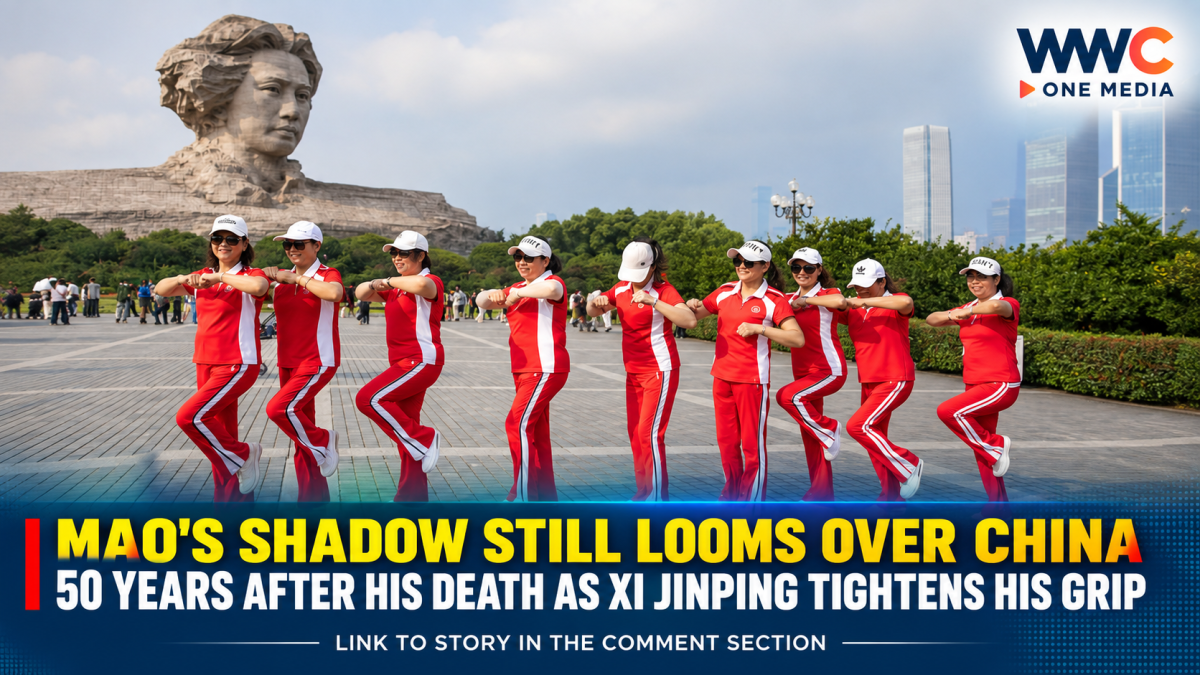
BEIJING — Fifty years after the death of Mao Zedong, the man who founded the People’s Republic of China, his influence continues to loom large over the world’s second-largest economy and its powerful Communist Party.
China marked the half-century anniversary of Mao’s death on September 9, 1976, with his image still dominating Tiananmen Square and his preserved body continuing to draw visitors to his memorial hall in Beijing.
But the anniversary has also renewed attention on a question that remains central to modern China: How can the Communist Party continue to revere Mao while acknowledging the devastating consequences of some of his most controversial campaigns?
A Founder Still Revered 50 Years Later
Mao led the Chinese Communist Party to victory and proclaimed the founding of the People’s Republic of China in 1949.
For many supporters, he remains the revolutionary leader who transformed China and restored national unity after decades of war and foreign intervention.
His legacy remains deeply embedded in China’s political identity. Mao’s giant portrait still overlooks Tiananmen Square, while visitors from across the country continue to queue at the Chairman Mao Memorial Hall to pay their respects.
The memorial hall extended visiting hours for the 50th anniversary as officials anticipated increased numbers of visitors.
The Cultural Revolution’s Lasting Trauma
Mao’s legacy, however, remains deeply complicated.
His death in 1976 helped bring an end to the Cultural Revolution, the decade-long political movement he launched in 1966.
During the campaign, Mao mobilized students and supporters against perceived enemies and those accused of following the “capitalist road.” The resulting upheaval fractured the Communist Party bureaucracy, disrupted the economy and led to widespread persecution and violence.
China’s Communist Party later officially described the Cultural Revolution as a grave error for which Mao bore primary responsibility.
Yet the party has never abandoned Mao’s place at the center of China’s political history, maintaining that his achievements outweigh his mistakes.
Xi Jinping Was Also Shaped by the Mao Era
Perhaps no current Chinese leader has a more personal connection to the trauma of the Cultural Revolution than President Xi Jinping.
Xi’s father, former vice premier Xi Zhongxun, was purged and persecuted during the political turmoil, while the family’s home was ransacked.
Xi himself was labeled a “reactionary student” as a teenager and faced interrogation and political pressure. In 1969, he was sent to the countryside, where he spent seven years in a poor village in northwestern China.
Despite those experiences, Xi has never publicly blamed Mao for his family’s suffering.
Political analysts say the experience profoundly shaped Xi’s understanding of power, political stability and the importance of maintaining Communist Party control.
Xi Has Brought Back Elements of Mao-Era Politics
Since taking power in 2012, Xi has increasingly consolidated authority in a way that has drawn comparisons with Mao.
Unlike several of his immediate predecessors, Xi has strengthened centralized control, emphasized ideological discipline and built a powerful personal political profile.
Xi has also had his name formally attached to China’s state ideology while still in office — something no Chinese leader since Mao had achieved.
Analysts say Xi has revived elements of Mao-era political symbolism while combining them with strong nationalism, populism and strict party discipline.
Kerry Brown, director of King’s College London’s Lau China Institute, said the symbolism and language associated with Maoism remain powerful in modern China.
Why China Cannot Simply Turn Its Back on Mao
Mao remains fundamental to the legitimacy of the Chinese Communist Party.
Completely rejecting him would create difficult questions about the party’s own history and its right to rule.
Instead, China’s leadership has adopted a carefully balanced approach: acknowledge serious mistakes while preserving Mao’s status as the revolutionary founder of modern China.
Xi has argued that China’s post-Mao reform era should not be used to completely repudiate the Maoist period.
That approach allows Beijing to preserve continuity between Mao’s revolution, Deng Xiaoping’s economic reforms and Xi’s current vision for China.
But it also limits how openly Mao’s darkest chapters can be discussed.
Mao Is Finding New Appeal Among Some Young Chinese
Fifty years after his death, Mao’s image is also attracting renewed interest among some younger Chinese.
Recent reporting has highlighted growing nostalgia for Mao among sections of China’s younger generation, with some drawn to his nationalist and anti-capitalist rhetoric amid concerns about economic pressure, inequality, unemployment and intense competition.
The trend presents a complicated challenge for China’s leadership.
The Communist Party continues to celebrate Mao as the founder of the People’s Republic, but it must also prevent uncontrolled debates about Maoism and revolutionary politics from challenging the modern political and economic system.
That balancing act has become part of Mao’s enduring legacy in China.
Could Xi Become China’s Longest-Serving Leader Since Mao?
Xi is already China’s most powerful leader in generations and is on track to become the country’s longest-serving paramount leader since Mao.
His consolidation of power has broken with reform-era practices that were designed to prevent excessive concentration of authority following Mao’s rule.
That has created an extraordinary historical irony.
The reforms that followed Mao’s death were partly intended to ensure that China would never again be dominated by a single leader in the same way.
Five decades later, Xi has rebuilt a political system with a far more centralized leadership structure than China had seen for decades.
Whether that model will remain stable after Xi eventually leaves office is one of the biggest unanswered questions surrounding China’s political future.
The Bottom Line
Fifty years after Mao Zedong’s death, China still lives with his legacy.
Mao remains a national icon and the founding figure of the People’s Republic, but his rule also left behind some of the most traumatic chapters in modern Chinese history.
Under Xi Jinping, Mao’s symbolism, nationalism and emphasis on centralized authority have taken on renewed importance.
Half a century after Mao’s death, the question is no longer whether his influence survived. It is how deeply his shadow still shapes the China of Xi Jinping — and what that could mean for the country’s future.
WWC ONE MEDIA J.M.D




Leave a Reply