
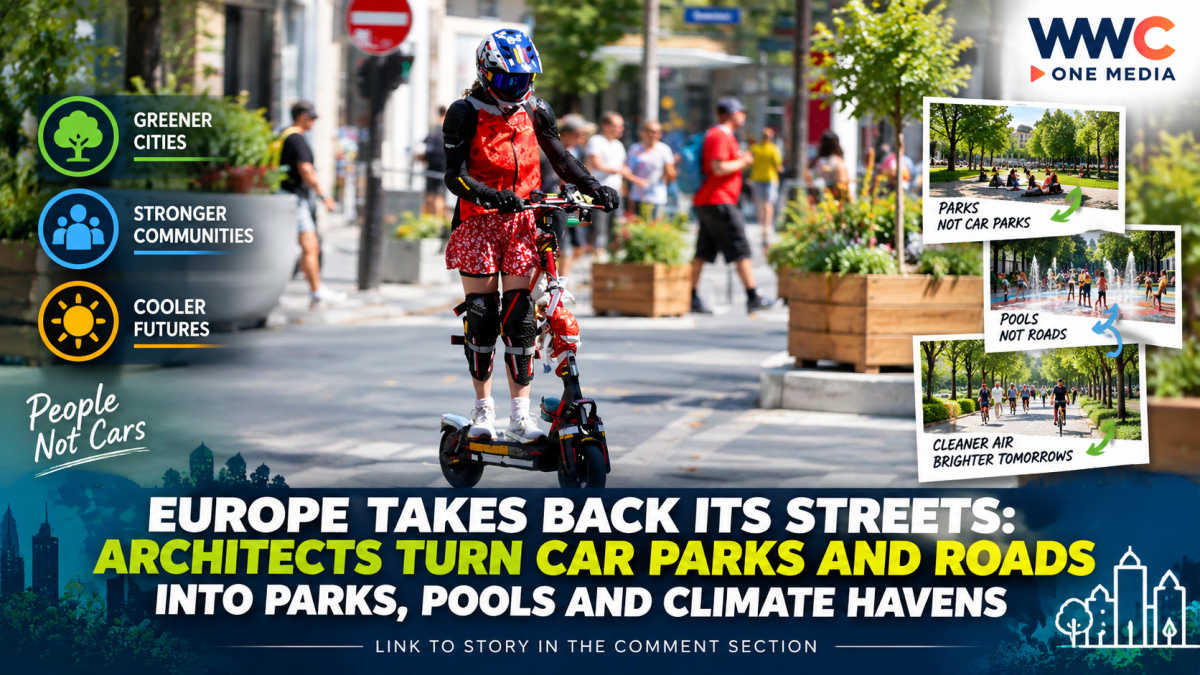
BARCELONA — For decades, European cities built their streets around cars. Now, a growing movement of architects is fighting to take that space back — transforming traffic-heavy roads, concrete roundabouts and massive car parks into parks, public pools and green spaces designed to help cities survive a hotter and wetter future.
The shift is at the heart of the 2026 European Prize for Urban Public Space, which has unveiled projects showing how cities can reclaim land once dominated by vehicles and turn it into places for people, nature and climate resilience. The prize, organized by Barcelona’s Center for Contemporary Culture and its European partners, has been recognizing public-space transformations since 2000.
From Traffic Roundabout to Public Bath
One of the most eye-catching projects highlighted in the competition came from Logroño, northern Spain, where Swiss architect Leopold Banchini transformed a neglected concrete traffic island into a temporary public bath.
The project, known as Round About Baths, repurposed an existing fountain basin as a shallow pool and used simple timber structures to create a space inspired by historic public baths.
The transformation lasted only a week during the Concéntrico architecture festival, but its message was much bigger: cities have surrendered enormous amounts of public space to cars — and reclaiming it is possible.
Banchini said car-centered urban planning has changed the way people move through cities, particularly families with children, who often have to navigate public spaces dominated by traffic and safety concerns.
The Biggest Obstacle? Cars and Politics
Turning roads and parking spaces into public areas is not always easy.
According to the architects behind several of the projects, permanent changes often require complicated negotiations over traffic regulations, safety requirements and political concerns.
Car infrastructure is deeply embedded in modern cities, and politicians can be reluctant to reduce road access or parking because of fears over public backlash.
The temporary nature of the Logroño bath project itself demonstrated that challenge. A permanent installation would have required more extensive safety approvals and changes to the surrounding traffic infrastructure.
Barcelona Buries Roads to Create Green Space
Some cities have managed to make far more permanent changes.
At Plaça de les Glòries Catalanes in Barcelona, major roads that once fed traffic into the city’s sprawling interchange were partly moved underground, opening space above ground for public and green areas.
The project represents a major reversal of decades of car-focused urban planning.
Instead of allowing roads to dictate how the space is used, the redesign gives pedestrians, residents and public life greater priority.
It is part of a broader debate playing out across Europe over whether city centers should remain primarily transportation corridors or evolve into spaces designed for people and communities.
Antwerp Turns Massive Car Park Into Climate-Ready Park
In Belgium, the transformation of Zuidpark in Antwerp shows how former car infrastructure can also help cities deal with the growing effects of climate change.
The 800-meter park replaced a large free car park and opened in 2024.
Architects dramatically reshaped the site, excavating much of the area and adding deep layers of soil to help trees and plants establish themselves more quickly.
Today, Zuidpark features around 500 new trees, providing much-needed shade during periods of extreme heat. Research cited by the project’s architects found that temperatures inside the park were significantly lower than elsewhere in the city.
Built for Heatwaves and Heavy Rain
Zuidpark was designed for more than just recreation.
As climate change brings both more intense heatwaves and heavier rainfall, the park includes lowered areas known as rain gardens that can collect and absorb excess water.
These spaces contain vegetation suited to wet conditions and reused stone uncovered during construction.
The result is infrastructure that serves multiple purposes at once: reducing heat, managing stormwater, supporting greenery and creating places for children to play.
It represents a growing trend in urban design — using nature and public space as part of a city’s climate-defense system rather than relying entirely on concrete infrastructure.
Cars Have Not Disappeared Completely
The transformation in Antwerp also highlights the compromises often required to reclaim urban space.
While the free surface car park was removed, a new paid parking facility with 2,000 spaces was built underground beneath parts of Zuidpark.
Architects involved in the project acknowledged the contradiction.
From a purely environmental perspective, locating so much parking near the city center could be questioned. But the compromise may have been necessary to secure support for building the park in the first place.
That balancing act reflects the larger challenge facing cities across Europe: how to reduce dependence on cars without ignoring the transportation needs of residents.
Five Projects Compete for Europe’s Urban Space Prize
The European Prize for Urban Public Space is one of Europe’s major platforms for recognizing projects that transform and improve shared urban environments.
The 2026 edition received 381 proposals from 38 European countries, with 25 projects initially selected before the final stage. The competition focuses on projects that address challenges including climate change, social inequality, mobility and access to public space.
The featured projects include transformations in Spain, Belgium, Portugal and Italy, demonstrating how different cities are experimenting with new approaches to streets, parks and public infrastructure.
The five finalists are scheduled to present their projects at Barcelona’s CCCB in October, with the winner to be announced during the award events in mid-October.
The Future of Cities May Not Belong to Cars
For generations, urban development often followed a simple principle: build more roads, create more parking and make it easier for vehicles to move.
The projects now being celebrated across Europe are challenging that idea.
A roundabout can become a swimming space.
A car park can become a forest-like urban park.
A traffic interchange can become a public square.
And streets once built primarily for vehicles can become tools for fighting heatwaves, floods and social isolation.
The Bottom Line
Europe is beginning to reclaim the space it gave away to cars.
From Barcelona to Antwerp and Logroño, architects are transforming roads, roundabouts and parking lots into greener, cooler and more people-friendly spaces.
The movement is about more than beautiful parks and clever architecture.
As climate change brings rising temperatures and more extreme weather, cities are discovering that the roads and parking spaces of the past could become some of their most valuable resources for the future.
The battle for Europe’s cities is no longer just about how fast cars can move through them — it’s about how well people can live in them.
WWC ONE MEDIA J.M.D




Leave a Reply