
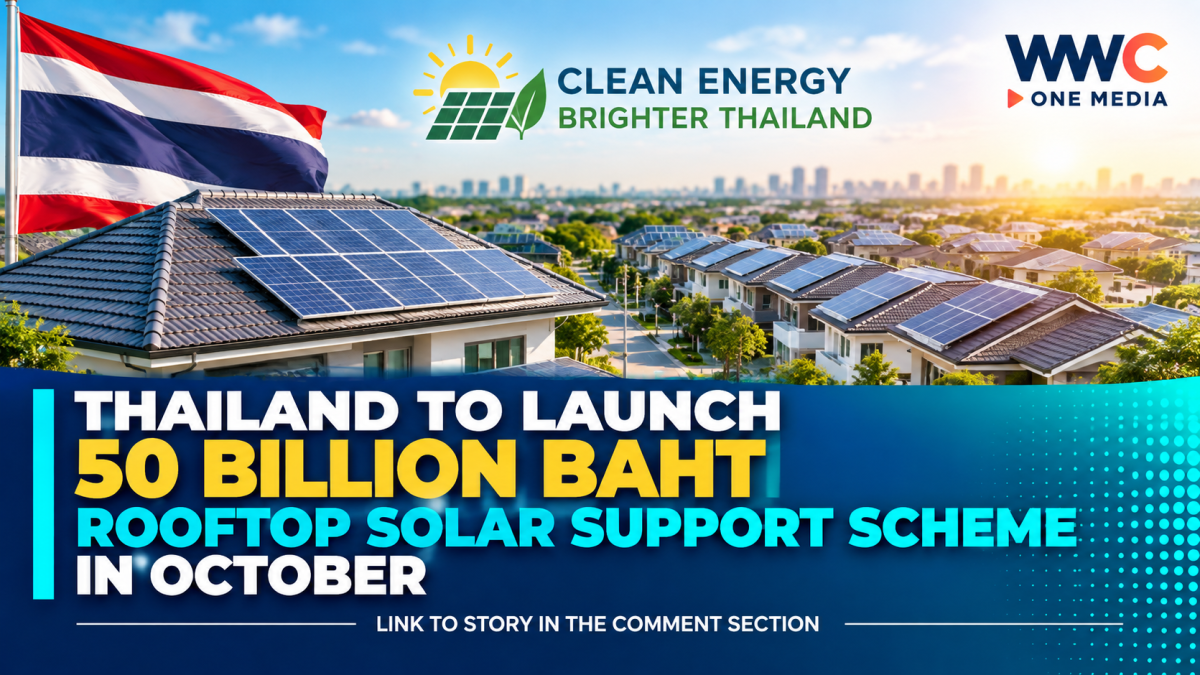
BANGKOK — Thailand’s government will launch a major rooftop solar support programme in mid-October, providing 50 billion baht in assistance to encourage households to install solar panels, Finance Minister Ekniti Nitithanprapas said.
The programme is part of the government’s wider push to expand renewable energy use and help consumers reduce their electricity costs.
The 50 billion baht package is worth approximately US$1.52 billion based on current exchange rates.
Support for household solar installations
The new programme will provide financial support to consumers interested in installing solar panels on their homes.
Thailand has been working to accelerate rooftop solar adoption as part of broader efforts to reduce reliance on conventional energy sources and promote cleaner electricity generation.
Earlier reports indicated that the government had considered subsidies of up to 50,000 baht per household for qualifying rooftop solar installations.
Launch set for mid-October
Finance Minister Ekniti said the programme is scheduled to begin in the middle of October.
Further implementation details, including eligibility requirements and the specific form of assistance available to households, are expected to become clearer as the launch approaches.
The initiative represents one of Thailand’s largest recent efforts to encourage households to invest in renewable energy.
Tax exemptions planned for some imports
The government will also exempt taxes on certain imported solar panel components.
The measure is intended to help reduce installation costs and make rooftop solar systems more affordable for consumers.
By lowering the cost of equipment while providing financial support for installations, authorities hope to encourage more households to switch to solar power.
Rooftop solar becomes a policy priority
Thailand has increasingly focused on expanding solar energy as electricity costs and energy security remain major concerns.
The country has significant solar potential, and policymakers have been exploring ways to make it easier for households to generate their own electricity.
Previous measures have included tax incentives for residential rooftop solar installations, while the government has also been studying broader subsidy programmes.
Potential savings for households
Rooftop solar systems can allow households to generate part of their own electricity, potentially reducing their dependence on power from the national grid.
The actual savings, however, can vary depending on factors such as:
- The size of the solar system
- Household electricity consumption
- Installation costs
- Available government support
- Electricity regulations and connection arrangements
The government’s new financial package is aimed at reducing the upfront barrier that prevents many households from installing solar panels.
The bottom line
Thailand will launch a 50 billion baht rooftop solar support programme in mid-October to help consumers install solar panels on their homes.
The government will also provide tax exemptions for certain imported solar panel components in an effort to reduce costs and encourage wider adoption.
The multi-billion-baht initiative marks a major push to bring solar power to more Thai households as the country expands its renewable energy ambitions and looks for ways to reduce electricity costs.
WWC ONE MEDIA J.M.D
Leave a Reply