
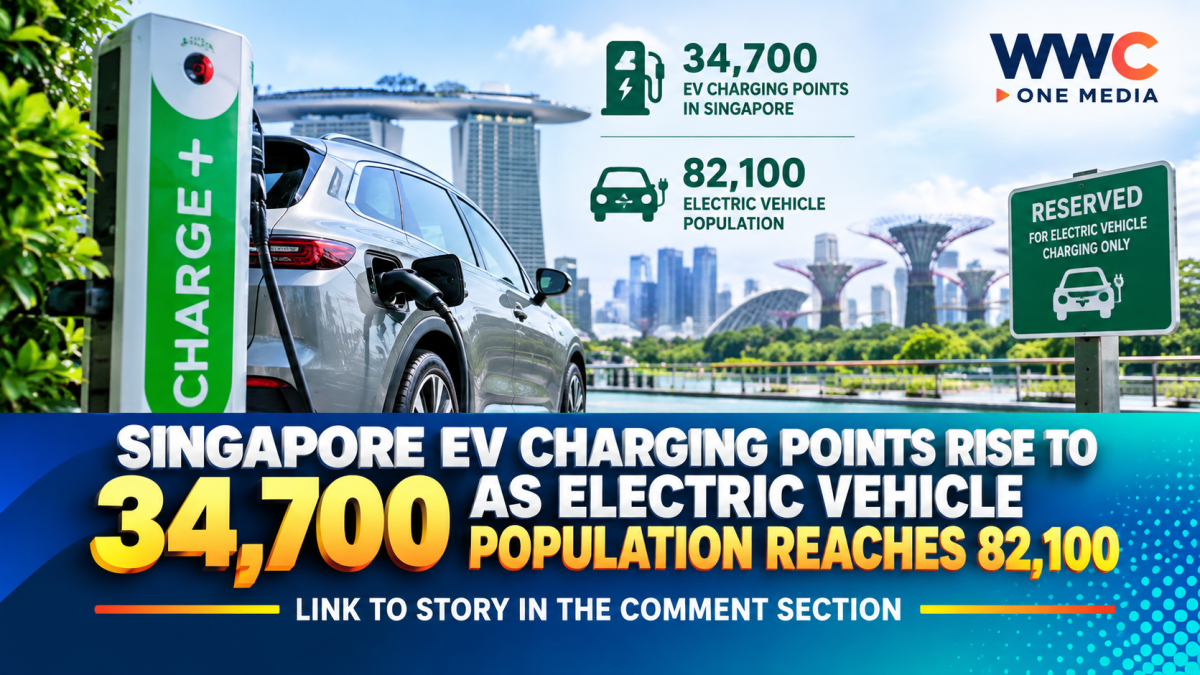
SINGAPORE — The number of electric vehicle charging points across Singapore has grown to 34,700, as the Republic’s EV population reached 82,100 in August amid rapidly rising demand for electric cars.
The Land Transport Authority announced the latest figures on World EV Day on Sept 9, revealing that Singapore added more than 4,000 charging points in just four months.
The growth in charging infrastructure comes as electric vehicles continue to account for a growing share of new car registrations in the country.
EV population rises sharply
Singapore’s EV population reached 82,100 in August, up significantly from about 57,200 in 2025.
The rise reflects the growing popularity of electric vehicles among motorists as more models enter the market and charging infrastructure becomes increasingly available across the island.
In the first eight months of 2026, EVs accounted for 63 per cent of all new car registrations, compared with 45 per cent during the previous year.
More than 4,000 chargers added in four months
The latest total of 34,700 charging points marks a significant increase from the more than 30,500 available earlier this year.
Singapore is working towards a target of deploying 60,000 EV charging points by 2030.
Under the national plan, 40,000 charging points are expected to be located in public car parks, while the remaining 20,000 will be installed at private premises.
Every HDB town to get a fast-charging hub
The Government is also planning to make fast charging more accessible to EV drivers living in public housing estates.
Every HDB town is expected to have at least one fast-charging hub by the end of 2027.
These hubs are planned to have at least six to eight 50kW charging points.
For many EV models, a 30-minute charge at such a facility could provide approximately 100km of additional driving range.
Government monitors demand and infrastructure
Singapore authorities have said they are closely monitoring EV adoption rates to ensure that charging infrastructure expands alongside demand.
The LTA coordinates with agencies including the Energy Market Authority, Housing and Development Board and JTC to support the rollout of chargers and related electrical infrastructure.
For locations with particularly strong demand, more chargers may be deployed where electrical capacity allows.
Charging network expands as EV sales surge
Singapore’s rapid expansion in charging infrastructure has been matched by strong growth in EV registrations.
The latest figures show that electric cars have moved from being a relatively small part of the market to becoming a major choice for new car buyers.
The expansion of chargers at HDB car parks, private developments and other locations is expected to play an important role as Singapore works towards its broader transition to cleaner-energy vehicles.
The Government has also updated national standards for EV charging systems to support the continued expansion of charging technology while improving safety and reliability.
EV incentive to end next year
The expansion comes ahead of another major change for prospective EV buyers.
Singapore’s EV Early Adoption Incentive, which currently provides an Additional Registration Fee rebate for newly registered cars and taxis, will end on Jan 1 next year.
The rebate is currently capped at S$7,500.
The bottom line
Singapore now has 34,700 EV charging points across the island after adding more than 4,000 in just four months.
At the same time, the country’s EV population has climbed to 82,100, with electric vehicles accounting for 63 per cent of new car registrations during the first eight months of 2026.
Singapore remains on track towards its goal of installing 60,000 charging points by 2030, while every HDB town is expected to have at least one fast-charging hub by the end of 2027.
As more Singaporeans switch to electric vehicles, the rapid expansion of charging infrastructure will be crucial in keeping the country’s EV transition moving forward.
WWC ONE MEDIA J.M.D




Leave a Reply