
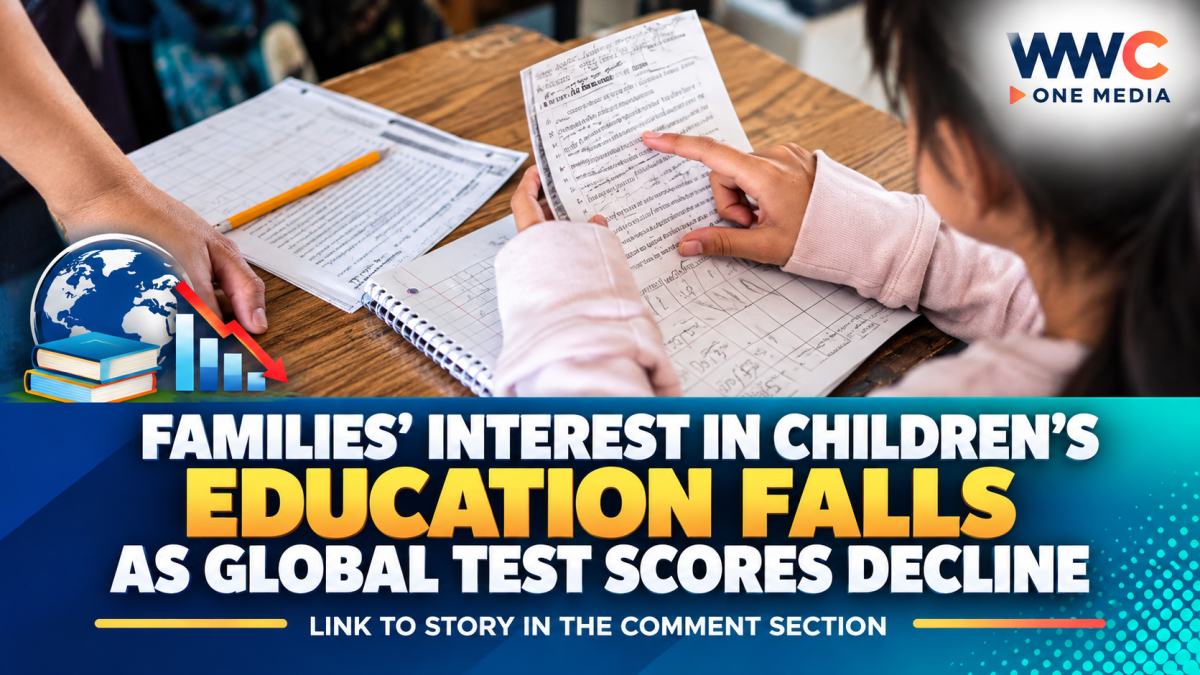
PARIS — Families’ involvement in their children’s education is declining in many parts of the world as student test scores continue to fall, according to newly released international assessment results.
The findings come from the 2025 Programme for International Student Assessment, or PISA, which tested more than 760,000 15-year-old students across 91 countries and economies.
The results showed a worrying decline in reading, mathematics and science performance, particularly in many high-income countries, while a separate survey pointed to falling parental engagement as one factor linked to weaker academic outcomes.
Student performance reaches new lows
The latest PISA results showed that academic performance has continued to weaken in many countries.
Reading scores have fallen sharply over the past decade, while mathematics and science results have also declined.
Among OECD countries, the results showed that students are now performing at some of the lowest levels recorded since the international assessment began.
Education experts said the decline cannot be explained by a single factor, with changes in family life, technology use, reading habits and school environments all playing a role.
Family engagement linked to better results
One of the major findings from the accompanying survey was the importance of parental involvement.
Students who reported receiving stronger support and encouragement from their families generally performed better, particularly in science.
However, family interest in children’s education has declined in many high-income countries, according to the findings.
The drop in engagement was especially noticeable among boys, raising concerns about whether some students are receiving enough encouragement and support outside the classroom.
Reading for pleasure continues to decline
The results also highlighted a continuing decline in reading for enjoyment.
More students are spending their free time on digital devices, social media and other forms of entertainment instead of reading books and longer texts.
Education experts warned that this shift may affect students’ ability to concentrate, understand complex information and think critically.
Reuters reported that average reading performance has fallen substantially from previous highs, with students increasingly struggling with deeper comprehension rather than simply recognising information in a text.
Screens and digital distractions raise concerns
Technology has become another major focus of the debate over falling student performance.
The PISA findings showed a link between heavy recreational screen use and weaker academic outcomes.
Students who spend long periods on digital devices can face greater distractions, while excessive use of smartphones and other technologies may reduce time spent reading, studying or interacting with family members.
However, the findings do not suggest that all technology is harmful.
Experts said digital tools can support education when used purposefully and under proper guidance.
AI brings opportunities and risks
Artificial intelligence is also changing the way students learn.
The latest findings raised concerns about students who rely heavily on AI chatbots without developing their own understanding of a subject.
Frequent or poorly guided AI use was associated with weaker academic performance in some areas.
At the same time, countries and education systems that provide teachers with the knowledge and support to use AI effectively have shown that the technology can also become a useful learning tool.
The challenge for schools is increasingly about teaching students when and how to use AI — rather than simply allowing or banning it altogether.
Asian education systems continue to lead
Despite the wider global decline, several Asian education systems continued to perform strongly.
Singapore, Japan, South Korea, Taiwan and participating regions of China were among the strongest performers across reading, mathematics and science.
Their results have renewed international attention on differences between education systems in Asia and many Western countries.
However, experts caution that high test scores alone do not tell the full story of an education system, as student well-being, creativity and access to learning opportunities also remain important measures of success.
Schools cannot solve the problem alone
The findings have added to calls for a broader approach to improving education.
Experts say schools cannot be expected to address declining academic performance on their own.
Parents, teachers and governments all have a role to play.
Key areas of focus include:
- Encouraging parents to take a greater interest in learning
- Helping children develop regular reading habits
- Reducing unnecessary digital distractions
- Supporting teachers in using technology effectively
- Teaching students to use AI responsibly
- Providing extra help to struggling learners
- Creating stronger connections between schools and families
A warning for the future
The decline in academic performance has raised concerns about the long-term consequences for societies and economies.
Reading, mathematics and science skills form the foundation for many jobs and are increasingly important in economies shaped by technology and artificial intelligence.
A generation of students with weaker foundational skills could face greater challenges adapting to future workplaces.
The results also suggest that educational gaps between countries could become more significant if struggling systems fail to reverse the decline.
The bottom line
Families’ interest and involvement in their children’s education appear to be declining in many countries at the same time that student performance in reading, mathematics and science is falling.
The latest PISA assessment points to a combination of challenges, including reduced parental engagement, declining reading habits and growing digital distractions.
Technology and AI offer new opportunities for learning, but education experts warn that they can also weaken performance when used without proper guidance.
As global test scores continue to fall, the message from the latest results is clear: improving education may require more than changes inside the classroom — families, schools and communities may all need to play a stronger role in helping children learn.
WWC ONE MEDIA J.M.D




Leave a Reply