
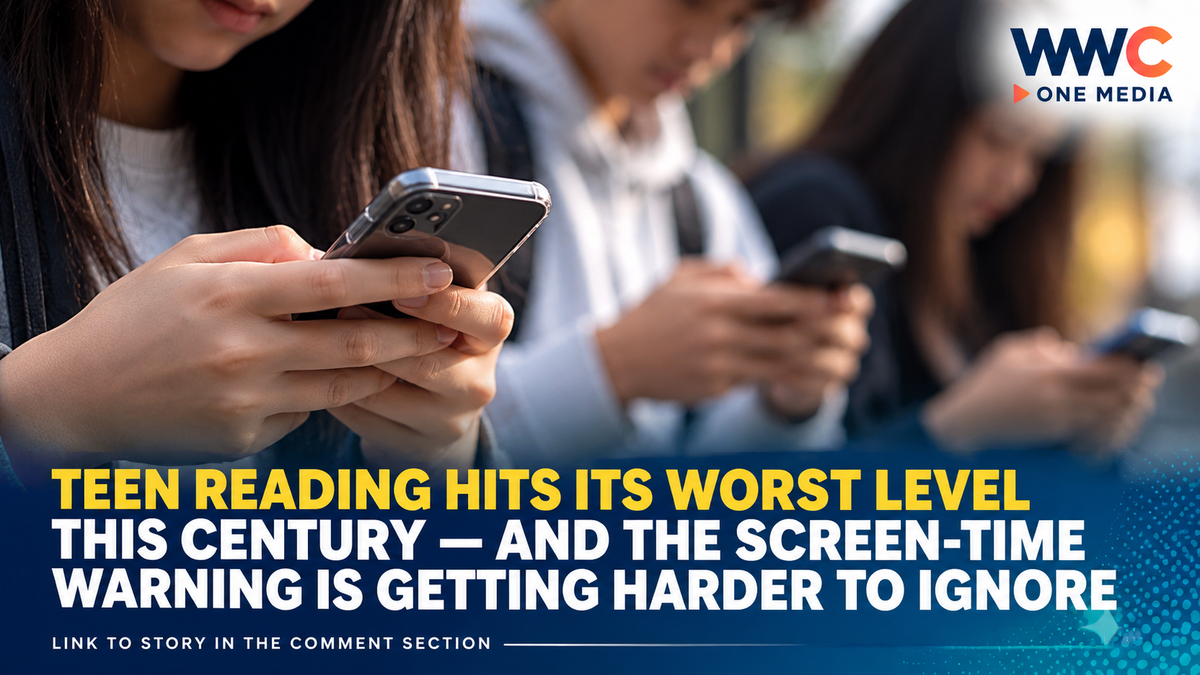
Teen Reading Hits Its Worst Level This Century — And the Screen-Time Warning Is Getting Harder to Ignore
Teenagers around the world are reading at their weakest level this century, with a major international education assessment pointing to longer screen time, declining reading for pleasure and growing digital distractions as factors accompanying the alarming decline.
The Organisation for Economic Co-operation and Development’s (OECD) latest Programme for International Student Assessment (PISA), released September 8, tested more than 760,000 15-year-olds across 91 countries and economies.
The results show that reading has suffered the steepest decline among the three core subjects assessed.
Across OECD countries, the average reading score fell 28 points between 2015 and 2025 — equivalent to roughly one and a half years of learning. The OECD said reading performance has now reached its lowest average level recorded in the assessment.
The average OECD reading score was 466 in 2025, down from a peak of 501 recorded in 2012.
The decline is not simply about teenagers reading fewer books.
The OECD also found signs that students are increasingly becoming “hasty” readers — moving rapidly through texts but struggling to understand, evaluate and accurately interpret what they have read.
Math and science have also weakened. Mathematics scores across OECD countries fell 22 points between 2015 and 2025, while science has declined over the longer term.
The screen-time problem
The latest findings put renewed attention on how teenagers use smartphones, social media and other digital devices.
The OECD found that students in member countries reported spending an average of 3.4 hours per weekday using digital devices for leisure, in addition to roughly three hours for learning at school or at home.
The organization stressed that technology itself is not necessarily the problem.
Digital tools can support learning when used purposefully. But excessive use and digital distraction are associated with weaker educational outcomes.
Digital distraction was linked to lower science performance in 59 of 82 education systems examined, while more than one in four students said classmates were distracted by digital devices in most or every science lesson.
The OECD also reported that performance began to decline when digital-device use for learning went beyond certain levels, reinforcing concerns about excessive screen exposure rather than technology in general.
The findings stop short of proving that smartphones or social media directly caused the global reading decline.
Instead, the OECD describes a broader pattern: increasing digitalisation, longer screen time and falling rates of reading for enjoyment have occurred alongside weaker literacy performance.
AI adds another layer
Artificial intelligence is also changing how teenagers read, write and learn.
Nearly half of students surveyed reported using AI chatbots for learning. But the OECD found that students who relied on AI for tasks such as drafting essays, summarising texts or researching topics tended to perform worse in science than those who used AI less frequently.
The difference was around 20 PISA points in some comparisons — roughly equivalent to a year of learning.
The message from the OECD is not that schools should simply reject technology or AI.
Instead, students need to remain actively involved in the thinking process.
AI can provide useful feedback, personalised practice and learning support, but allowing technology to do the difficult thinking for students may undermine the very skills schools are trying to develop.
East Asia remains the exception
Despite the global deterioration, several education systems continue to outperform their peers.
Singapore, Japan, Korea, Chinese Taipei and participating Chinese jurisdictions remained among the strongest-performing systems, with the United Kingdom also reaching the top 10 across all three major subjects.
The OECD says these results demonstrate that the decline is not inevitable.
Countries that use technology more deliberately — rather than allowing digital devices to dominate classroom attention — provide potential lessons for other education systems.
What about the Philippines?
There is a strikingly different development in the Philippines.
While the global OECD average continued to fall, Filipino 15-year-olds posted their highest PISA scores since the country began participating.
The Philippines recorded 367 points in reading, 371 in mathematics and 373 in science in the 2025 assessment. Reading improved by 20 points from 2022, mathematics by 16 points and science by 17 points.
The improvement is significant, but it does not mean the country’s literacy problem has been solved.
Only 31% of Filipino students reached at least Level 2 proficiency in reading, compared with 69% across the OECD. Almost no Filipino students reached the highest reading proficiency levels.
The Philippines therefore presents a complicated picture: its students made substantial gains from the previous PISA cycle, even as their overall reading proficiency remains far below the OECD average.
The country’s latest results also underscore why reading remains critical beyond the classroom. In an era of social media, misinformation and generative AI, students increasingly need to distinguish fact from opinion, evaluate sources and understand lengthy or complicated information.
And that may be the biggest warning contained in the latest PISA results.
The challenge is no longer simply getting teenagers to read more.
It is getting them to slow down, think deeply and understand what they are reading — before the next notification, video or AI-generated answer pulls their attention away.




Leave a Reply