
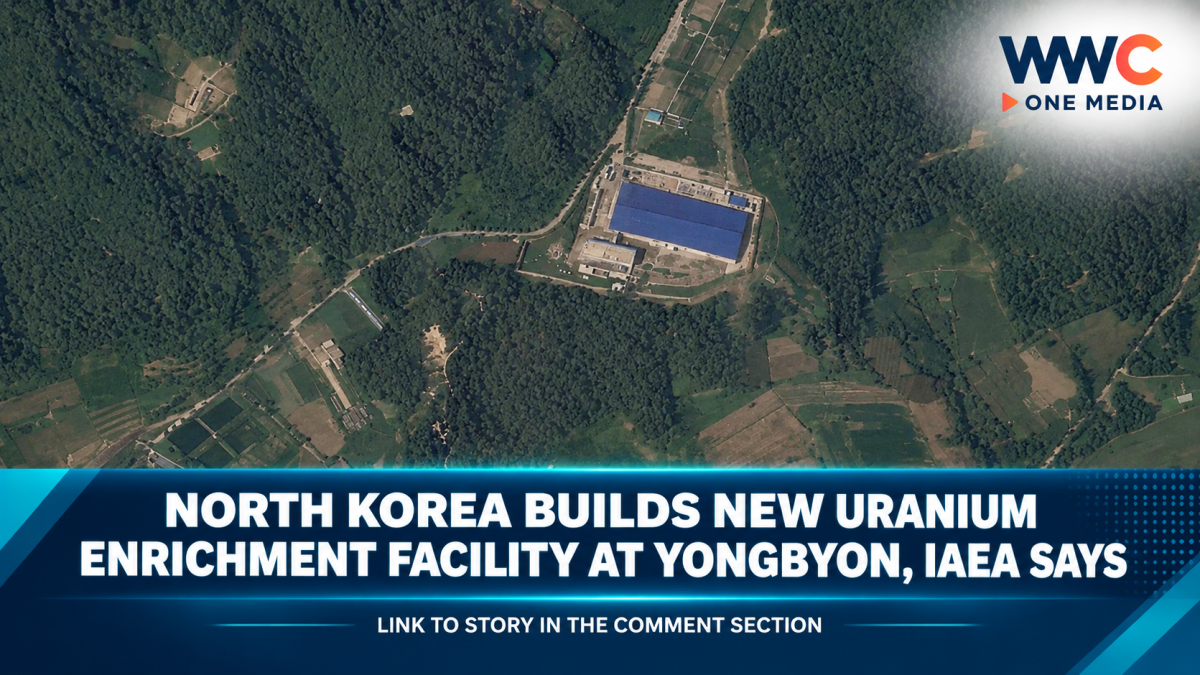
VIENNA — North Korea has built a new uranium enrichment facility at its Yongbyon nuclear complex, the International Atomic Energy Agency has said, raising fresh concerns over Pyongyang’s expanding ability to produce material for nuclear weapons.
The IAEA said the new facility could house up to 28 centrifuge cascades, marking a significant expansion of North Korea’s nuclear infrastructure.
The agency’s assessment is based on satellite imagery and photographs released by North Korean state media, as international inspectors have not been allowed inside the country since 2009.
New facility adds to Yongbyon’s nuclear capacity
According to the IAEA, the new building at the Yongbyon nuclear complex has two storeys, with space for centrifuge cascades on both floors.
Centrifuges are used to enrich uranium by increasing the concentration of uranium-235.
Highly enriched uranium can be used in the production of nuclear weapons.
The new facility could therefore significantly increase North Korea’s capacity to produce nuclear material, although the IAEA cannot directly verify operations on the ground.
Satellite imagery fills the gap left by inspectors
The IAEA has been unable to carry out inspections in North Korea since the country’s inspectors were expelled in 2009.
As a result, the agency has relied heavily on satellite imagery, open-source information and photographs released by North Korean state media to monitor developments.
The lack of direct access means the agency cannot independently confirm all activities taking place inside North Korea’s nuclear facilities.
However, the latest imagery and photographs have provided what the IAEA considers strong evidence of continued expansion at Yongbyon.
Kangson site also shows signs of expansion
The IAEA also reported expanded activity at an annex of the Kangson site near Pyongyang.
The annex was constructed in 2024, and the agency said operations there appear to have expanded.
Kangson has long been a focus of international concern because of suspicions that it may be connected to uranium enrichment activities.
The developments at both Yongbyon and Kangson suggest that North Korea is continuing to expand multiple parts of its nuclear programme.
IAEA raises serious concerns
The UN nuclear watchdog expressed serious concern over the latest developments.
The agency said the continued expansion of North Korea’s nuclear programme violates United Nations Security Council resolutions.
The IAEA has repeatedly warned that the growth of enrichment and reactor activities could increase North Korea’s ability to produce fissile material for nuclear weapons.
Earlier this year, IAEA Director General Rafael Grossi also warned of increased operations at several facilities within the Yongbyon complex, including its reactor and reprocessing infrastructure.
North Korea rejects outside oversight
North Korea has continued to insist that its status as a nuclear-armed state is irreversible.
Pyongyang has also rejected the authority of the IAEA over its nuclear programme, arguing that the agency has no legal right to interfere in its internal affairs.
North Korea withdrew from the Nuclear Non-Proliferation Treaty process years ago and has remained outside international nuclear monitoring arrangements.
Why Yongbyon matters
The Yongbyon nuclear complex has been at the centre of North Korea’s nuclear programme for decades.
The sprawling site contains facilities associated with:
- Nuclear reactors
- Uranium enrichment
- Fuel production
- Reprocessing activities
- Research and development
International concern has grown as satellite imagery has continued to show new construction and increased activity across the complex.
The latest enrichment facility adds another layer to concerns about how quickly North Korea may be expanding its ability to produce nuclear material.
The bottom line
North Korea has built a new uranium enrichment facility at its Yongbyon nuclear complex, according to the International Atomic Energy Agency, in what could significantly expand the country’s capacity to produce nuclear material.
The facility can reportedly accommodate up to 28 centrifuge cascades, while expanded operations have also been observed at a site near Pyongyang.
With IAEA inspectors still unable to enter North Korea, the agency is relying on satellite imagery and state media photographs to track the country’s nuclear activities.
The latest findings add to international concerns that Pyongyang is continuing to expand its nuclear weapons infrastructure despite UN sanctions and long-standing international pressure.
WWC ONE MEDIA




Leave a Reply