
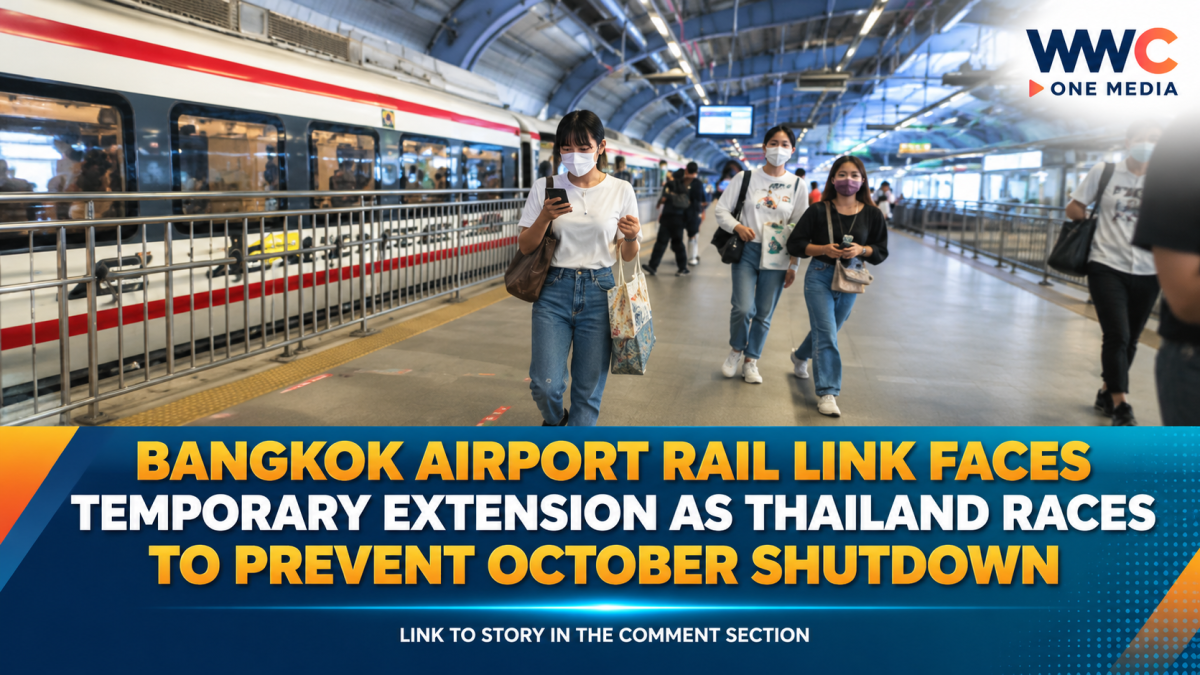
BANGKOK — Thailand’s government is racing to ensure Bangkok’s Airport Rail Link continues running without interruption after its current operating arrangement expires at the end of September, with authorities now seeking a temporary extension of up to four months while a longer-term takeover plan is prepared.
Deputy Prime Minister and Transport Minister Phiphat Ratchakitprakarn has assured passengers that the Airport Rail Link will continue operating from Oct 1, even if the State Railway of Thailand (SRT) has to absorb additional costs or losses during the transition.
The immediate challenge is finding enough time to complete the handover.
The SRT has been instructed to negotiate with the current operator, Asia Era One, for a temporary extension of around two to four months while state authorities prepare to assume responsibility for the service.
Airport Rail Link will continue, government says
The Thai government has sought to reassure passengers that there will be no sudden shutdown of the Airport Rail Link on Oct 1.
The service is an important transport connection between central Bangkok and Suvarnabhumi Airport and is heavily used by commuters, workers and international travellers.
Phiphat said the Transport Ministry would take all possible steps to prevent passengers from being affected by the change in management.
Even if negotiations with the existing operator prove difficult, the government says it has contingency plans to keep trains running.
The priority is simple: no disruption to passengers.
Why does the Airport Rail Link need an extension?
The current operating arrangement involving Asia Era One is due to end on Sept 30, 2026.
Asia Era One is part of the CP Group-linked consortium involved in Thailand’s high-speed railway project connecting three airports:
- Don Mueang
- Suvarnabhumi
- U-Tapao
The company’s role in operating the Airport Rail Link is linked to the wider public-private partnership.
However, the relationship between the private operator and the government has become increasingly complicated following disputes over the three-airport high-speed railway project.
Asia Era One has sought to exercise its right to exit the wider partnership, creating uncertainty over who will operate the Airport Rail Link after Sept 30.
SRT seeks two-to-four-month temporary deal
Thailand’s latest plan is to keep the current operator running the Airport Rail Link temporarily while the SRT prepares for a transition.
Officials are seeking an extension of approximately:
Two to four months.
The additional time would allow the SRT to organise a smoother transfer of management and operational responsibilities.
Under the longer-term plan, an SRT subsidiary would take over responsibility for the service.
Authorities are also considering bringing experienced personnel from the current operator into the transition process to reduce the risk of operational problems.
SRT subsidiary expected to take over
The longer-term plan involves the S.R.T. Electrified Train Company Limited, or SRTET.
SRTET previously operated the Airport Rail Link before management arrangements changed under the wider three-airport railway project.
The government now sees the SRT subsidiary as one of the main options for ensuring continued operations.
Officials have also considered hiring a private company to help manage the service during a temporary period lasting between six months and one year.
The government therefore has several options.
Option one:
Asia Era One continues temporarily.
Option two:
SRTET takes over operations.
Option three:
A private company is brought in to provide short-term operational support.
For now, authorities appear focused on securing a temporary agreement first.
Train shortage adds another problem
The management transition is not the only issue facing the Airport Rail Link.
Authorities have also discovered problems involving train wheels.
Inspections found wheel-wear issues affecting the fleet.
The Airport Rail Link normally requires around nine trains for daily operations.
However, only four trains were initially available for service after inspections identified the problem.
Officials said trains that had passed inspections could return to service, with the immediate goal of increasing the number of operational trains to five or six before additional maintenance is completed.
Passengers have already noticed longer waits
The shortage of available trains has affected service frequency.
Passengers recently reported longer waiting times, with trains operating approximately every 15 minutes instead of the usual shorter intervals.
The reduced frequency has caused crowding and complaints from some commuters and travellers.
The government is now under pressure to solve two problems at once:
Keep the service operating.
Restore enough trains to maintain normal frequency.
Why is Asia Era One leaving?
The Airport Rail Link situation is closely connected to Thailand’s troubled three-airport high-speed railway project.
The wider project was designed to connect:
- Don Mueang Airport
- Suvarnabhumi Airport
- U-Tapao Airport
Asia Era One has sought to exit the public-private partnership.
One of the major disputes involves the project’s payment structure.
The private partner reportedly sought changes that would allow payments based on construction progress rather than waiting for payment under the original framework.
Thai authorities have said such changes are difficult to implement under the existing contract.
The government has also argued that the private company cannot simply walk away from the agreement unilaterally.
That dispute is continuing separately from the immediate issue of keeping the Airport Rail Link running.
Government separates the Airport Rail Link from the wider dispute
Thailand’s Transport Ministry has stressed that maintaining Airport Rail Link services is the immediate priority.
Even while negotiations over the three-airport railway project continue, authorities want to ensure passengers are not caught in the middle.
That is why the government is seeking a temporary operating agreement.
The idea is to give the SRT enough time to take control of the service without forcing a rushed handover.
Phiphat has said continued operations will take priority, even if the SRT must temporarily bear financial costs or losses.
What does this mean for passengers?
For now, passengers should not expect the Airport Rail Link to stop operating on Oct 1.
The government has publicly promised continued service.
However, passengers could continue to experience some temporary issues while authorities deal with:
- Train shortages
- Wheel maintenance
- Longer waiting times
- Management uncertainty
- The transition to a new operator
The immediate goal is to restore more trains to service and ensure enough staff and management systems are in place before the current arrangement ends.
Authorities say passengers should not be affected by the ownership or management transition.
A temporary extension is still being negotiated
One important detail is that the temporary extension has not simply been guaranteed automatically.
Negotiations with Asia Era One are continuing.
Earlier discussions did not immediately produce a final agreement, and the company indicated that proposed extensions would need consideration by senior management.
That means the government is preparing alternatives in case the temporary deal is not finalised.
This is why the SRT’s takeover preparations are moving forward at the same time.
Thailand does not want to depend entirely on a last-minute agreement.
Why the Airport Rail Link matters
The Airport Rail Link is more than just a service for tourists travelling to Suvarnabhumi Airport.
It is also an important part of Bangkok’s wider transport network.
The service connects passengers with central Bangkok and other urban rail systems.
A prolonged shutdown would create problems for:
- Daily commuters
- Airport employees
- Airline passengers
- International tourists
- Businesses around stations
- Bangkok’s wider transport network
That makes a smooth transition politically and economically important.
Government faces a tight deadline
The current arrangement expires on Sept 30.
That leaves authorities with limited time to:
- Finalise negotiations with the existing operator.
- Restore enough trains to regular service.
- Prepare SRTET or another operator.
- Ensure experienced staff are available.
- Prevent disruption on Oct 1.
The government says it is confident the service will continue.
But the tight deadline explains why officials are seeking a temporary extension rather than attempting an immediate full handover.
What happens next?
The SRT will continue negotiations with Asia Era One over a temporary operating extension.
At the same time, authorities will continue preparing the SRT’s subsidiary to assume management if necessary.
Train maintenance will also remain a priority.
The immediate target is to increase the number of available trains and improve service frequency before the transition becomes more complicated.
The longer-term future of the Airport Rail Link will depend partly on how the wider dispute over the three-airport high-speed railway project is resolved.
The bottom line
Bangkok’s Airport Rail Link is not expected to shut down on Oct 1.
Thailand’s government has pledged to keep the service running as the current operating arrangement comes to an end.
But the transition is proving complicated.
Authorities are seeking a temporary extension of two to four months with the current operator while the State Railway of Thailand prepares a takeover. At the same time, wheel-wear problems have temporarily reduced the number of available trains and contributed to longer waiting times.
For passengers, the government’s message is reassuring:
The Airport Rail Link will continue.
The bigger question now is whether Thailand can complete the management transition and restore normal train capacity without further disruption.
WWC ONE MEDIA J.M.D



Leave a Reply