
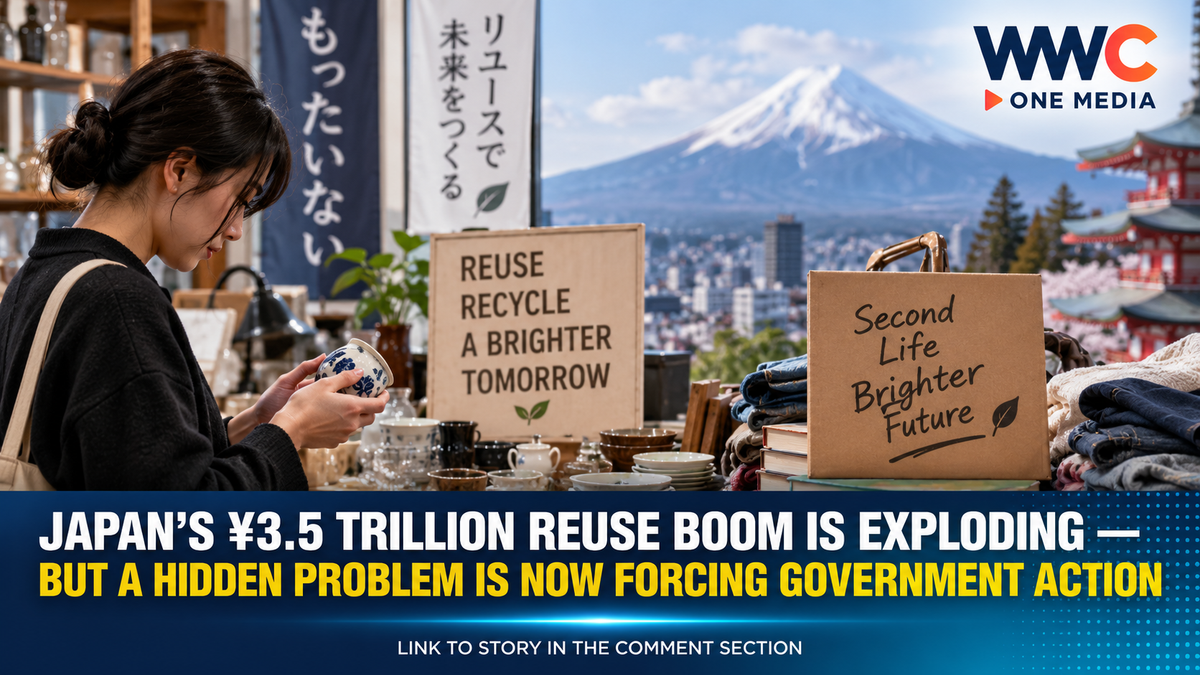
Japan’s secondhand economy has become a multitrillion-yen industry, but authorities are increasingly concerned that some businesses are exploiting consumers who need help disposing of unwanted belongings.
The country’s reuse market has expanded as inflation encourages consumers to seek cheaper alternatives to new products, while Japan’s aging population and growing number of vacant family homes create increasing demand for household clear-out services.
According to Japan’s Environment Ministry, the domestic reuse market was worth approximately ¥3.5 trillion in 2024, based on consumer final demand. Automobiles accounted for the largest share, at about ¥1.92 trillion, while non-automotive reuse represented roughly ¥1.58 trillion.
The ministry’s figures show that the market has continued to expand over the long term, rising from about ¥3.10 trillion in 2012 to ¥3.50 trillion in 2024.
But the rapid growth has also created an opening for businesses accused of using questionable practices.
Consumer complaints are climbing
The National Consumer Affairs Center of Japan recorded 2,680 consultations related to unwanted-household-goods collection in fiscal 2025, roughly double the level recorded in fiscal 2016, according to the Japan Times report.
Some cases involve extremely expensive contracts.
One consumer reportedly paid ¥1 million for a household clear-out service but said the agreed items were not properly collected. Another complained that belongings with sentimental value were discarded without permission.
The problem is not limited to high-priced services.
Japan’s Environment Ministry has previously highlighted concerns about operators advertising apparently free collection before imposing fees, as well as businesses making unsolicited visits to homes to purchase used goods.
Why the government is stepping in
Japan’s Environment Ministry plans to develop guidelines during fiscal 2027 to help consumers identify reliable reuse businesses.
The proposed system would establish standards for evaluating operators and could provide additional support to businesses that meet quality requirements.
The government is simultaneously trying to expand — not restrict — the legitimate reuse economy.
Its roadmap sets a goal of reaching ¥4.6 trillion in annual reuse-market value by 2030, while creating a more reliable and properly regulated market.
That creates an unusual balancing act for policymakers: Japan wants more reuse, but it also wants consumers to know whom they can trust.
The aging-home problem is fueling demand
One of the biggest forces behind the industry’s growth is Japan’s changing demographics.
As the population ages and family structures become smaller, more households are dealing with belongings accumulated over decades — particularly when parents move, enter care facilities or leave homes that their children do not plan to occupy.
That is creating demand for professional companies that can sort household possessions, determine what can be resold and dispose of what cannot.
The Japan Times reported that industry representatives expect this demand to continue growing.
The reuse economy is therefore becoming more than a thrift-shopping trend. It is increasingly connected to Japan’s aging society, vacant homes, waste management and the broader transition toward a circular economy.
Japan is already warning consumers about what they buy
The risks extend beyond household-clearance companies.
Japan’s National Institute of Technology and Evaluation warned earlier this year about safety problems involving used products. Over the five years through 2024, 310 accidents involving secondhand products were reported, with around 90% involving fires and roughly 30% involving products containing lithium-ion batteries.
Bicycles, air conditioners, kerosene heaters and fan heaters were among products involved in reported accidents.
Meanwhile, the National Consumer Affairs Center has also warned consumers about problems involving purchases of accessories and precious metals as rising gold prices increase the incentive to sell unwanted valuables.
What consumers should watch for
Japan’s consumer authorities advise people to be particularly careful when hiring companies to remove unwanted household goods.
Consumers should:
- Check whether the operator has the required local authorization for household-waste collection.
- Ask the municipality for information about authorized operators.
- Get estimates from multiple companies.
- Confirm exactly what services and items are covered.
- Check whether additional charges can be imposed.
- Read the contract before agreeing.
- Be cautious about unsolicited buyers or collection companies.
- Avoid assuming that an advertised “free” collection service will necessarily cost nothing.
The National Consumer Affairs Center specifically says that, as a general rule, household waste collection requires authorization from the relevant municipality.
It also says consumers may have cooling-off rights in certain situations, including cases where a company was invited to provide an estimate but a contract was concluded on the spot, or where the final charge differs substantially from the advertised price.
The bigger story
Japan’s reuse economy is not collapsing. Quite the opposite.
The government wants the sector to become substantially larger, with the official roadmap targeting ¥4.6 trillion by 2030.
The challenge is making sure that growth does not come at the expense of consumers.
As Japan’s population ages, vacant homes increase and living costs remain a concern, the demand for secondhand goods and household-clearance services is likely to remain strong.
That means the government’s next challenge may be just as important as growing the market itself: making Japan’s reuse economy big enough to matter — and trustworthy enough for consumers to use without fear.




Leave a Reply