
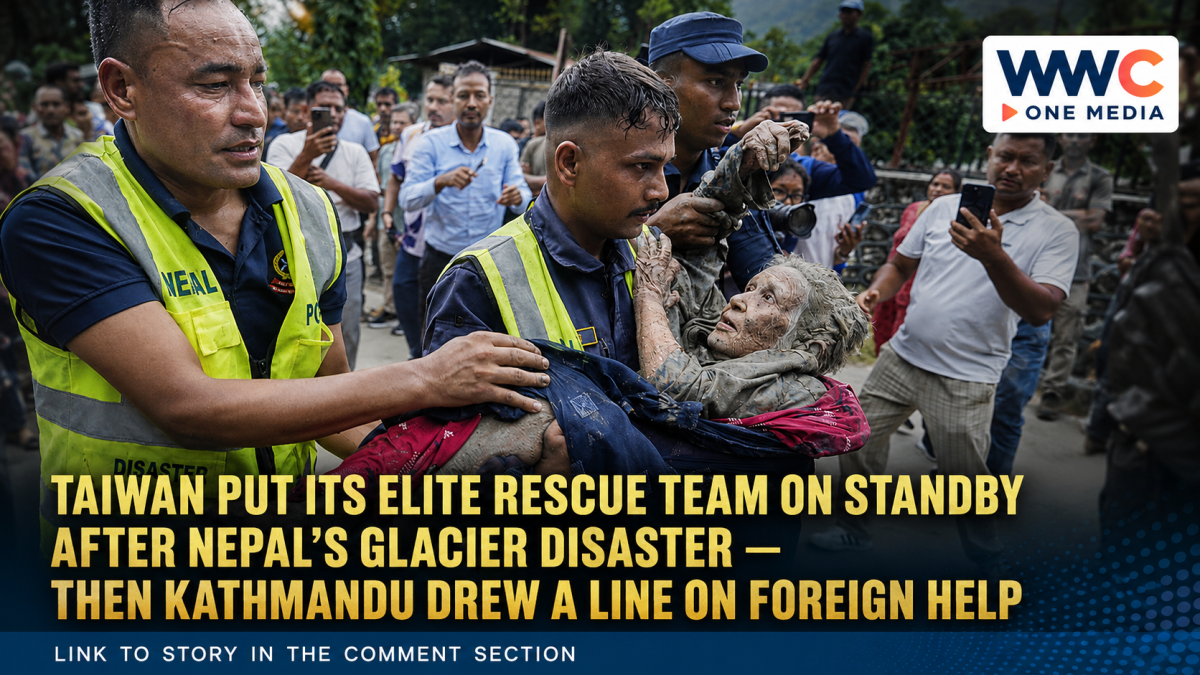
TAIPEI/KATHMANDU — Taiwan has placed its national search-and-rescue specialists on standby following the catastrophic glacier-triggered floods that devastated communities along the Nepal-Tibet border, but a new development could determine whether the Taiwanese rescuers ever deploy: Nepal says it does not currently need foreign teams for ordinary search-and-rescue operations.
Taiwan’s government ordered its national special search-and-rescue team, along with rotating units from Tainan, Hsinchu City and Chiayi County, to prepare for possible deployment after the August 26 disaster, according to Taiwan’s National Fire Agency.
National Fire Agency Director-General Hsiao Huang-chang said Taiwan was prepared to respond quickly if an official request for assistance arrived, working in coordination with the Ministry of Foreign Affairs.
As of the initial announcement, however, Nepal had not requested a Taiwanese rescue deployment.
That distinction has become even more significant.
Nepal Says It Needs Technical Expertise — Not More General Rescue Teams
Nepalese Foreign Minister Shisir Khanal told Reuters that Kathmandu can handle general search-and-rescue operations with its own personnel and does not want unnecessary duplication of teams.
What Nepal does need from abroad, Khanal said, is highly specialized assistance.
Those requirements include rescuing people trapped inside tunnels, reopening transportation and communications where bridges have been destroyed, identifying bodies through DNA testing and improving the ability to preserve remains for longer periods.
Nepal has also requested temporary Bailey bridges from neighboring India and China after roughly two dozen bridges were destroyed or rendered unusable in the disaster zone.
That means Taiwan’s prepared rescue contingent remains on standby, but any eventual Taiwanese assistance could depend on what Kathmandu formally requests as the emergency shifts from immediate rescue toward specialized recovery and reconstruction.
Death Toll Climbs as Thousands Remain Missing
The scale of the disaster has continued to grow dramatically since Taiwan first announced preparations for a possible deployment.
By Saturday, August 29, Nepal’s disaster agency said 626 people had been confirmed dead and 2,426 were missing in Nepal alone, according to the Associated Press.
Chinese authorities reported another seven deaths and 554 missing in Tibet, putting the number of people still unaccounted for across the disaster zone at nearly 3,000 based on the latest figures cited by AP.
More than 3,700 people have been rescued in Nepal.
The casualty count remains fluid, however, as authorities continue to reconcile lists of residents, workers, tourists, trekkers and pilgrims who were in the Himalayan border region when the disaster struck.
Hundreds of foreigners are among those reported missing.
The Nepal-Tibet corridor attracts international trekkers as well as Hindu and Buddhist pilgrims traveling toward Mount Kailash and surrounding sacred sites. Workers from several countries were also employed at infrastructure and hydropower projects in the region.
What Actually Caused the Disaster?
Early reports suggested an earthquake might have triggered the catastrophe.
That assessment has since changed.
Scientists determined that seismic instruments had detected the enormous energy released when a mass of glacier ice, rock and debris collapsed — meaning the seismic signal was an effect of the collapse rather than proof that an earthquake caused it.
The catastrophe appears to have begun with an enormous ice-and-rock avalanche high in the Himalayas.
The collapse sent material into the river system, producing a cascading surge of water, ice, rocks, mud and debris that raced downstream through communities in Nepal and China’s Tibet region.
The flood struck settlements, roads, bridges, hydropower facilities and the strategically important Gyirong border crossing.
Researchers with the International Centre for Integrated Mountain Development said the event affected the Bhote Koshi and Trishuli River corridor and described it as a major cross-border flash-flood disaster whose full consequences are still being assessed.
At one point, water in the Trishuli River reportedly surged by as much as nine meters in roughly half an hour.
The speed and force gave residents little time to escape.
Another Threat Emerged After the First Flood
The original collapse also created new hazards upstream.
Debris blocked waterways and formed temporary lakes, raising fears that another sudden release of water could send a second destructive surge toward already devastated communities.
Rescue operations were temporarily suspended when one barrier lake began overflowing, forcing emergency teams to move to safer ground.
Reuters reported that rescue operations later resumed after officials judged the immediate threat more manageable, although authorities continued monitoring upstream lakes.
Satellite imagery had shown at least one lake increasing in size without an obvious outlet, intensifying concern that pressure could build behind unstable debris.
By Saturday, Chinese monitoring data indicated that the lake’s level had fallen substantially from its earlier peak, but emergency personnel remained alert for further flooding.
Poor weather has created another obstacle.
Nepalese military officials said helicopter operations were temporarily halted Saturday because of weather conditions, even as ground teams continued searching disaster sites.
One of the most difficult rescue operations is taking place at the Upper Trishuli-1 Hydropower Project in Rasuwa district, where authorities believe more than 100 people could be trapped inside a tunnel containing more than a meter of thick mud.
That type of operation helps explain why Nepal is now requesting specialized technical assistance even while declining additional conventional foreign rescue teams.
Taiwan Checks on Nationals in Tibet
Taiwanese authorities have also been attempting to determine whether any of their citizens were caught in the catastrophe.
The Mainland Affairs Council said 51 Taiwanese nationals had registered as being in Tibet through the government’s voluntary travel-registration system.
The council asked the Straits Exchange Foundation to use available channels to check on their safety.
Formal Taiwan-China government communication has largely remained suspended since 2016, making cross-strait emergency coordination more complicated.
Taiwan’s Foreign Ministry said Thursday that it had received no reports of Taiwanese nationals being trapped or otherwise affected by the disaster at that stage.
President Lai Ching-te subsequently expressed condolences to victims and their families on Friday, saying he hoped recovery operations would proceed safely and swiftly.
Climate Change Under Scrutiny — But Scientists Urge Caution
The disaster has also renewed concern over the stability of glaciers and mountain slopes across the warming Himalayas.
Scientists interviewed by Reuters said climate change can create conditions that destabilize high-altitude rock and ice by reducing the support provided by glaciers, increasing meltwater and changing freeze-thaw cycles.
However, experts cautioned against declaring climate change the sole or immediate cause of this particular collapse before detailed geological studies are completed.
Researchers instead describe the event as potentially involving several connected hazards — glacier instability, collapsing rock and ice, temporary river blockages and sudden flooding — combining into one extremely destructive chain reaction.
The distinction matters because the Himalayas contain thousands of glaciers, glacial lakes and steep mountain valleys extending across national borders.
A collapse occurring high in one country can trigger a disaster many kilometers downstream in another.
Taiwan Is Ready — But Kathmandu Will Decide What Comes Next
Taiwan’s decision to ready its national rescue specialists demonstrates that Taipei was prepared to respond rapidly to one of Asia’s deadliest natural disasters in recent years.
But the situation has evolved since the original deployment preparations were announced.
Nepal is now signaling that the biggest gaps are not simply additional rescuers digging through debris.
Kathmandu says it needs specialized expertise, temporary bridges, tunnel-rescue capabilities, forensic identification, communications restoration and eventually enormous reconstruction assistance.
For Taiwan, that leaves its rescue teams prepared but waiting.
Whether they ultimately board aircraft for Nepal — or whether Taiwan’s assistance takes an entirely different form — now depends largely on what the Nepalese government decides it needs next.




Leave a Reply