
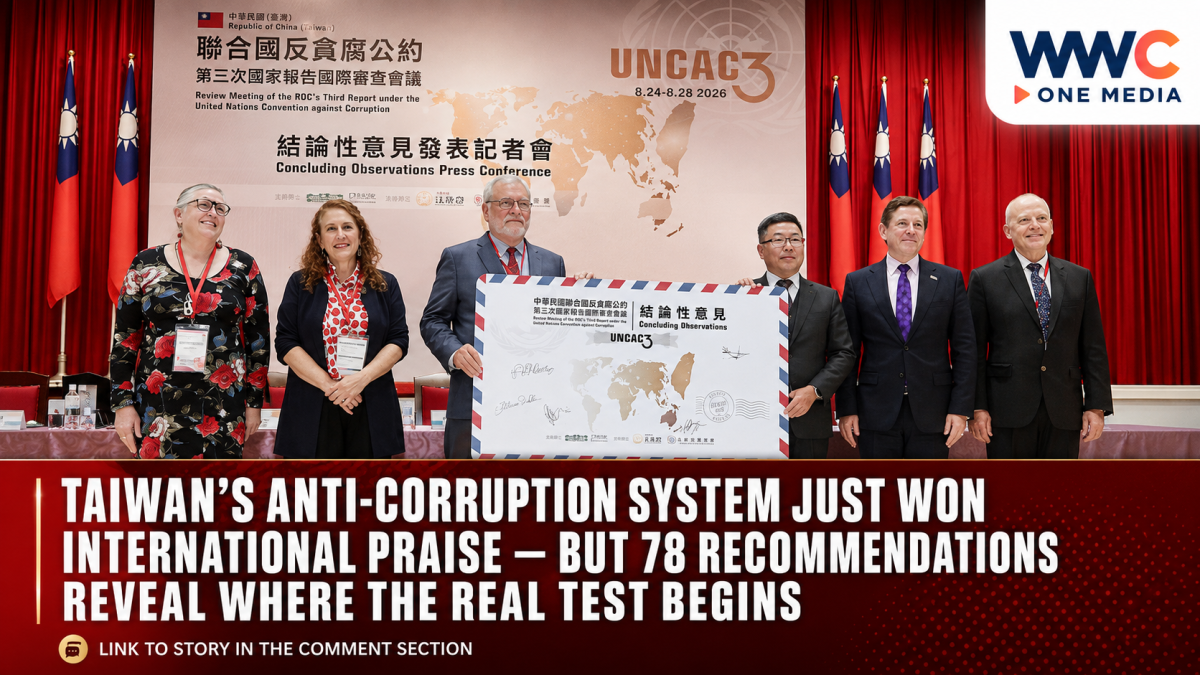
TAIPEI, Taiwan — Taiwan has won strong praise from a panel of international anti-corruption experts for building what they described as a mature and innovative integrity system. But behind that endorsement came a much tougher message: the island still faces major transparency and accountability gaps involving government procurement, defense, political money, lobbying and the private sector.
Five international experts reviewing Taiwan’s third national report under the United Nations Convention against Corruption, or UNCAC, recognized 41 measures and best practices while issuing 78 challenges and recommendations following two days of intensive discussions with government agencies, academics and civil-society representatives.
The review concluded on August 28, with committee chairman José Ugaz, a former chairman of Transparency International, saying Taiwan had established a solid foundation for anti-corruption governance.
But the panel’s message was not simply that Taiwan should create more rules.
The next challenge, reviewers said, is proving that the systems already in place actually reduce corruption risks in measurable and verifiable ways.
Taiwan Earns Praise for Procurement and Integrity Systems
Among the strongest endorsements was Taiwan’s use of its Government Procurement Integrity Platform and Government e-Procurement System.
Committee member Gillian Dell said the mechanisms could serve as examples for other countries, highlighting Taiwan’s efforts to make public purchasing more transparent and resistant to improper influence.
Experts also pointed to Taiwan’s Enterprise Service Integrity Platform and its inclusion of state-owned enterprises in integrity-award assessments as evidence that the government is trying to extend anti-corruption standards beyond traditional public agencies and into the business sector.
Committee member Duncan Hames said those initiatives demonstrated a commitment to developing a broader culture of business integrity.
But that praise came with significant conditions.
Defense Transparency and Government Procurement Remain Pressure Points
Dell said Taiwan still had room to strengthen transparency in national defense, maintain sufficient judicial capacity and ensure that government procurement procedures are backed by stable and effective anti-corruption safeguards.
The defense recommendation is particularly noteworthy as Taiwan dramatically expands military spending and procurement amid mounting security pressure from China.
The reviewers did not allege corruption in Taiwan’s defense sector. Rather, their recommendation focused on improving transparency and safeguards in an area where national-security requirements can naturally limit public disclosure.
That distinction is important: the review identified risks and areas for reform, not evidence that wrongdoing had occurred.
Political Donations and Lobbying Face More Scrutiny
Another major concern involves the flow of money and influence through politics.
Committee member Julie Haggie praised Taiwan’s implementation of conflict-of-interest rules but called for faster and greater transparency surrounding political donations, lobbying activities and lobbying registration.
Those recommendations strike at a central challenge facing democracies worldwide: voters may know who holds political office, but determining who is funding political activity or seeking to influence government decisions can be much harder.
Improving disclosure could therefore become one of the most politically sensitive parts of Taiwan’s response to the review.
Experts Want Tougher Rules for Companies
The panel also pushed Taiwan to strengthen corporate accountability.
Hames recommended improving the transparency of registered-company information, increasing the reliability of government corporate registries and developing a system of criminal liability for legal entities.
Such reforms could make it easier for authorities, businesses and the public to determine who ultimately controls companies and potentially strengthen enforcement when corporate structures are used to facilitate misconduct.
The experts also highlighted Taiwan’s capabilities in prosecution, anti-money laundering, corruption-risk assessments, virtual-asset management and the recovery of illicit proceeds.
Committee member Peter Ritchie urged Taiwan to build on those strengths and share practical case studies with businesses and international partners.
Why Taiwan Is Being Reviewed Despite Not Belonging to the UN
There is an important political and legal backdrop to the process.
Taiwan is not a member of the United Nations and therefore does not participate in UNCAC in the same way as UN-recognized states parties.
Instead, Taiwan incorporated the convention into domestic law in 2015 and voluntarily established its own system of periodic national reports and international expert reviews. Its first international UNCAC review took place in 2018, followed by a second review in 2022.
Taiwanese Justice Minister Cheng Ming-chien said ahead of this year’s review that the government voluntarily follows UNCAC standards and uses outside reviews to measure policy effectiveness, identify weaknesses and determine priorities for reform.
For the first time, Taiwan’s third national report also used the same type of self-assessment checklist employed by countries formally participating in the convention, according to Taiwan News.
The 78 Recommendations Follow an Earlier Reform Push
This is not Taiwan’s first lengthy anti-corruption homework list.
The international panel that reviewed Taiwan’s second UNCAC report in 2022 issued 104 concluding observations, covering issues including whistleblower protection, political financing, international corruption investigations and corporate transparency.
The latest review therefore represents another checkpoint in a longer effort to determine whether anti-corruption reforms are moving from legislation and policy design into measurable results.
Taiwan’s broader international standing has also improved.
In Transparency International’s 2025 Corruption Perceptions Index, released in February 2026, Taiwan scored 68 out of 100 and ranked 24th among 182 countries and territories, its highest ranking to date. In East Asia, it remained behind Singapore, Hong Kong and Japan.
The CPI measures perceptions of public-sector corruption rather than directly documenting individual corruption cases, but the improvement provides another indicator of how Taiwan is viewed internationally.
What Happens Next
Minister without Portfolio Lin Ming-hsin said the government would use the committee’s recommendations as references when developing future anti-corruption policies and drafting legislation.
Taiwan plans to report on its progress in its next national report and subsequent international review.
That means the most consequential part of the process begins after the applause fades.
Taiwan has now been told that many of the foundations of its anti-corruption system are working and, in some cases, could serve as international models.
But the 78 recommendations show that international reviewers are asking a harder question next:
Can Taiwan turn transparency rules, procurement platforms and integrity programs into demonstrable reductions in corruption risk — especially in politically sensitive areas such as defense spending, corporate accountability, lobbying and campaign finance?
For Taipei, the next international review may ultimately be judged less by how many new mechanisms it creates than by whether it can prove the existing ones work.



Leave a Reply