
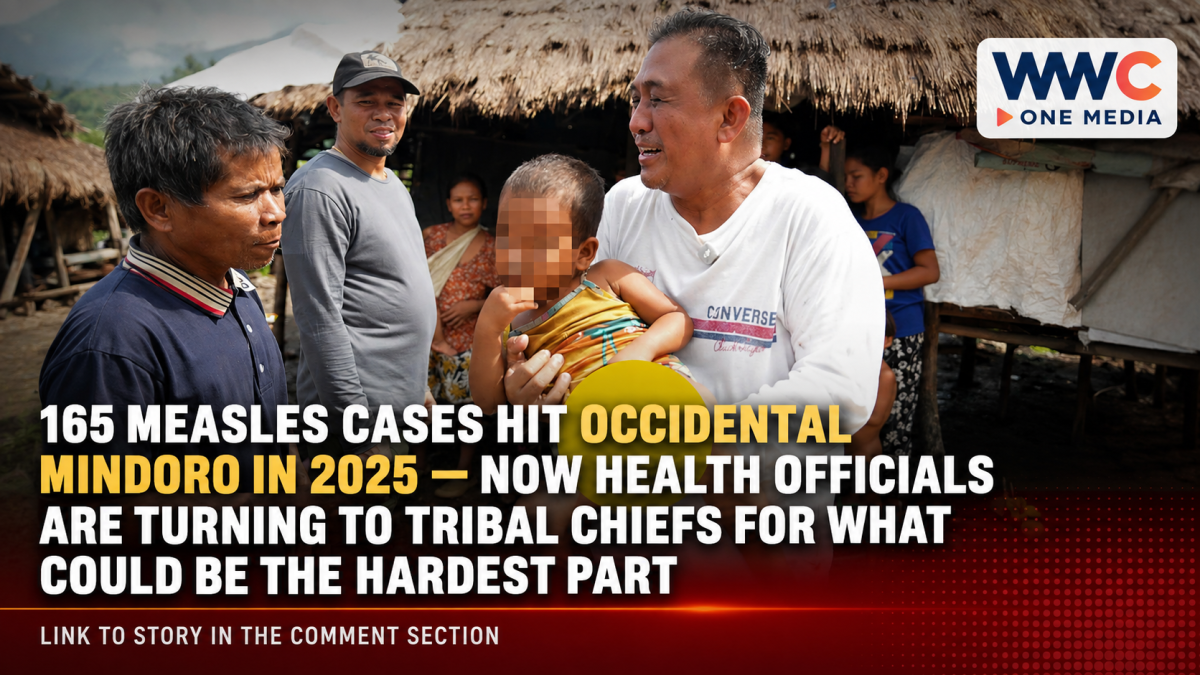
SAN JOSE, Occidental Mindoro — Health authorities in Occidental Mindoro are turning to some of the most trusted voices in Indigenous communities—their tribal chieftains—as the province intensifies efforts to close dangerous vaccination gaps following a measles surge that hit Sablayan particularly hard in 2025.
The Provincial Health Office said Indigenous leaders are playing a crucial role in persuading families to have their children immunized against measles and rubella, particularly in communities where hesitation, misinformation and limited access to health services can make conventional vaccination campaigns more difficult.
According to the PHO, Occidental Mindoro recorded 165 measles cases in 2025, with 125—or roughly three-fourths—coming from Sablayan alone. Health officials said most of the Sablayan cases were recorded among Indigenous communities, underscoring why tribal leaders have become central to the province’s latest immunization strategy.
Why health officials are turning to tribal leaders
PHO Health Education and Promotion Officer Jayson Torres said convincing families in Indigenous communities cannot always be accomplished simply by sending outside health workers into villages. Tribal leaders often carry greater credibility because they are members of the communities themselves and hold positions of trust and authority.
That means the government’s campaign is increasingly about more than transporting vaccine doses. Health workers are working with municipal governments, barangay officials and Indigenous leaders to explain why vaccination matters, answer parents’ questions and bring immunization services closer to families.
The approach mirrors a broader lesson highlighted by the World Health Organization: reaching children in geographically isolated or hesitant communities often requires local leaders, accessible vaccination sites and community trust—not merely the availability of vaccines. WHO said local leaders elsewhere in the Philippines have also helped counter misinformation and encourage families to participate in measles immunization campaigns.
Sablayan had already seen how quickly measles could disrupt a community
The scale of the risk became particularly clear in March 2025.
A Department of Social Welfare and Development disaster report said the first confirmed measles case in Barangay San Agustin, Sablayan, was reported on March 2, 2025. Local authorities subsequently placed 242 families under isolation, representing 702 people, while the local health office launched an anti-measles vaccination operation the following day.
DSWD reported that more than ₱765,000 in government assistance was eventually provided to affected families during the response.
Those events formed part of a much wider measles problem. WHO reported that the Philippines recorded more than 5,000 measles cases in 2025, prompting the government to plan the nationwide “Ligtas Tigdas” Measles-Rubella Supplemental Immunization Activity, supported by WHO, UNICEF, the U.S. Centers for Disease Control and Prevention and other partners.
Vaccination coverage is improving—but the 95% goal remains the bigger challenge
Occidental Mindoro’s vaccination numbers have been improving.
The original PIA report said the province had achieved 57.6% of its MR-SIA target as of August 24, with health authorities aiming for at least 95% coverage.
More recent figures reported by the Philippine Daily Inquirer show that Occidental Mindoro had climbed further by August 26. Some 34,146 of the province’s 54,894 targeted children had been vaccinated, equivalent to 62.20% coverage—the highest rate among MIMAROPA provinces at that point.
Across MIMAROPA, however, only 157,357 of 312,191 eligible children, or 50.40%, had received the supplemental measles-rubella vaccine as of August 26. The campaign generally targets children 6 to 59 months old, including children who previously received measles vaccines, because the supplemental campaign is designed to rapidly close population-level immunity gaps.
Importantly, although the original campaign period was scheduled to end on August 28, the latest MIMAROPA advisory cited by the Inquirer said parents could continue bringing eligible children to fixed and temporary vaccination posts until September 4 as part of the extended or mop-up effort.
Health officials are fighting misinformation at the same time
Another obstacle is vaccine misinformation.
Occidental Mindoro health authorities said social-media posts falsely portraying vaccines as dangerous have contributed to parental fears. Nurses and Barangay Health Workers are therefore holding health-education sessions at vaccination sites, explaining vaccine benefits, possible side effects and what parents should expect after immunization.
The challenge is significant because measles is an exceptionally contagious airborne viral disease. It can cause serious complications and death, particularly among young and vulnerable children, but vaccination remains the primary means of prevention.
For Occidental Mindoro, the involvement of Indigenous chieftains could therefore prove critical. The province has already shown that vaccination coverage can climb rapidly when health workers, local governments and communities work together. But with coverage still below the 95% objective in the latest figures available, the final test is whether authorities can reach the children who are hardest to find—and the families who remain hardest to convince.
Accuracy Check
The 165 Occidental Mindoro cases and 125 Sablayan cases cited by PIA refer to 2025, not a newly reported province-wide outbreak in August 2026. The current reports primarily describe the 2026 vaccination campaign aimed at preventing renewed transmission. The March 2025 DSWD report separately documents the confirmed case and community response in Barangay San Agustin.
There is also an important timing update: PIA’s August 28 story referred to an August 28 campaign endpoint, but newer MIMAROPA reporting said vaccination posts would continue through September 4 during the extended/mop-up period.

Leave a Reply