
MANILA, Philippines — The battle over Vice President Sara Duterte’s impeachment trial is no longer confined to the evidence being presented inside the Senate.
A new dispute is emerging over what the people involved in the historic proceedings can say outside the impeachment courtroom — and whether the same restrictions will actually be enforced against everyone.
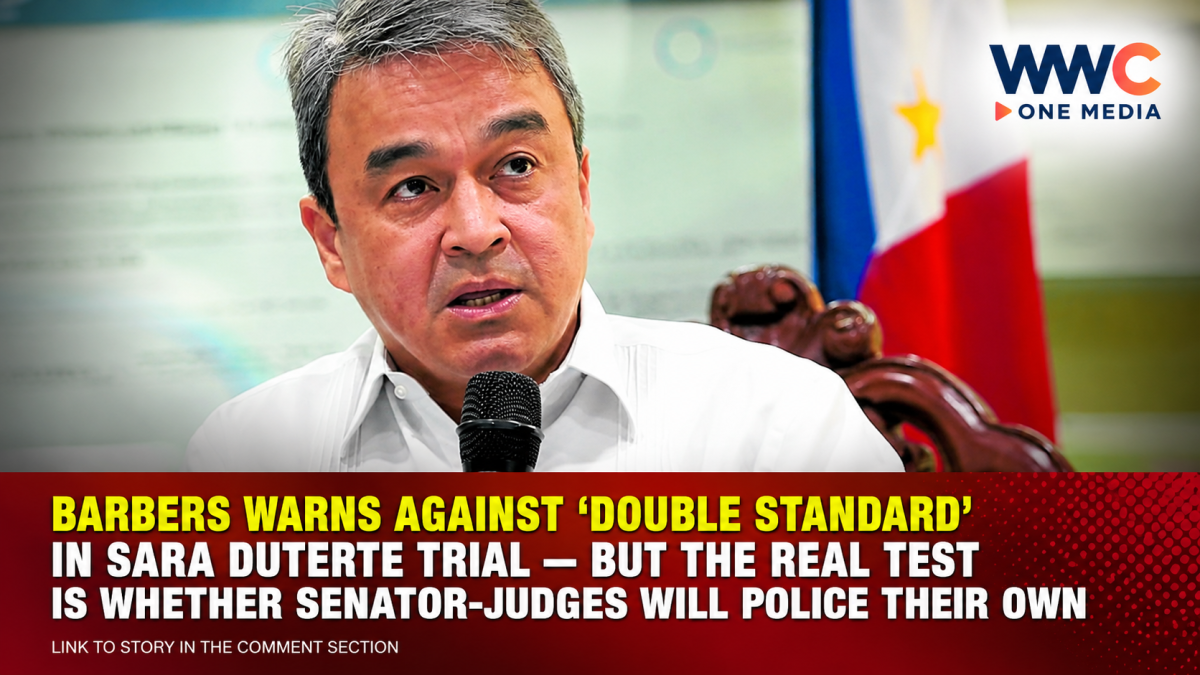
House impeachment team adviser and spokesperson Robert Ace Barbers warned Saturday that there should be no double standard in enforcing the Senate impeachment court’s sub judice rule, saying senator-judges, prosecutors, defense lawyers and Duterte herself must all be held to the same standard.
The warning comes after Senate impeachment court Presiding Officer Francis “Chiz” Escudero moved to tighten enforcement of Rule 18, which restricts public comments on the merits of the pending impeachment case.
“If this Rule 18, the sub judice rule of this impeachment court, is really going to be implemented, this must apply to everybody,” Barbers said during the Saturday News Forum in Quezon City.
His message was straightforward: no participant should enjoy special treatment simply because of political position, institutional power or which side of the impeachment fight they are on.
Senator-Judges Are Covered Too
The issue has become particularly sensitive because the senators hearing Duterte’s case are not ordinary legislators while the impeachment court is sitting.
They are acting as senator-judges who may ultimately decide whether the vice president should be convicted or acquitted.
Barbers said that if prosecutors and defense lawyers are expected to avoid public statements that could affect the case, senator-judges should face the same level of scrutiny.
The question put to Barbers during the forum specifically referred to public remarks by Sen. Robin Padilla, although Barbers did not personally single Padilla out in his response.
Instead, he focused on the broader principle.
If any senator-judge goes beyond the limits imposed by the court, Barbers argued, the violation should receive the same attention as a similar violation committed by a prosecutor, defense lawyer or other person covered by the rule.
Escudero’s ruling itself reminds members of the impeachment court to preserve impartiality and judicial decorum, while possible violations involving senators may also be addressed through internal Senate mechanisms, including its ethics processes.
What Exactly Does Rule 18 Prohibit?
Rule 18 of the Senate’s impeachment rules is intended to prevent participants from effectively trying the case through television interviews, press conferences and social media instead of inside the impeachment court.
GMA News reported that Escudero’s August 26 ruling bars senator-judges as well as prosecution and defense counsels from publicly discussing the merits of Duterte’s pending case.
The restriction also covers the person being impeached — meaning Duterte herself — along with counsels and witnesses.
The tougher enforcement is prospective, meaning the stricter penalties and standards announced by Escudero apply to statements made after the ruling.
Among the areas participants must be particularly careful discussing are disputed facts, the credibility of witnesses, the strength or weight of evidence, the viability of particular charges or defenses, and the possible outcome of the proceedings.
The purpose is not simply to reduce political noise. The broader objective is to prevent outside statements from influencing senator-judges or undermining public confidence in the court’s impartiality.
Duterte Herself Has Already Been Reminded
The scope of the rule became unmistakably clear on August 26 when Escudero specifically instructed Duterte’s defense lawyers to remind the vice president that she, too, is covered.
That happened after the prosecution raised a public statement issued by Duterte criticizing what she described as name-calling and political theatrics during the proceedings.
Escudero did not penalize Duterte for that particular statement because it was issued while the stricter ruling was being announced and the court was applying its directive prospectively.
But he warned that future statements falling within the prohibited areas could trigger action from the impeachment court.
Duterte’s defense team acknowledged the reminder.
Both Prosecution and Defense Say They Will Comply
The stricter rule has already changed how both camps approach the media.
GMA News reported that representatives of both the House prosecution and Duterte’s defense said they would comply with Escudero’s directive.
Defense spokesperson Michael Poa even said he canceled scheduled media interviews because answering questions about the case could accidentally cross the line into discussion of its merits.
Under the ruling reported by GMA, lawyers found violating the restrictions may receive a severe reprimand and stern admonition for a first offense. Second and succeeding violations may result in fines of as much as ₱30,000 per violation.
But Barbers Also Wants Some Leniency
There is an important second part to Barbers’ position.
While demanding equal enforcement, he is also asking the impeachment court not to interpret the rule so strictly that the public is left unable to understand what is happening inside one of the country’s most consequential political proceedings.
Barbers said prosecutors should still be permitted to communicate factual information already presented in open court, provided they do not argue about the credibility of witnesses, the strength of evidence or how senator-judges should decide the case.
The House of Representatives said Barbers appealed for some “leniency,” arguing that impeachment is sui generis — a unique constitutional proceeding — and that Filipinos have a legitimate interest in receiving accurate information about it.
For example, Barbers said a spokesperson should be able to tell the public what a witness actually testified to without then declaring whether that witness was truthful or whether the testimony proves Duterte guilty.
That distinction could become increasingly important.
The House prosecution has said it intends to continue providing factual updates while respecting the court’s restrictions, partly to prevent misinformation and distorted versions of testimony from spreading online.
Why the Issue Matters
The dispute goes beyond media strategy.
An impeachment trial is simultaneously a constitutional proceeding, a legal confrontation and an enormous political event watched by millions of Filipinos.
Too little restraint could turn the proceeding into a daily battle for public opinion, with prosecutors, defense lawyers, politicians and witnesses attempting to influence the narrative outside the Senate.
But restrictions that are too broad could create another problem: ordinary citizens may struggle to understand evidence and developments emerging from proceedings that can run for hours.
The challenge for Escudero and the impeachment court is therefore not simply deciding how strictly Rule 18 should be enforced.
It is determining whether it can be enforced consistently.
And that is the point at the center of Barbers’ argument.
If prosecutors can be sanctioned for crossing the line, the defense must face the same standard. If Duterte herself is restricted, the rule must apply to her. And if senators temporarily wearing the robes of judges publicly venture into territory prohibited by the court, Barbers argues that their position should not shield them from scrutiny.
That principle may become increasingly difficult to maintain as the trial moves deeper into contested evidence and eventually toward the most politically explosive stage of all: deliberations and voting.
Because the credibility of the impeachment court will ultimately depend not only on the verdict it reaches — but also on whether Filipinos believe the rules were applied equally before that verdict was cast.

Leave a Reply