
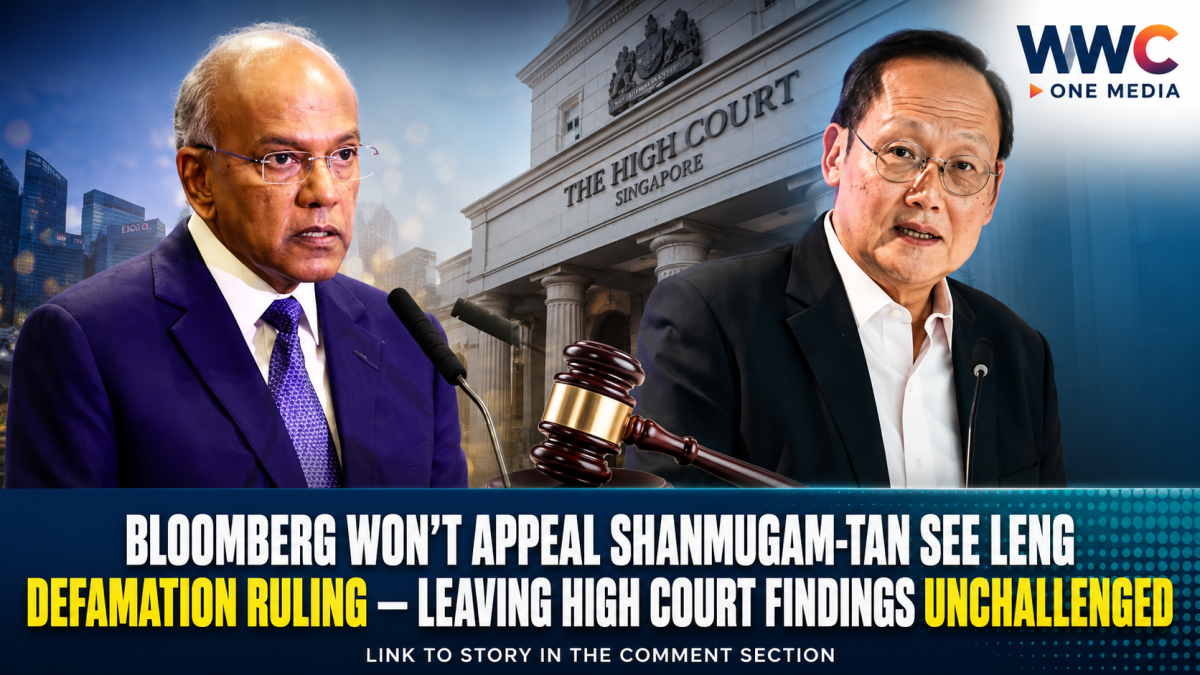
SINGAPORE — Bloomberg and one of its journalists will not appeal a landmark Singapore High Court ruling that found they defamed two senior Cabinet ministers, bringing one of the city-state’s most closely watched media-law battles to a potentially decisive end.
The appeal deadline has expired without Bloomberg or reporter Low De Wei filing an appeal against the judgment in favour of Senior Minister and Coordinating Minister for National Security K Shanmugam and Minister for Trade and Industry (Energy and Industry) Tan See Leng, according to Channel NewsAsia.
That means the High Court judgment — including its findings on defamatory meaning and malice — remains unchallenged.
The financial consequences are substantial.
Bloomberg and Low had already been ordered to pay S$230,000 in damages to each minister, or S$460,000 combined. CNA reported that the defendants must additionally pay S$423,000 in costs and disbursements, bringing the amounts ordered in connection with the two cases to roughly S$883,000.
But the bigger significance of the case goes well beyond the money.
It has become a major test of where Singapore courts draw the line between aggressive public-interest journalism and reporting that creates a defamatory impression about public officials.
The Article That Triggered the Lawsuit
The dispute originated from a Bloomberg report published in December 2024 about Singapore’s ultra-exclusive Good Class Bungalow, or GCB, market.
The article examined property transactions in which caveats had not been lodged and discussed concerns about secrecy and transparency in high-end residential deals.
It also referred to Singapore’s massive S$3 billion money-laundering scandal before discussing property transactions involving Shanmugam and Tan.
The ministers argued that placing their transactions within that narrative wrongly suggested they had conducted their property dealings in a secretive or improper manner.
Bloomberg and Low contested the claims.
Their defence was essentially that the report concerned a wider trend in Singapore’s luxury-property market and that references to the ministers’ transactions were examples within that broader story — not accusations that either minister had committed wrongdoing.
The High Court disagreed.
What the Judge Actually Found
In a written judgment issued on July 14, 2026, Justice Audrey Lim ruled that the Bloomberg article was defamatory when assessed as a whole.
The official case, Shanmugam Kasiviswanathan v Bloomberg L.P. & Anor [2026] SGHC 147, involved both ministers’ claims being tried together.
The court found that the way the report connected the ministers’ property transactions with themes of secrecy, opacity and money laundering created a defamatory impression.
The Business Times reported that Justice Lim also found Bloomberg and Low had acted with malice, including findings concerning information the reporter knew was false or published without caring whether it was true. The judge also considered Bloomberg’s decision to remove the article’s paywall, thereby expanding its audience, in assessing malice.
South China Morning Post reported that the S$230,000 awarded to each minister consisted of S$170,000 in general damages and S$60,000 in aggravated damages.
The court also rejected Bloomberg’s attempt to rely on the so-called Reynolds public-interest defence, finding that the English-law defence does not form part of Singapore law.
That legal point could have implications beyond this particular dispute because it highlights the different framework publishers face when defending public-interest reporting in Singapore.
Bloomberg Had Stood By Its Reporting
The absence of an appeal is particularly notable because Bloomberg had not publicly accepted the court’s criticism of its journalism.
CNA reported that after the High Court ruling, Bloomberg continued to maintain that its reporting was accurate and characterised the report as a solid piece of journalism. The organisation previously declined to tell CNA whether it intended to appeal the judgment, challenge the amount of damages or determine how the financial liability would be divided between Bloomberg and Low.
That made the passing of the appeal deadline an important moment.
Shanmugam argued in a Facebook statement that Bloomberg’s decision not to appeal meant the High Court’s findings concerning falsehoods, malice and wrongful conduct would remain on the judicial record.
That is Shanmugam’s interpretation of Bloomberg’s decision, rather than a statement from Bloomberg itself.
Bloomberg has not publicly said that declining to appeal amounts to accepting every criticism contained in the judgment.
That distinction matters.
A party can choose not to appeal a court ruling for many reasons, including legal strategy, cost or an assessment of the chances of overturning a decision. What can be stated definitively is that no appeal was filed within the deadline and the High Court ruling therefore remains in force and unchallenged through an ordinary appeal.
Ministers Say Case Was About Integrity, Not Silencing the Press
Shanmugam and Tan have repeatedly framed the litigation as an attempt to protect their reputations and the integrity of the public offices they hold rather than an effort to restrict legitimate journalism.
Following the July judgment, they said freedom of expression does not include the freedom to publish false and defamatory allegations without proper basis.
The Straits Times reported that the ministers characterised the controversy as one involving what they called malicious targeting and false allegations, rather than a challenge to press freedom itself.
Tan said after the appeal period ended that the case had effectively come to a close and that the proceedings had allowed both ministers to clear their positions and defend the standing of their offices.
The Cost of Losing Keeps Growing
The damages were only part of Bloomberg and Low’s financial exposure.
At the end of July, The Business Times reported that Justice Lim awarded S$145,000 in legal costs to each minister, amounting to S$290,000 for the two cases before additional disbursements were taken into account.
CNA’s latest report puts the total costs and disbursements payable at S$423,000.
Combined with the S$460,000 damages award, the amounts ordered therefore approach S$900,000.
For a global media organisation, the monetary figure may not be existential.
The precedent is potentially more consequential.
Why This Case Matters Beyond Bloomberg
The ruling lands at the intersection of three politically and commercially sensitive subjects: press freedom, the reputations of public officials and Singapore’s tightly held luxury-property market.
Good Class Bungalows occupy a unique position in Singapore.
They are among the country’s most valuable private homes and are generally located in designated GCB areas, making transactions involving politicians, wealthy business figures and prominent families a natural subject of public and media interest.
But the High Court ruling sends an equally clear warning about how those transactions are framed.
Journalists can investigate public officials, scrutinise property deals and question transparency.
What publishers cannot safely assume is that a report will be protected simply because its broader subject is of legitimate public interest. The meaning created by the article as a whole — including headlines, context, sequencing and associations — can become crucial in a defamation case.
For newsrooms covering Singapore, that may ultimately be the most important consequence of the Bloomberg judgment.
Bloomberg fought the allegations through a full High Court trial.
It lost.
It publicly stood by its journalism after the judgment.
And now, with the appeal deadline gone, the findings against it remain intact.
The courtroom battle may be over — but the debate over what this ruling means for investigative journalism in Singapore is unlikely to disappear with it.

Leave a Reply