
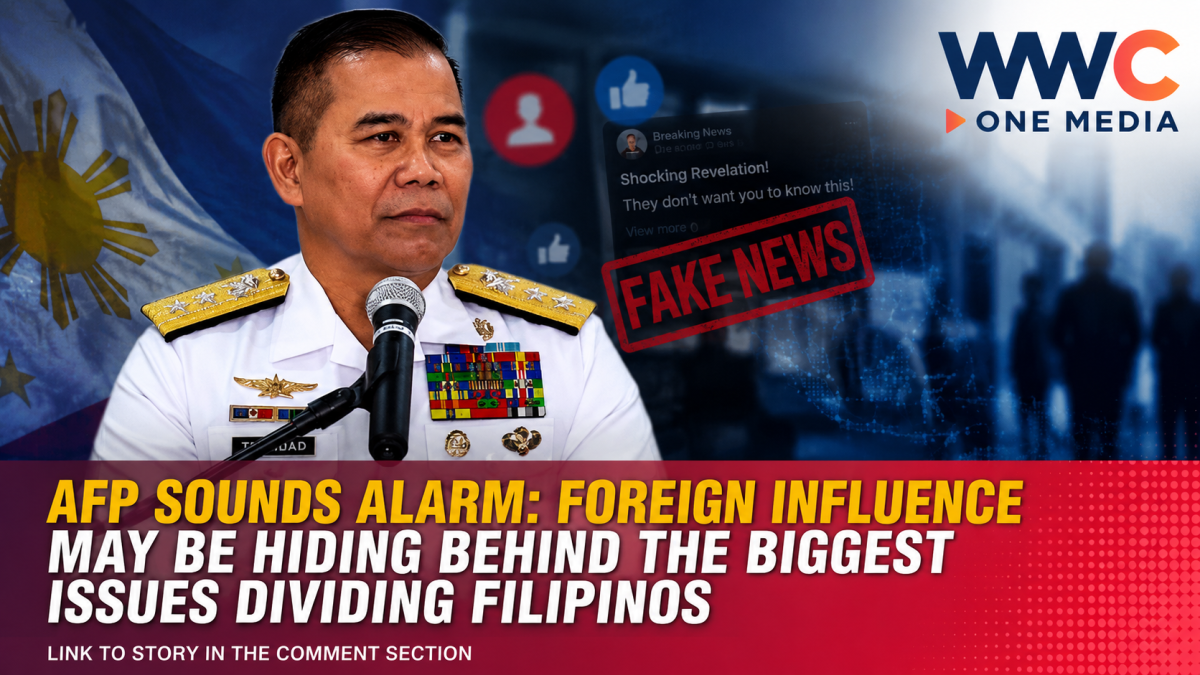
MANILA, Philippines — The Armed Forces of the Philippines (AFP) has raised fresh concerns over what it describes as a growing pattern of foreign malign influence operations exploiting some of the country’s most divisive local issues, including the impeachment trial of Vice President Sara Duterte.
AFP spokesperson for the West Philippine Sea, retired Rear Admiral Roy Vincent Trinidad, said information operations that previously focused heavily on geopolitical narratives are increasingly finding their way into domestic controversies—making them more difficult for the public to identify.
According to Trinidad, the shift has become noticeable over the past four to six months, with online messaging moving beyond familiar narratives involving the West Philippine Sea, China and Davao politics and into emotionally charged issues closer to home.
The concern, officials say, is not simply about misinformation—but about who may be amplifying divisive narratives and for what purpose.
From Geopolitics to Local Controversies
Speaking at a public forum, Trinidad said foreign malign influence campaigns appear to be “riding on” local issues, including Sara Duterte’s ongoing Senate impeachment trial, controversies surrounding flood-control projects and the issue involving Philippine Sanjia-Steel Corp.
Philippine Star reported that Trinidad’s social media monitoring and analytics indicated a pattern of foreign influence activity surrounding these controversies. The report specifically identified China as a concern, with Trinidad saying narratives were allegedly being exploited to create disruption and advance strategic interests.
The AFP official said the changing nature of information operations makes them more challenging to detect because they can blend into legitimate public debate and existing political disagreements.
Why the Sara Duterte Trial Is a Major Target for Online Narratives
The warning comes as Vice President Sara Duterte’s impeachment trial continues to dominate political discussions both inside and outside the Senate.
The impeachment proceedings have examined allegations involving the handling of confidential funds, among other accusations. Duterte has repeatedly denied wrongdoing and maintained that the allegations against her are not supported by evidence.
The trial has also generated intense public debate, prompting Senate impeachment court officials to tighten restrictions on public comments concerning the merits of the case under the applicable impeachment rules.
That highly charged environment, security officials warn, can create fertile ground for misleading or manipulated content to spread rapidly online.
Prosecution Team Warns: Check the Evidence, Not Just Viral Posts
Former Surigao del Norte Representative Robert Ace Barbers, who serves as an adviser and spokesperson for the House prosecution team, urged Filipinos to be more critical of information circulating online.
Barbers said misinformation has also targeted lawmakers who supported the impeachment, arguing that personal attacks and misleading narratives can distract the public from the actual evidence and arguments presented in the impeachment court. Similar warnings were reported by ABS-CBN News and the Philippine Daily Inquirer.
The message from the prosecution side is straightforward: follow the proceedings, examine the evidence and be cautious about viral claims that lack verifiable sources.
A Broader National Security Concern
The AFP’s latest warning is part of a wider concern within the Philippine government about the growing overlap between external security threats and domestic information environments.
Defense Secretary Gilberto Teodoro Jr. previously warned that foreign malign influence can blur the traditional line between internal security and external defense, particularly when outside actors attempt to influence public opinion or exploit domestic instability.
Trinidad said the AFP expects the challenge posed by malign information operations to remain a concern in the years leading up to 2028, when President Ferdinand Marcos Jr.’s term ends.
The Bigger Question: Who Benefits From a Divided Philippines?
The AFP warning does not mean that every criticism of the government or every opinion about the Sara Duterte impeachment trial is foreign-driven. Political disagreement and criticism remain part of a democratic society.
The concern raised by security officials is that foreign actors may exploit existing frustrations, controversies and divisions by amplifying misleading narratives or manipulating online conversations to serve broader strategic interests.
As the impeachment trial continues and political tensions remain high, the battle for public opinion may increasingly play out not only in the Senate impeachment court—but also on millions of Filipinos’ social media feeds.
For the public, the challenge is becoming clearer: In an age when misinformation can travel faster than facts, the most viral narrative is not always the most truthful one.
What Filipinos Should Watch
- Verify claims through credible and multiple news sources.
- Distinguish between legitimate political opinion and unverified factual claims.
- Follow official impeachment proceedings and examine evidence in context.
- Be cautious of coordinated-looking posts, manipulated videos and anonymous accounts pushing highly emotional narratives.
The AFP’s warning adds a new dimension to an already historic political battle—and raises a question that may become increasingly important as 2028 approaches: Are Filipinos simply debating their differences, or are outside forces learning how to weaponize them?
Leave a Reply