
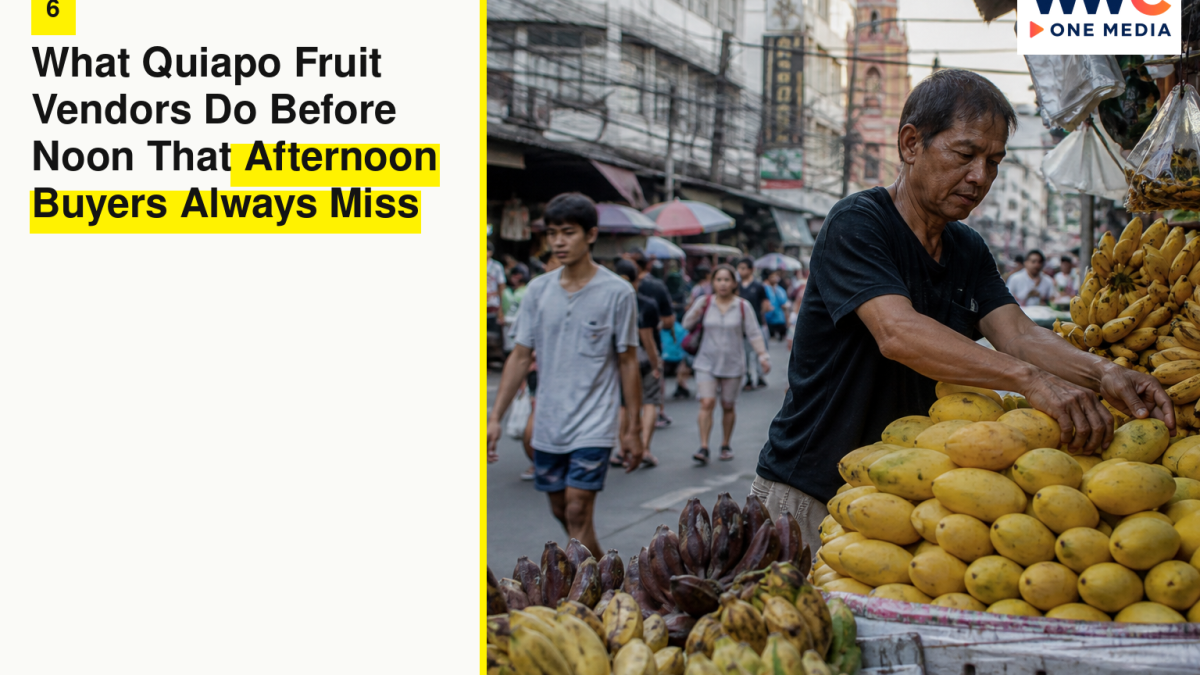
MANILA, Philippines — Quiapo fruit in the morning is a working market. In the afternoon it is often a leftover plus heat. What Quiapo fruit vendors do before noon that afternoon buyers always miss is not a secret handshake. It is crates, shade, a second layer, and a first bag that goes to people who showed up while the LRT still sounded like a commute and not like a punishment. Under the line, along the streets that feed toward the church, fruit still has a future before noon. After that, Manila heat becomes a second vendor.
Afternoon buyers can still eat. They should look harder. A boarding-house counter in a room off Recto is not a chiller. A plastic bag on a jeepney floor is not a cold chain. Mango season and lanzones season will colour the stalls — the smell, the pile, the way a vendor keeps one crate back — without this desk inventing a price or a ranking of named stalls as if a committee had voted. The work is earlier than your lunch break. The miss is later, when the display is still pretty and the fruit is already tired.
Six early-day moves. They have names because unnamed advice is how you go home with a beautiful banana that will not survive the walk to Carriedo. Read them as a morning errand if you can. If you cannot, read them as the inspection list afternoon buyers were never handed.
1. The dawn crate sort under the LRT that Quiapo fruit vendors finish before noon
Before noon in Quiapo starts earlier than people who work in Makati want to admit. Vendors sort crates when the light is still useful and the under-LRT shade is still shade, not a trapped oven. What looks like a finished stall at 11 a.m. is often the second arrangement of the day. The first arrangement was for the people who buy to resell, to stock a small cart, to fill a household that will actually eat fruit today. You missed that if you arrived after a meeting.
The crate sort is physical. Firm with firm. Ripe-today in a shallow tray that will move. Ripe-tomorrow in a deeper crate that still gets air. Damage in a bag that will be sold as “for shake” or eaten by the stall, not hidden under a glossy top forever. Afternoon buyers always miss this because by afternoon the sort has been disturbed by a hundred hands. The tray is a remix. The remix is not always a lie. It is a different product.
Stand where you can see the side of a crate, not only the face toward the pedestrian flow coming off the station. Under the LRT the face is theatre. The side is inventory. If a vendor is still lifting from a crate on the ground, you are closer to the morning product. If everything is already a pyramid, you are closer to the brochure. Pyramids happen before noon too. The tell is whether anyone is still sorting or whether the stall has switched to defence.
What not to do: photograph the pyramid and leave. The fruit does not get riper because you documented it. If you are only passing through Quiapo toward the church or toward a jeep, buy what you will eat before the day ends, or do not buy. The dawn crate sort is a gift to people who will be home before the fruit sits in a bag through a 3 p.m. crawl.
Mango season makes the sort louder. You will smell it before you see which crate is for today. Lanzones season makes it quieter and more about clusters that still look intact. Neither season is a price list in this piece. Both seasons are why the morning sort matters more, not less. Heat plus sugar is a clock.
2. The second-layer flip before the display looks pretty
The top is a brochure. What Quiapo fruit vendors do before noon includes a flip you will not see unless you are there while they still have the patience to show it. A second layer in the tray is the fruit that will actually be in your bag. Morning regulars ask. They point. They wait while a hand goes under. Afternoon buyers take the top because the top is still trying to be beautiful, and beauty at 3 p.m. under the LRT is often a coat.
Ask to see a second layer. You do not need a speech. A nod at the tray and “yung baba” is enough in a stall that still wants to sell you something you will return for. If the vendor refuses every time, you have information. Move. The market is not one stall. It is a street of overlapping shade, overlapping radios, overlapping claims. This desk will not number those stalls. Numbering them would be a fake ranking. Use your hands and your nose.
The flip is also how you learn the stall’s morning honesty. Before noon, a vendor who still has pride would rather sell you a mixed bag you will finish than a pretty bag you will curse at a sink in a rented room. After noon, pride competes with the fact that the fruit is now a decaying asset on a table. You can still get a good bag. You should assume you must inspect as if the brochure is lying even when it is not.
Weight is part of the flip. Lift. A mango that is only colour is a different object from a mango that has density. A bunch that is only leaves and string is a different object from fruit. Afternoon light makes colour louder and weight easier to skip because you are tired and the crowd is a different crowd — more passing through, more church-and-errand, less wholesale muscle.
What not to do: squeeze until you have bruised the second layer yourself. Inspection is not an audition to destroy stock. If you do not know how a fruit should feel, buy a small amount, eat it today, and learn. Quiapo will still be there. Your boarding-house bin does not need a science project.
3. The regulars’ first bag — follow the auntie, not the colour
Before noon, the first bags are not for the person with the camera. They are for the person who already knows which stall they will insult if the lanzones are off. Watch who gets the bag that is packed without a performance. Follow that plastic, not the selfie. What Quiapo fruit vendors do before noon for regulars is a slightly different product: less theatre, more edible.
You will not become a regular in one visit. You can still copy the move. Stand back. See which tray a woman with a jeepney-ready tote is pointing at. See whether the vendor pulls from a crate behind the knee rather than from the pyramid. That pull is the morning economy. Afternoon buyers always miss it because by then the regulars have already gone to work, to a canteen, to a house that needed fruit on the table before the kids left.
Colour is not useless. Colour is just not a ranking. Red-green mango theatre happens in every season that can support it. Purple waxiness happens to fruit that travelled. The auntie’s bag is a better signal than a gradient. If two aunties leave without buying, that is also a signal. If a line exists that is not a tourist pause, get in it. If the line is a pause for a phone, keep walking under the LRT until the crowd looks like it came to eat.
What not to do: ask a regular to explain the market to you as if they are staff. They are buying lunch fruit. Copy with your eyes. Buy a small amount from the same pull if the vendor allows. Say thank you. Leave. Quiapo sidewalks are not a seminar.
Carriedo heat, Hidalgo spillover, the crush toward the church: geography is why the first bag matters. Fruit that has to survive a walk through that crush in the morning is already selected for a life. Fruit that has to survive it at 4 p.m. plus a transfer is selected for a shorter life. Buy accordingly.
4. The mango and lanzones split: ripe-today versus ripe-Thursday
Season is colour, not a fake price board. When mangoes are in, Quiapo smells like a decision. When lanzones are in, the stalls change shape — clusters, bags, a different kind of arguing. What vendors do before noon in those months is a split you should name out loud: fruit for today, fruit for Thursday. Afternoon buyers always miss the split because they buy as if all fruit were a souvenir.
Ripe-today is for the room you will be in tonight. A boarding house with one window. A family kitchen off a side street. A desk that will not see you until late. Eat it. Do not store it next to a laptop charger and hope. Ripe-Thursday is firmer, sometimes uglier, sometimes from a crate that is not facing the walkway. Before noon, vendors will still tell you which is which if you ask like a person who will actually wait. After noon, everything is today, because today is the only remaining marketing plan.
Do not turn this into a calendar cult. You are not required to buy green mango and wait like a project manager. If you have no fridge, there is no Thursday. There is only today. If you have a fridge that is already a tetris of leftovers, fruit that needs four days is how you discover slime on a Sunday. The split is a tool. Use it only if your kitchen can honour it.
Other fruit will sit beside the season stars. Banana, papaya, watermelon in wedges that should make you think about how you will carry juice on a jeep. The same split applies. Before noon, wedges may still have been cut this morning. Afternoon wedges are a different contract with flies, heat, and plastic wrap that has been doing its best. If you want a wedge, buy less, eat sooner, and do not take it on a long ride as if it were a sealed bottle.
What not to do: demand a season fruit as if the stall owed you a peak experience because a feed told you it was time. Seasons are uneven. A stall can have a beautiful pile and a tired pile in the same hour. The morning split is how you stay out of the tired pile without a ranking of names.
5. The ice-and-shade shuffle that afternoon heat undoes
Under the LRT, shade is a moving asset. Sun shifts. A tarp sags. A jeep blocks a breeze and then leaves. What Quiapo fruit vendors do before noon is an ice-and-shade shuffle: which tray sits on a wet crate, which pile faces the exhaust, which bag of ice is still ice. You can see it if you look at the ground, not only at the fruit. Melt patterns. A towel. A block that is still a block.
Afternoon buyers always miss the shuffle’s morning version because they meet the stall after the ice has become water and the water has become a sticky film. The fruit may still be fine. The margin of fine is thinner. Buy smaller. Skip the already-warm cut fruit. Skip the pile that has been in a sun stripe for an hour while the vendor dealt with a different customer. You can see the sun stripe. It is not mystical.
Boarding-house logic belongs here. If you must shop after work, you are not banned from Quiapo. You are banned from pretending the morning shuffle is still in effect. Take a bag that can close. Do not bury fruit under a laptop. Walk toward a jeep or the station without touring the rest of the district as if the bananas were on a holiday. Get the fruit into a room that is not the street.
If you have any choice of day, a morning with a slightly worse commute beats an afternoon with a prettier walk. Fruit is not a lifestyle backdrop. It is perishable in a city that does not forgive. The LRT overhead is shelter and also a lid. Stand there long enough after lunch and you will feel why vendors who still have pride move the best of a lot before noon.
What not to do: ask for extra ice as if the stall were a convenience store, then drip melt through a bag onto a stranger on the train. If you need ice, you needed a morning buy or a nearer stall. Quiapo can still be the trip. The trip has to end at a kitchen.
6. The price talk that happens when the lot is still whole
Before noon, price talk is about a lot that still has a future. A vendor can move volume. A regular can take a bag without turning it into a scene. Afternoon buyers always miss this because they arrive when the lot is a remainder, and remainder talk is a different sport: defensive, tired, sometimes cheaper, sometimes not cheaper at all because the remaining pieces are the ones that have to be sold as if they were still morning.
This desk will not invent a peso figure. Cardboard signs change. A number here would be fiction by next week. What does not change is the shape of the talk. Morning: you can ask for a mix, a second layer, a ripe-Thursday bag, without the vendor hearing only “discount.” Afternoon: every question sounds like a discount, even when you meant quality. If you can only come later, lead with the inspection, not with the bargain. Smell, lift, flip. Then talk.
Whole-lot timing is also why people who buy for a small household should not copy people who buy for a stall. A crate price is not your price. A bag you will finish is your price. Before noon you can still buy small without being treated as a nuisance if you are quick, clear, and not performing a tasting. After noon, small buys compete with the vendor’s need to kill off stock. That can help you. It can also load you with fruit that needed to die off.
What not to do: film a haggle. The market is a workplace under a train. People are trying to finish a morning. Your clip is not a public service. Buy or walk.
If the talk goes nowhere, there is another stall in another strip of shade. Quiapo is not a single counter. The miss is not that afternoon fruit is always bad. The miss is that the morning still had a whole lot, a sort, a shuffle, a regular’s pull, and a split between today and Thursday. You can reconstruct pieces of that with your hands. You cannot reconstruct the ice.
If you can only go after work
Then the rules compress. Smell and weight, not colour alone. Ask for the second layer anyway. Buy what you will eat in a day if it is already warm. Copy the remaining regulars if any are left — the people buying for a house, not for a feed. Skip cut fruit that has been waiting. Skip the pyramid that is only a pyramid. Take less. Eat sooner. A Manila boarding-house counter is not a chiller cabinet. A fridge that opens onto a warm room is only a delay.
Plan the walk. Church crowd, underpass, a jeep that will not move. Fruit in a thin bag will bruise because Quiapo sidewalks do not care about your ripe-today mango. Double-bag. Hold it like eggs. Do not put it under a laptop in a backpack. If you are transferring toward LRT-2 or toward a ride that will take you north, the fruit is now on a clock that includes stations. Stations are heat.
You can still win an afternoon bag. Vendors who still have pride would rather sell you something edible than argue. Meet them there. The six morning moves are the ideal. The afternoon version is a shorter list with less romance: inspect, buy small, leave, eat.
What this is not
This is not a ranking of Quiapo fruit stalls, named or numbered. This is not a quote from a vendor who did not sit down with a recorder. This is not a claim that morning fruit is always cheaper. Sometimes it is not. Morning fruit is more often still a fruit. This is not a tourist map of the church, the market, and a smoothie as a personality. It is a timing note for people who actually eat what they carry home.
Mango season and lanzones season will come and go without a statistic attached. When they are on, the stalls will tell you with smell and volume. When they are off, do not force a peak that is not there. Buy the banana. Buy the papaya. Apply the same six moves. The LRT will still be loud.
Bottom line
Quiapo before noon is when fruit still has a future. What Quiapo fruit vendors do before noon that afternoon buyers always miss is a crate sort under the LRT, a second-layer flip, a regular’s first bag, a today-versus-Thursday split, an ice-and-shade shuffle, and a price talk that happens while the lot is still whole. Afternoon is possible if you smell, lift, check the second layer, buy less, and copy the auntie, not the display. Manila heat is the silent stall. Shop like it is already on the clock.




Leave a Reply