
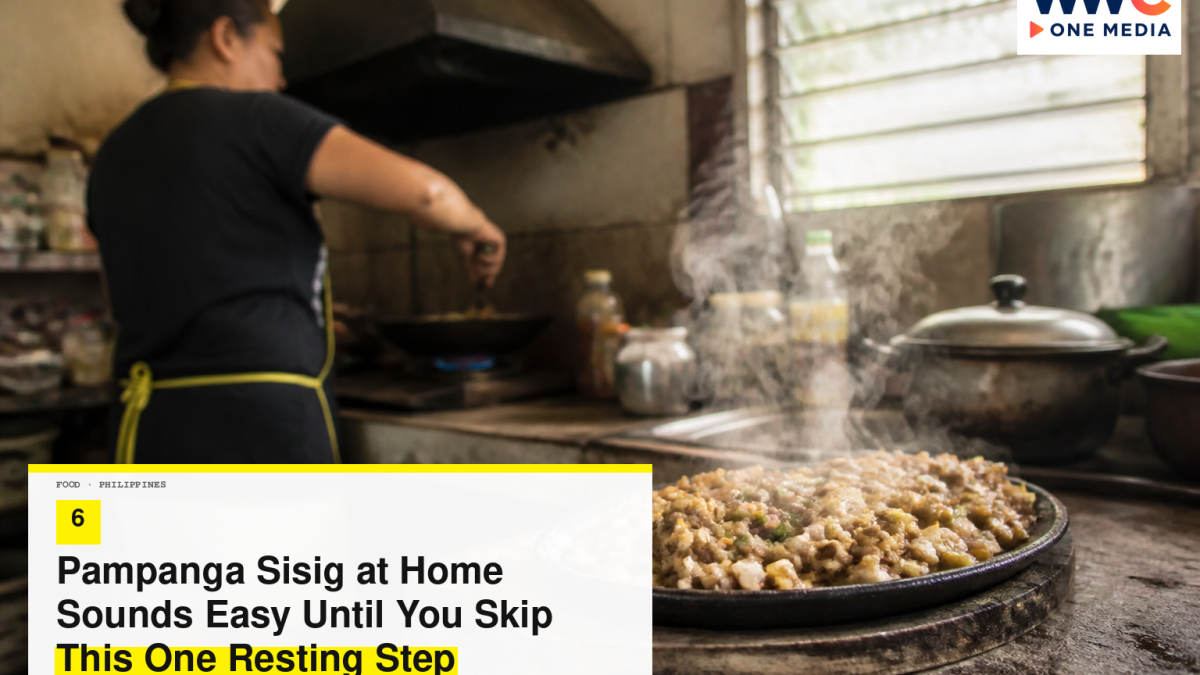
PAMPANGA, Philippines — Pampanga sisig at home sounds easy until you skip this one resting step. The dish fails in the pause, not in the chop. In an Angeles kitchen after a shift, or in a San Fernando walk-up with a sizzling plate that only comes out for guests, the meat needs time after boiling or grilling so it fries into crisp instead of steam. Skip that and you get a wet scramble that still tastes of vinegar and regret.
This is not an origin myth with a named inventor. Kapampangan cooks have argued about faces, livers, and sizzling plates longer than a newsdesk URL. What this desk can stand on is process you can do on a weeknight without a restaurant hood: cook ahead, rest until the meat will cube, chop, dry the pan, fry in batches, rest again between those batches, finish loud with onion and acid, and treat the sizzling plate as a finish, not as the cooking method. The one resting step people skip is usually the first one — the cool-down — or the one between fry batches when the pan is crowded and the cook is hungry.
Six process moves. They assume pork, because that is the plate most people mean when they say they will “just make sisig.” Chicken sisig follows the same physics with less fat. Either way, steam is the enemy. A wet board in a warm Angeles room is steam’s friend. So is a lid. So is dumping everything into a cold pan because a video made it look like one motion.
1. Cook the pig ahead, then rest until it will cube
Warm meat in a hot pan is a steam bath. The first cooking — a boil with aromatics, or a grill if you have a grill that is not a building-management problem — is not sisig yet. It is the ingredient. In a San Fernando kitchen you do this before you need dinner. Morning, if you have a morning. Before a BPO shift, if your life is inverted. The pot can sit while you work. The rest is the point.
Rest means the meat is no longer throwing steam you can see. Fridge if you have a fridge you trust. Counter if the room is not a Pampanga afternoon and you will chop soon. A plastic container without a tight lid for the first cool, so you are not trapping weather. Then a lid for the fridge. Label if the fridge is shared. Angeles housemates have eaten “the leftover” before.
You do not need a restaurant rack. You need time. If you boil and chop immediately, the cube will smear. You will call the recipe a lie. The recipe was waiting. If you grill and chop immediately, you will lose juice onto the board and then wonder why the pan is a puddle. Give it the pause. That pause is the resting step the title is about, the one that sounds optional when you are already hungry.
What not to do: leave a pot of boiled pork on a stove overnight in a warm kitchen and call it resting. Resting is a cool-down you still respect as food. If you cannot fridge it, compress the timeline and cook closer to eating, but still wait until you can cube. Food safety is not a vibe.
Chicken follows the same rule. Cook, cool, cube. Chicken will dry out if you rest it into jerky. Do not. Rest until it holds a cut. Then move. Pork is more forgiving of a longer fridge rest, which is why it fits a workday better.
2. Chop when it will hold a cube, not when it is still steaming
Mush means you were impatient, not that Pampanga sisig is impossible in a home pan. The board should see cubes and small bits, including the parts that make the dish taste like itself — a bit of fat, a bit of skin if you boiled with skin, liver if you are using liver and you actually like it. If you do not like liver, skip it without a speech. Home cooking is allowed to be the household’s plate.
Chop small enough that a sizzling plate later will still make sense, not so small that you have paste. Paste is a different dish. A Angeles night market can sell you a version that looks almost minced. Your home pan will treat paste as a steam cake. Err toward a small cube you can still see.
The board will get wet. Wipe it. Wet boards water the pan. People skip this because it feels like extra washing. It is the difference between fry and stew. A San Fernando kitchen with one board for everything should wash after the raw stage, rest the meat in a bowl, then chop on a dry board. Sequence is hygiene and texture.
If you are cooking after a shift, chop sitting down. This is not a restaurant line. A tired chop is how you leave sinew in and then hate the plate. Trim what you will not chew. You already paid for it; you do not have to perform thrift as jaw work.
What not to do: use a food processor because a video looked fast. You will get baby food, then you will drown it in mayonnaise to hide the baby food. If you want a creamy finish, that is a later choice, not a rescue for a bad chop.
3. Dry the pan, then fat, then meat — crowding is steam
The pan has to be hot and not wet. If you just washed it, dry it on the flame. Then fat. Then meat. The order is the recipe. Crowding is the second way to steam it, after skipping the rest. An Angeles home burner is not a restaurant flattop. You will do batches. Batches are not a failure of efficiency. They are how a small pan makes sisig instead of pork porridge.
Fat can be from the meat, a spoon of the rendered bits, or a neutral oil if the cut was lean. You are not deep-frying. You are giving the cubes a surface. Do not stir as if you were scrambling eggs in the first minute. Let a side take colour. Then turn. If the pan hisses in a wet way, it is too crowded or the meat was not rested. Pull some out. Finish the batch. Do not add onion yet. Onion now will die and water the pan.
A kitchen along MacArthur Highway, window open, extractor if you have one: this stage smokes. Tell the household. Turn off the alarm if yours is dramatic, then turn it back on. Do not cook under a closed hatch in a unit that will smell like a grill for two days. Neighbours in a San Fernando walk-up did not order your sisig.
What not to do: pour in vinegar at this stage to “season.” You will steam the crust you just made. Acid is late. Salt can be light now if the boil was already seasoned. Taste later. You cannot unsalt a sizzling plate.
If the meat was chicken, the pan needs even more honesty about crowding. Chicken cubes weep. Batches, heat, patience. The resting step before the chop matters more here, not less.
4. The resting step in Pampanga sisig between fry batches that people skip
This is the twin of the first rest, and the one a hungry cook skips with a spatula. Between batches, the cooked cubes need a place to sit that is not a steaming pile in a bowl with a plate on top. Spread them. A rack if you have one. A pan in a low oven if you have an oven. A wide plate in a warm Angeles kitchen if that is what you have. The point is not to cool to fridge temperature. The point is not to stew in their own steam while you fry the next handful.
Pampanga sisig at home sounds easy until this resting step disappears and every batch goes into a bowl that becomes soup. You will then dump the soup back into the pan with onion and call it a mix. It will taste like a mix. It will not eat like the plate you meant.
Use the pause. Wipe the pan if there is wet residue. Add a little fat for the next batch. Keep the heat honest. If your burner cannot recover, wait. A recovered pan is faster than a crowded pan that you fight for ten minutes.
This is also when you chop onion, chilli, and the calamansi or vinegar situation, so they are ready for the finish and not melting on the board in the steam. Mise en place is a fancy name for not being chaotic in a small kitchen. A San Fernando counter with one square of space still has room for two bowls: meat resting, aromatics waiting.
What not to do: cover the resting meat with foil “to keep it warm” and trap weather. Warm is good. Weather is not. If you must cover, tent loosely. Better: time the batches so the rest is short.
The title’s one resting step is, for most failed plates, the cool after the boil. For cooks who already cool, it is this one — the pause between fries. Honour both and the sizzling plate has something to sizzle.
5. Acid and onion near the end so they stay loud
Early onion dies. Late onion is sisig. When the meat has colour, when the batches are back in the pan just long enough to meet each other, then onion, chilli if you want heat, a sharp acid. Calamansi if you have it. Vinegar if that is the house. A little of the boiling liquid is not a substitute for acid; it is wet. Do not add it unless you are making a different, saucier plate on purpose.
Loud means you can still smell onion in the room. If the onion is brown and sweet, you added it at the fry stage and this is now a different ulam. Fine, if you meant that. If you meant sisig, keep some onion with a bite. Chop a little extra for the table. Angeles households that grew up with the plate will add more at the table anyway. Let them.
Mayonnaise, egg, butter: these are finishing arguments, not the structure. If you add them, add them off the highest heat so you do not scramble a sauce into rubber. If you skip them, you still have a plate. Do not let a comment section convince you that a home sisig without a creamy finish is inauthentic. Authenticity fights are not a resting step. They are a thread.
Taste for salt after acid. Acid changes salt. A San Fernando cook who salts early and sours late will overdo it. You have a sizzling plate coming. The plate will concentrate. Under-season a little in the pan if the plate is screaming hot.
What not to do: empty a whole bottle of seasoning sauce because the colour is not brown enough for a photo. Photos lie. Your mouth has to live in Angeles after the photo.
6. The sizzling plate is a finish, not a cooking method
The plate you heated on the stove, the cast thing that makes the sound, is theatre with a job: it drives off a last bit of wet and keeps the onion talking at the table. It is not where you cook raw meat. It is not where you skip the rests. If you dump boiled cubes onto a screaming plate and call it sisig, you have a steam show and a smoke alarm. The neighbours still did not order this.
Heat the plate while you finish the pan. Oil it lightly so the meat does not weld. Transfer. Listen. If you hear fry, you rested. If you hear a wet roar and then silence, you skipped a resting step and the plate is boiling. You can still eat it. Call it what it is. Next time, cool, chop dry, fry in batches, rest the batches, then plate.
In a home kitchen the plate is also a burn hazard on a plastic table in a rented Angeles room. Put a trivet. Tell people it is hot. Do not set it on a laptop desk. Do not walk it through a dark hallway. The sound is part of the dish. The hospital is not.
If you do not own a sizzling plate, a hot pan at the table is enough. The dish is the texture and the loud finish, not the purchase. San Fernando hardware aisles will sell you a plate when you want one. Until then, do the rests. The plate cannot rescue a wet chop.
Serve with rice. This is not a salad. A cucumber or a pickled thing on the side helps the same way acid helped Carcar lechon on a different island: fat needs a cut. Leftovers, if any, go into a pan tomorrow as a fried rice, not back onto a sizzling plate that will only dry them into sadness.
What not to do: cook the entire kilo of face or shoulder as a one-night performance for two people. Sisig is rich. Make what you will finish. The resting steps are easier on a smaller batch. Tomorrow’s leftover rice will thank you more than a second sizzle at midnight.
Angeles and San Fernando kitchens, after a shift
The process fits inverted lives. Boil in the morning. Rest in the fridge through a shift along the highway. Chop at night. Fry. Plate. If you try to do all six steps after you already hungry-angry, you will skip the rest and hate the URL that told you it was easy. It is easy only if the rest is scheduled.
A small extractor, a window toward an alley, a roommate who has to wake at dawn: cook the smoky part with courtesy. Sisig at 1 a.m. is a relationship test in a shared unit. If the test is not worth it, cook earlier. The fridge will hold the rested meat. The fridge will not hold a grudge as neatly.
Shopping is palengke or a meat stall you already use. This desk will not invent a secret cut name as if a chef had whispered it. Ask for the parts your household will chew. If face is more than you want to handle, a mix of fatty pork that can cube will still take the process. You will not get a 1:1 restaurant plate. You will get a home plate that does not steam itself to death.
What this is not
This is not a biography of a named inventor. Origin stories of sisig are a crowded genre and a good way to get a fact wrong in public. This is not a ranking of Angeles sizzling houses. Go eat them when you want the plate without the dishes. This is not a claim that mayonnaise is required or banned. This is not a statistic about how many home cooks skip the rest. Enough of them skip it that the wet scramble is a known object.
No fake quotes from a Kapampangan tita. If your tita has a rule, use hers at her table. At yours, use the rests.
Bottom line
Pampanga sisig at home is a resting step. Cool the cooked meat until it will cube, chop on a dry board, fry in a pan that is actually hot, rest the batches so they do not stew, finish with onion and acid that still have a voice, and use the sizzling plate as a finish. Skip the pause and you get steam. If you are cooking after a shift in Angeles or San Fernando, start the boil before work, rest in the fridge, fry at night. That is the whole trick, and it is not glamorous.




Leave a Reply