
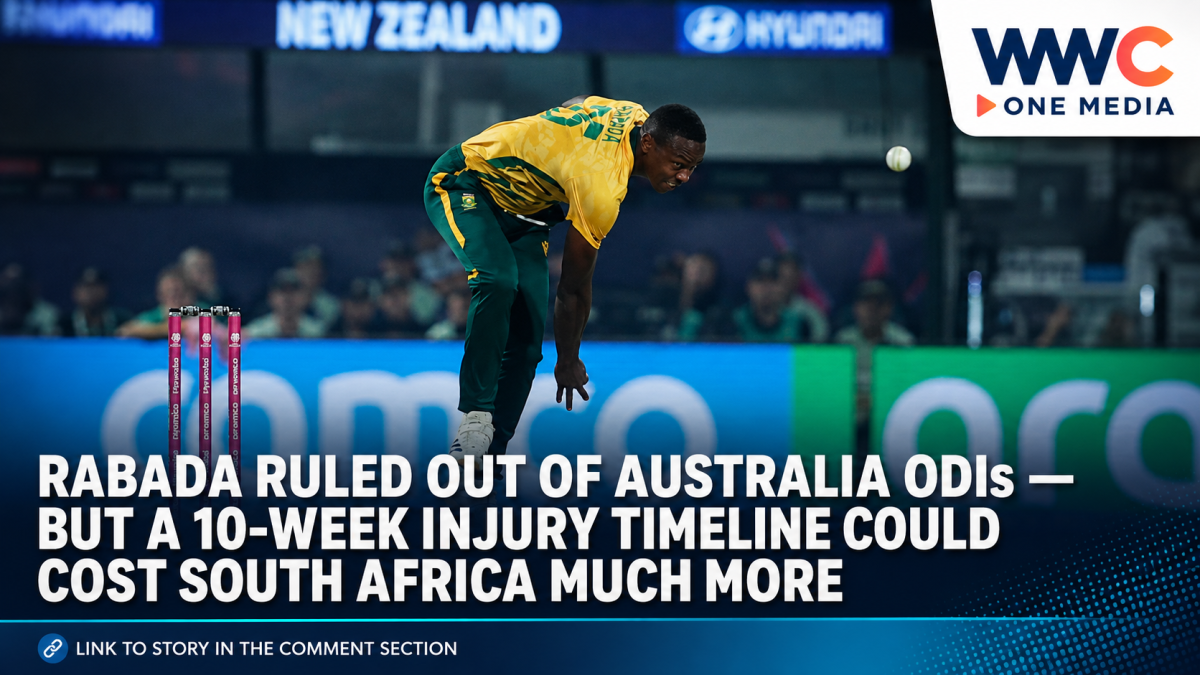
South Africa have suffered a major blow before Australia even arrive.
Pace spearhead Kagiso Rabada has been ruled out of the Proteas’ three-match ODI series against Australia in September because of a right hamstring injury — and the bigger concern is whether one of the world’s premier fast bowlers will recover in time for the far more important Test series that follows.
Cricket South Africa confirmed that Rabada will miss the ODIs, which begin in Durban on September 24, as he undergoes rehabilitation.
But while CSA has stopped short of ruling him out of the Tests, reports surrounding the severity of the injury have raised the prospect that South Africa could be without their attack leader for much longer.
Rabada’s Australia Test Series Is Now in Doubt
CSA said Rabada’s availability for the three-Test series against Australia will depend on how he progresses through rehabilitation, with selectors expected to make a decision closer to the opening Test.
That match begins in Durban on October 9, followed by Tests in Gqeberha from October 18 and Cape Town from October 27.
The official position therefore remains clear: Rabada is out of the ODIs, but he has not yet been formally ruled out of the Tests.
However, the unofficial prognosis is considerably more worrying.
Lions bowling coach and former South Africa great Allan Donald has reportedly indicated that Rabada could require nine to 10 weeks on the sidelines, with reports describing the problem as a grade-three tear of his right hamstring.
CSA itself has not publicly confirmed that grading.
If the longer recovery estimate proves accurate, the timeline would put Rabada’s participation in some — and potentially all — of the Australia Test series in serious jeopardy.
Why Losing Rabada Against Australia Would Hurt So Much
This is not simply another fast-bowler injury.
Rabada has been one of South Africa’s most effective weapons against Australia throughout his career.
The 31-year-old has taken 58 wickets in 11 Tests against Australia at an average of 21.39, an even better return than his already elite career Test bowling average of 22.03.
Across his Test career, Rabada has collected 340 wickets from 73 matches.
And Australia know better than almost anyone what he can do when the stakes are highest.
Rabada was central to South Africa’s historic victory over Australia in the 2025 ICC World Test Championship final at Lord’s, taking nine wickets in the match.
He claimed five wickets in Australia’s first innings and another four in the second as the Proteas secured the title.
That performance alone explains why his fitness ahead of Australia’s return to South Africa is about much more than simply replacing one name on a team sheet.
South Africa Do Have Fast-Bowling Options — But Replacing Rabada Is Different
The Proteas are not short of pace-bowling talent.
Marco Jansen, Lungi Ngidi and Corbin Bosch are among the leading candidates to shoulder additional responsibility if Rabada is unavailable.
South Africa can also consider options such as Gerald Coetzee, Kwena Maphaka and Dane Paterson, while SABC Sport noted that Anrich Nortje could potentially return to the Test conversation despite not playing the format since 2023.
That gives South Africa depth.
What it does not necessarily give them is another Rabada.
His ability to take wickets with the new ball, reverse an older ball, produce breakthroughs on relatively quiet surfaces and sustain pace across long Test spells makes him particularly difficult to replace.
The Timing Could Have Major World Test Championship Consequences
There is another reason South Africa will be monitoring every stage of Rabada’s recovery closely: the World Test Championship.
The defending champions face an important stretch of Test cricket that includes home series against Australia, England and Bangladesh, as well as an away assignment against Sri Lanka.
SABC Sport reported that the Proteas would need seven victories from their next 10 Tests to guarantee another place in the World Test Championship final.
That makes every home Test increasingly valuable — and Australia are hardly the opponent South Africa would choose to face without their premier strike bowler.
Australia Have Problems of Their Own
The injury does, however, arrive at a time when Australia are not entirely settled either.
Australia recently split their Test series against Bangladesh, recovering from a surprise defeat in Darwin by winning the second Test convincingly in Mackay.
Their world-class bowling attack remains formidable, but questions continue around the batting order.
Marnus Labuschagne’s form has attracted scrutiny, while Australia have continued assessing their options at the top of the order ahead of the South African tour.
That could make Rabada’s availability even more significant.
A full-strength South African pace attack operating in home conditions would have presented a severe examination for an Australian batting unit still searching for its ideal combination.
Without Rabada, that equation changes.
The Next Few Weeks Could Decide Much More Than an ODI Series
For now, South Africa know one thing for certain: Rabada will not face Australia in the three-match ODI series from September 24 to 30.
Everything after that remains less certain.
CSA is keeping the door open for a Test return and will assess him as rehabilitation progresses.
But if the reported nine-to-10-week recovery period proves accurate, South Africa may soon have to prepare for a much more uncomfortable scenario — facing Australia across three Tests without the bowler who destroyed them in last year’s World Test Championship final.
And with another World Test Championship campaign already gathering importance, Rabada’s hamstring could influence far more than three September ODIs.
It could help shape South Africa’s entire home summer.




Leave a Reply