
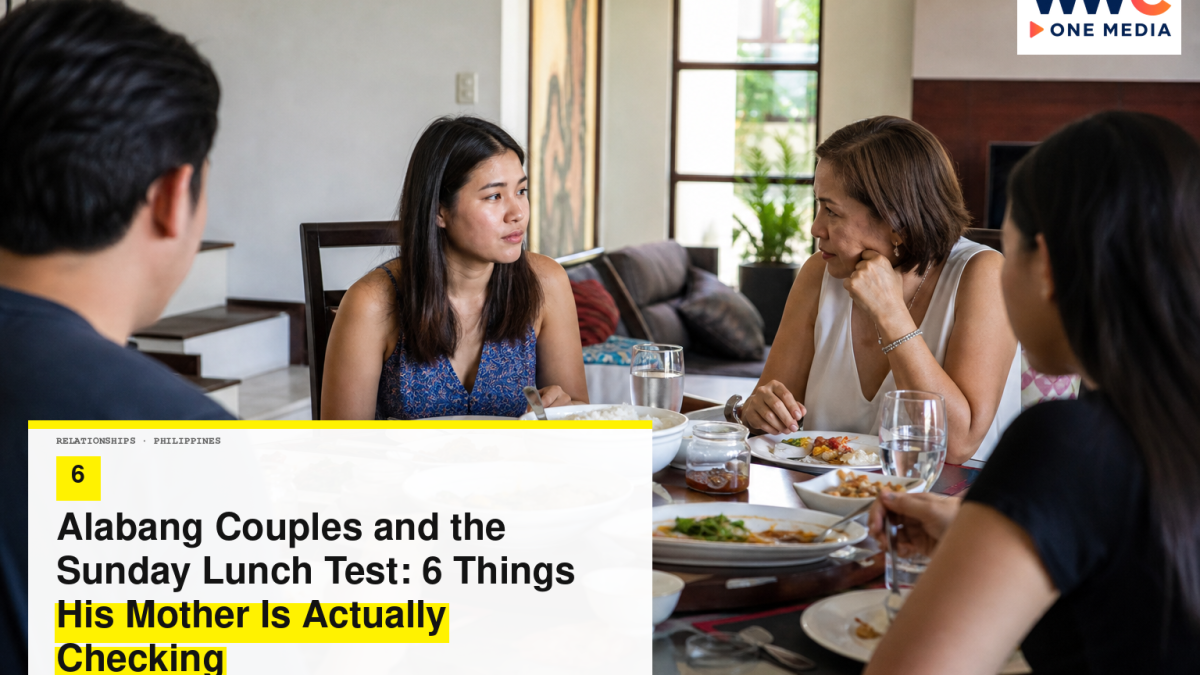
ALABANG, Philippines — Sunday lunch in Alabang is not brunch. It is not a Festival food-court date with better chairs. For Alabang couples, the Sunday lunch test starts before you even park: Sucat crawling, SLEX a lottery, the last two kilometres into a village that still wants a sticker or a name at the gate. His mother has been running this hour since before you existed in the story. Shoes off. Who you greet. Whether you wait to be told where to sit. Whether you treat the person washing glasses like furniture. Whether you can eat sinigang without turning it into a review.
She is not checking if you are pretty. Pretty she already saw in a photo. She is checking six things. Miss them and the car conversation after will be about her, not about the traffic.
The mall is ten minutes away. Westgate, Festival, Alabang Town Center, the whole south-of-EDSA stack. The house is the exam. If you thought the exam was a dinner in BGC you paid for, you have the geography wrong.
1. Shoes off, names first, and the ninety seconds that set the Sunday lunch test
The door is not a formality. In a lot of Alabang houses — Ayala Alabang village, a Filinvest interior, a Muntinlupa walk-up that still behaves like a house — shoes come off. Sometimes there is a rack. Sometimes there is a look. If you keep your sneakers on because they were expensive, you have already told the room something. If you wait to be asked, you have told them you need a script.
Greet the mother first if she is the one who opened. Then the father, if he is there and not in a recliner with the game on. Then whoever is actually in the kitchen, which may be an ate, a kasambahay, a sister home from a dorm in Taft. Names. Po and opo if that is the house. Match a warmer house after you have the temperature, not before. A hug you invent because you saw it on a series is worse than a nod that is clean.
Do not film the entry. Do not ask where to put the pasalubong while you are still standing on the mat. Hand it once, to her, not to him to “give later.” Goldilocks from the other side of the city is fine. A bag that flexes an import is a price tag. Ask him in the car what she actually uses. Guessing expensive is not safer than guessing small.
If there is a dog, ask before you pet it. If there is a helper, greet her like a person with a name, not like a feature of the unit. His mother is watching that greeting even when she pretends to be busy with the rice.
What not to do in the first ninety seconds: keep a phone in your hand, laugh at a private joke with him in English that leaves the doorway out, correct the way he said your name, or announce that you almost turned toward Festival because “this doesn’t look like the pin.” She lives here. You are the visitor.
Script for the door, short enough to keep: “Good afternoon po. Thank you for having me. These are for you.” Then shut up and take the shoes off. If someone says sit, sit. If they say wait, wait. You are not hosting.
2. The table is the interview, not the Festival date you rehearsed
Alabang couples who treat Sunday lunch like a restaurant will fail the table. You do not order. You are served, or you serve yourself when told. You take rice. You take ulam. You do not build a plate that looks like a diet. Declining everything is a problem. Declining one thing with thanks — allergy, faith, a real doctor — is usually fine if you say it once, without a lecture about macros.
Eat before you talk about your job. The first twenty minutes are the plate, the salamat, the second helping you did not have to finish but should acknowledge. People who drive down from Makati and treat lunch as a pit stop before “real” coffee at Town Center are remembered. They are not remembered kindly.
Watch how the table talks. Some Alabang families narrate. Some eat. If they eat, you eat. If an uncle asks what you do, answer in two sentences, then ask him something that is not a setup for your LinkedIn. If his mother puts food on your plate, that is not a trap. It is how a lot of houses still say you are here. You can leave a little. You cannot leave the gesture unthanked.
Phone on silent, face down, not beside the glass. A smartwatch that lights up every Slack ping is a second phone. Church may have been this morning; the blessing at the table may still happen. You sit still. You do not film it. You do not skip the moment to check a Grab.
The Festival version of you — the one who splits a pasta and talks about a BGC opening — can stay at Festival. This table has a different clock. If the ulam is leftover from yesterday, that is not a slight. Leftover is often a love language south of Sucat. If you cannot eat pork, he should have said so in the car, not at the serving spoon.
What not to do: salt before tasting, explain a Poblacion place unasked, rank their rice cooker, or say “we usually just do Ayala” as if Ayala Alabang were a punchline and not their map.
3. Who helps in the kitchen, and who treats the kitchen as staff
His mother is checking who you are after the plates move. Offer, then wait. The first minutes in a kitchen you do not know are often in the way. After the meal, when someone is clearly going to wash, stand up. Take a towel or a stack. Do not reorganise her drying rack. Do not explain how your place in Taguig does it.
If there is a kasambahay, you do not become the new manager. You also do not become the guest who never sees her. “Salamat po” with a name is better than a performance of washing every glass while she stands there unemployed in her own job. Ask him beforehand: does his mother want help, or does help from a girlfriend read as a comment on the house. Houses differ. Alabang is not one house. Ayala Alabang is not Cupang. A village interior with a helper is not a walk-up where his sister cooks.
What she is actually scoring is simpler than feminism-versus-tradition Twitter. She wants to know if you can see work. If you sit like a visitor while he becomes a son again — plate delivered, glass refilled, no standing — she files that. If you drag him to the sink as a couple stunt, she files that too. The move is: match him if he helps, initiate quietly if he forgets, stop if you are told to sit, and do not make a third offer that turns into a scene.
Do not correct a recipe. Do not photograph the spread. Do not send your group chat a plate. His family is not content. Festival food is content. This is a house.
If you are the one who cooked at home all week and now you are being served, you can still dry a plate. Unpaid kitchen hours are not a personality you import into her Sunday. They are a conversation for the car, later, with him, about whether he only knows how to be fed in this postcode.
Script at the sink: “I’ll dry po.” Then dry. If she says no, you sit without a speech. The speech is how girlfriends become a story the aunts tell in October.
4. How you talk about her son in the room, and how you do not
She is listening for whether you like him, manage him, or audition him. Correcting his story in front of her — dates, jobs, how you met — reads as a preview of the marriage. Letting him lie about a small thing and then kicking him under the table is worse. If he inflates, you can be quiet. You can also say, lightly, “that was the other weekend,” and move. You cannot hold a tribunal at her table.
Praise that sounds like a presentation is a tell. “He’s so driven” delivered to the mother who packed his baon in high school will make her tired. She knows him. She wants to know if you know him on a Tuesday. A small true thing travels further: he queued at the gate without performing, he remembered his uncle’s name, he did not make you carry the bag from the car in the heat.
Do not use the lunch to negotiate the relationship. No “we’ve been talking about moving in” unless he set that with her. No visa talk. No ring talk you invented because an aunt asked. An aunt asking is not your cue to give a keynote. Smile, defer to him, let him answer his own family. If he cannot answer, that is data for the car. It is not your rescue mission over the menudo.
Jealousy tells: if you freeze every time a female cousin speaks, she sees it. If you perform extra sweetness only when she looks, she sees that too. Alabang mothers have been to Town Center. They know a mall face.
What not to do: call him by a bedroom nickname at the table, narrate a fight you had on SLEX, or ask her to “take your side” about a job in Ortigas. She is not your barkada. She is his mother. Those are different jobs.
5. Money, work, and the Ayala flex she can smell from the gate
She is not asking for your payslip. She is reading the flex. The car you arrived in. Whether you talk about a Taguig condo as weather. Whether every story ends in a restaurant she did not choose. Whether you treat Festival as slumming and Town Center as the real mall. Alabang has money and Alabang has people who work in the malls that money walks through. Do not assume which house this is from the village name.
If she asks what you do, two facts, then a question back. If she asks where you live, a postcode and a commute, not a brand. If an uncle asks what things cost in Makati, do not turn it into a lecture on south-of-the-river living. Curiosity is etiquette. A monologue about NAIA and your “contacts” is not.
Pasalubong that flexes — imported liquor nobody asked for, a speech about the Grab fare from BGC — puts a price on the visit. Food that can be served that day is enough. If you live in QC or Pampanga, bring something ordinary and good from there. Famous and loud is the flex.
She is also checking whether you make her son pay for a lifestyle he narrates and cannot carry. If he is still on a family car, a family phone plan, a room that is clearly still his, and you talk as if you are both already a household in a Molito rental, the gap will show. You do not have to shame him. You also do not have to pretend the gap is chemistry.
Work talk: graveyard, BPO, hybrid, a clinic in Muntinlupa, a bank in Makati — all of these are normal in this corridor. Ranking jobs at her table is how you lose the corridor. If your hours collide with Sunday lunch, say so once, with a real end time, not with a vibe that you are too busy for soup.
What not to do: pay for the meal that was never a restaurant, tip the kasambahay in front of the mother as a scene, or ask who owns the house. Title is not small talk. Neither is “so when are you retiring” aimed at his father during the meat.
6. Whether you will still be here next Sunday, and the calendar underneath the lunch
The Sunday lunch test is a calendar test wearing rice. She wants to know if you are a one-time display or a person who can repeat. Church or no church. A grandmother in the other room. A sibling who might drop in from a dorm. The uncles who stay for the game. If you spend the meal looking at the clock because you booked a 3 p.m. something at Westgate, she files you as a visitor who used her house as a waypoint.
Have a real end time that is not “when it gets awkward.” A drive back before Sucat thickens. A shift tonight. A mother of your own who also eats on Sundays. Say it once, early, kindly. “We need to leave by two po, my shift starts.” That is adult. “We’ll see” and then a restless leg under the table is a child.
She is checking holidays in advance without asking. Holy Week. A birthday. Christmas Eve versus Christmas Day, which in a lot of Filipino houses is a custody schedule for grown children. You do not have to commit to a decade. You do to not mock the idea that Sundays happen every week.
If you are not that serious yet, do not fake a family-member performance. Polite, present, gone at the time you named, debrief in the car. Over-performing a daughter-in-law on lunch three is how lunch nine becomes a fight about why you “changed.” Under-performing — headphones energy, Festival energy, “I’ll wait in the car” energy — is how you never get lunch nine.
The long question she will not say out loud: will you absorb into this family’s map, or extract him to a condo and a group chat that laughs at Alabang. You do not have to pick in month two. You do have to stop talking as if Alabang were a punchline while eating her food.
Sucat traffic is already a score, so stop treating the drive as a vibe
You will be late if you treat Sucat like a rumour. Sunday late morning southbound can still jam at the usual pinches: the approach off SLEX, the Alabang exit patience test, the last stretch toward a village gate that wants a name, a sticker, sometimes both. If you are coming from QC, from Makati, from a Taguig tower that thinks south is a concept, leave earlier than your pride wants.
Build the buffer into the lunch, not into a speech when you arrive. Text her, or have him text her, when you are actually on the approach. “We hit Sucat, twenty minutes” is a sentence. “On the way” sent from a café in BGC is a different sentence. She can read maps. She has lived with this road longer than you have dated her son.
Parking: village interiors fill with relatives. Do not block a neighbour. Do not idle with music leaking. Do not honk as a greeting. If you take a Grab, pin the gate not the mall. If the driver wants Festival because that is the pin everyone uses, correct it before you are in the wrong drop-off arguing in the heat.
What not to do on the drive in: fight. SLEX is a terrible chapel. If you are already sharp with each other by Muntinlupa, you will bring that face into her hallway. Pull over at a 7-Eleven, drink water, reset. The Sunday lunch test includes the face you walked in with.
If you are the Alabang-based one fetching a partner from the north, do not punish them with a story about how easy the south is. It is not easy from Cubao. It is a Saturday of a Sunday. Budget the hours as part of the relationship, not as evidence that they “don’t try.”
The car conversation after is a couple room, not a courtroom
The car after is where Alabang couples either become a team or start a second, stupider lunch. Do not open with your review of his mother. Open with logistics: fuel, bathroom, whether you need food because you were too nervous to eat, whether he needs a minute of quiet before you talk.
Then one true thing each. What worked. Whose name you missed. What he needs to brief you on next time — the uncle who tests, the sister who cooks, the topic that is landmine this year. Whether you were too stiff at the sink. Whether he disappeared into son-mode and left you as the exhibit.
Do not text your group chat a live review from the village gate. Do not send a photo of the table. Do not screenshot a relative. His family is not content. The group chat will turn it into a roast. The roast will leak. Alabang is not as far from your group chat as your group chat thinks.
If something was actually bad — a job comment, a wedding-pressure question, a comparison to an ex who still attends church with them — you still wait until you are out of the driveway. He owns the follow-up with his people. You own the follow-up with him. If he refuses to debrief at all, that is also a result. You cannot date a man who only exists as a son from noon to four and as a boyfriend after the Shell station.
Script for the first five minutes of the car: “I’m tired, not mad. Can we do names and one thing to fix for next time, then music.” If you are mad, say mad, with one example, not a decade. Sucat will still be Sucat. You do not need to add a prosecution.
If the lunch went well, do not immediately book next Sunday as a personality. Ask him. His mother may want a repeat. He may need a week of being a person. Both can be true.
First-lunch script that fits in Notes, including what you ask him before the gate
Before you leave your place, he briefs you. If he refuses to brief you on his own family, the lunch is not the real test. Ask, and put the answers in Notes, not in your head while Festival ads play on the jeepney screen of your brain.
Ask him: shoes off or on. Who is in the house. Names and what you call them. Who cooks. Whether there is a helper and her name. Pork, spice, leftovers. Church before or not. Where you sit. How long lunch actually is. Who you greet first. What topic is dead this year — a job loss, a sibling abroad, a medical thing. What you should not wear. Parking. End time. Whether pasalubong goes to his mother or onto a table.
Ask him what he is nervous about. That answer is often the real map.
Your script, if you need one on paper:
Gate: smile, names if the guard asks, no joke about the sticker.
Door: greeting, pasalubong, shoes, phone away.
Table: rice, ulam, thanks, two-sentence job, questions back, no phone.
After: offer to help, accept no, do not stage a sink takeover.
Exit: thank her, thank the cook, thank the helper by name, do not linger in a second goodbye that becomes a new conversation you cannot finish.
Car: logistics, then one true thing each.
You will still miss something. Missing one name is human. Missing the entire briefing because you wanted the day to be “natural” is how natural becomes a story she tells his tita.
Objections Alabang couples use to skip the test, and why they fail
“We’re not that serious.” Then do not do Sunday lunch in her house. Do Festival. Do Town Center. Do a mall movie. Sunday lunch is already a family room. Walking into a family room as a maybe, then under-performing because you want an escape hatch, is how you hurt people you claimed not to be serious with. Pick the room that matches the temperature.
“His mom already likes me from Facebook.” Facebook is a highlight. The house is a body in her space, eating her food, using her bathroom, taking a tone with her son. Likes do not transfer.
“I’ll just be myself.” Yourself includes whether you can follow a house. Yourself at a Poblacion bar is not yourself at a 12:30 table in a village. Both can be you. Only one of them is being asked for today.
“She should accept me as I am.” She does not have to accept a first lunch as a forever. She has to feed you. You have to be a guest. Acceptance is a later word. Guest is the word for today.
“We already ate at Westgate so we’ll just drop by.” Drop-by after you have eaten is an insult in a lot of houses, dressed as efficiency. If you are coming, come hungry enough to be honest at the plate. If you cannot, reschedule. Do not make her food the encore.
“I’ll wait in the car, family is stressful.” Then you are not doing the Sunday lunch test. You are doing a pickup. Say that. Do not call it meeting the family.
If he is the one objecting — “don’t overthink, she’s chill” — still ask the briefing questions. Chill mothers still notice shoes. Chill is a tone, not a policy.
What not to do, in one ugly list, so you can stop improvising
Do not arrive in club clothes because you have a thing in Molito later.
Do not bring a friend “for moral support.”
Do not live-post Stories from the living room.
Do not ask to charge your phone in her bedroom.
Do not go looking for the liquor cabinet.
Do not offer to pay at a table that was never a bill.
Do not compare her cooking to his yaya’s, even as praise.
Do not say “when we have kids” unless that conversation already exists with him, in private, in daylight.
Do not disappear into a bathroom group chat.
Do not start a political argument because an uncle baited you. You can be a person with a spine next visit. First lunch is not your TED Talk.
Do not get drunk at lunch. A beer if they offer and he is having one, maybe. A performance of being fun is how fun becomes a story.
Do not overstay because leaving feels rude. Leaving at the time you named is polite. Overstaying while checking Westgate crowd levels is rude.
Do not fight with him in her kitchen.
Do not kiss him long in her hallway.
Do not call her Mom on lunch one.
That list is not morality. It is the set of unforced errors Alabang couples keep walking into because they thought the test was chemistry.
If you are the Alabang son, this is also your test. Brief her. Brief your girlfriend. Do not make them improvise each other. Tell your mother a true version: how long you have been together, whether this is a first meeting, when you need to leave. Tell your girlfriend the names, the landmines, the shoes, the helper, the uncle. Stay a person at the table. If you vanish into the game on TV and leave her with your aunts, you did not bring a partner. You brought a guest and abandoned her.
If your mother is sharp, you do not fix that by whispering “don’t mind her” as if your girlfriend were a child. You sit beside her. You change the topic. You own the follow-up later. You do not outsource courage to a woman who just took her shoes off in a house she does not know.
If you are ashamed of the house — too small, too much helper, too village, not village enough — that shame will leak. Festival cannot launder it. Deal with the shame before Sunday, or do not do Sunday yet.
The car conversation after is yours to open if she is tired. Do not demand a grade. Ask what she needs next time. Then listen without defending your entire childhood.
Bottom line
Alabang couples treat Festival like the city and Sunday lunch like a cameo. His mother is actually checking six things: shoes and the first ninety seconds, the table as interview, who helps in the kitchen, how you talk about her son in the room, the money-and-Ayala flex, and whether you can repeat a Sunday. Sucat will try to make you late and sharp. The car after is a couple room, not a group chat. Brief, eat, help, leave when you said, debrief without a roast. The mall is ten minutes away. The house is still the exam.




Leave a Reply