
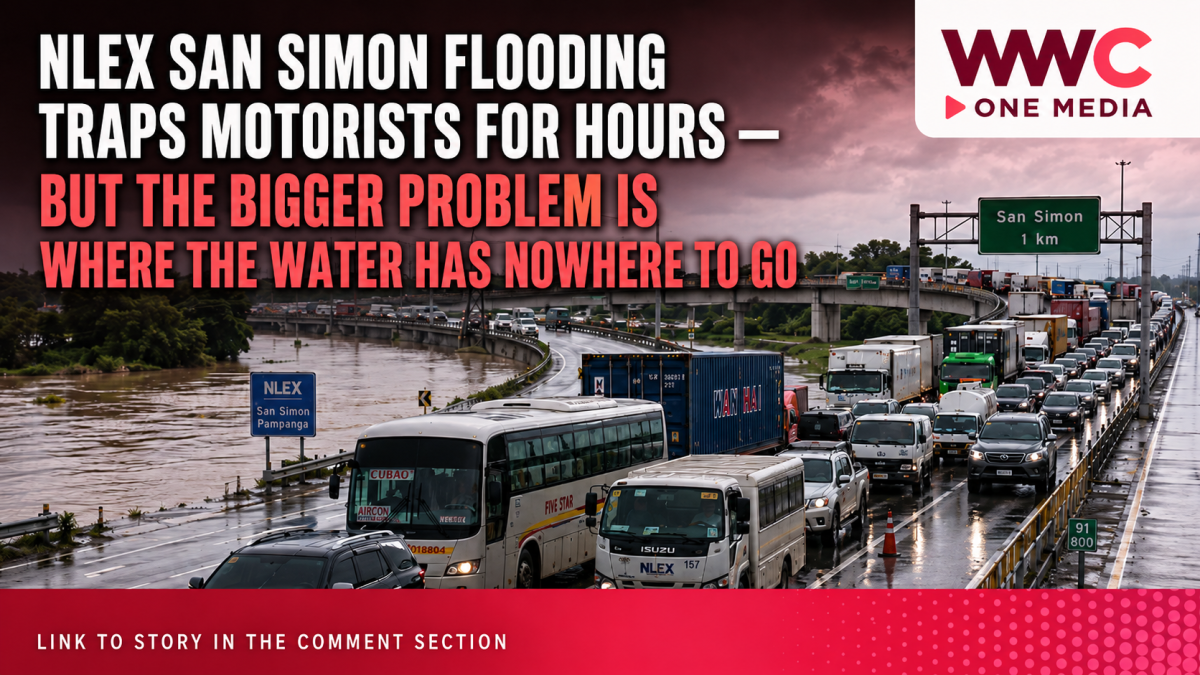
PAMPANGA, Philippines — Motorists heading through the North Luzon Expressway faced another punishing commute Tuesday morning as rising floodwaters around San Simon, Pampanga forced traffic diversions, closed several entry points and left long lines of cars, buses and cargo trucks crawling toward northern Luzon.
The disruption centered on the San Simon Interchange and Tulaoc section of NLEX, where floodwater linked to the rising Pampanga River continued to spill into portions of the expressway after days of heavy monsoon rains.
By 9 a.m. on September 1, NLEX Corporation was diverting Class 1 vehicles traveling northbound to the Balagtas Exit, directing them through Maharlika Road and toward the Central Luzon Link Expressway, or CLLEX. The Balagtas northbound entry was temporarily closed to Class 1 vehicles, while Sta. Rita and Pulilan northbound entries were temporarily closed to all vehicle classes.
The diversions quickly created queues that included delivery trucks and provincial buses. Some drivers told GMA News they had already spent hours in traffic, while other motorists parked and waited in hopes that conditions would improve. Travelers heading as far north as Cagayan were warned to expect considerably longer journeys.
Floodwater is hitting both directions
The traffic problem was not limited to northbound motorists.
An NLEX advisory reported by The Philippine Star at around 8:20 a.m. showed heavy traffic and water buildup in Tulaoc and the San Simon Interchange in both directions.
At Tulaoc northbound, Lane 1 was passable to all vehicle classes while Lane 2 was limited to Class 2 and Class 3 vehicles. At the San Simon Interchange northbound, Class 1 vehicles could not pass through the available lane.
Southbound motorists also faced heavy congestion through Tulaoc and San Simon, although sections closer to Metro Manila—including Balintawak, Valenzuela and Meycauayan—were reporting relatively light traffic at the time.
Conditions have been changing rapidly as water levels fluctuate, meaning individual lane restrictions and entry closures can change from one NLEX advisory to the next.
A nightmare that began before Tuesday
Tuesday’s traffic crisis was the continuation of an ordeal that had already stranded motorists for hours over the weekend and on Monday.
GMA reported that some travelers had been stuck from around midnight, with others taking as long as six hours to get through the flooded section. Another report said the congestion at one point stretched for around 10 kilometers.
Separate Philippine Star reporting described a roughly seven-kilometer traffic buildup, with what would normally be around a 40-minute trip taking some motorists as long as five hours.
The problem is particularly serious because NLEX is the principal expressway linking Metro Manila with Bulacan, Pampanga and much of northern Luzon. When a critical section becomes restricted, the impact spreads quickly to passenger vehicles, provincial buses, logistics fleets and cargo traffic.
And the obvious alternative roads have not necessarily provided an easy escape.
MPTC said MacArthur Highway was also heavily flooded in places, leaving travelers with limited options outside the expressway.
Why can’t NLEX simply pump the water out?
The answer appears to be more complicated than drainage inside the expressway itself.
The flooding has engulfed much of the surrounding municipality. The Office of Civil Defense was cited by The Philippine Star as reporting that roughly 95 percent of San Simon had been submerged.
Pampanga Governor Lilia Pineda has explained that floodwaters are struggling to drain downstream, creating backflow as already flooded communities and waterways become overwhelmed.
Public Works Secretary Vince Dizon similarly attributed the situation to the enormous volume of water generated by the prolonged Habagat rains, saying that simply adding pumps would not solve the problem while water continues flowing back into the same area.
That helps explain why motorists are seeing water on an elevated toll road in the first place: the crisis extends beyond the NLEX drainage system and into the broader Pampanga River basin and surrounding flooded communities.
NLEX rolls out emergency flood barriers
Metro Pacific Tollways Corporation, which operates NLEX, has apologized to motorists and announced a series of emergency measures.
The company plans to deploy temporary concrete flood barriers along roughly 300 meters of both the northbound and southbound carriageways in the Tulaoc area. Siphoning trucks and additional pumping equipment are also being used, while a counterflow lane is being provided for emergency and response vehicles.
But MPTC itself acknowledges that pumping has limitations while floodwater continues entering the expressway from surrounding areas.
For the longer term, the company says it plans to further raise portions of the NLEX pavement in Tulaoc.
The road there has already been elevated by about 0.7 meter, according to MPTC. Another round of raising, however, is linked to plans to elevate the Tulaoc Bridge sufficiently to maintain the required vertical clearance, with engineering assessments still needed.
That makes the latest flooding more than just another traffic advisory.
A similar major flooding problem hit the San Simon section in 2023, after which portions of the road were raised. The return of severe flooding is now renewing questions about whether piecemeal road elevation can keep pace with the increasingly difficult drainage problem surrounding one of Central Luzon’s most important transport corridors.
More rain remains a concern
The weather is another variable motorists cannot ignore.
PAGASA said the Southwest Monsoon would continue bringing rain to Pampanga and other parts of Luzon on September 1. Tropical Depression Pilandok remained far east of extreme Northern Luzon and was considered unlikely to make landfall, but prevailing weather conditions were still expected to keep parts of Luzon wet.
That means the crucial question for NLEX users is no longer simply how quickly traffic can be cleared.
It is whether Pampanga River levels and surrounding floodwaters can fall fast enough to prevent another round of restrictions—and whether the engineering fixes now being deployed can stop San Simon from becoming the same bottleneck the next time prolonged monsoon rain hits Central Luzon.

Leave a Reply