
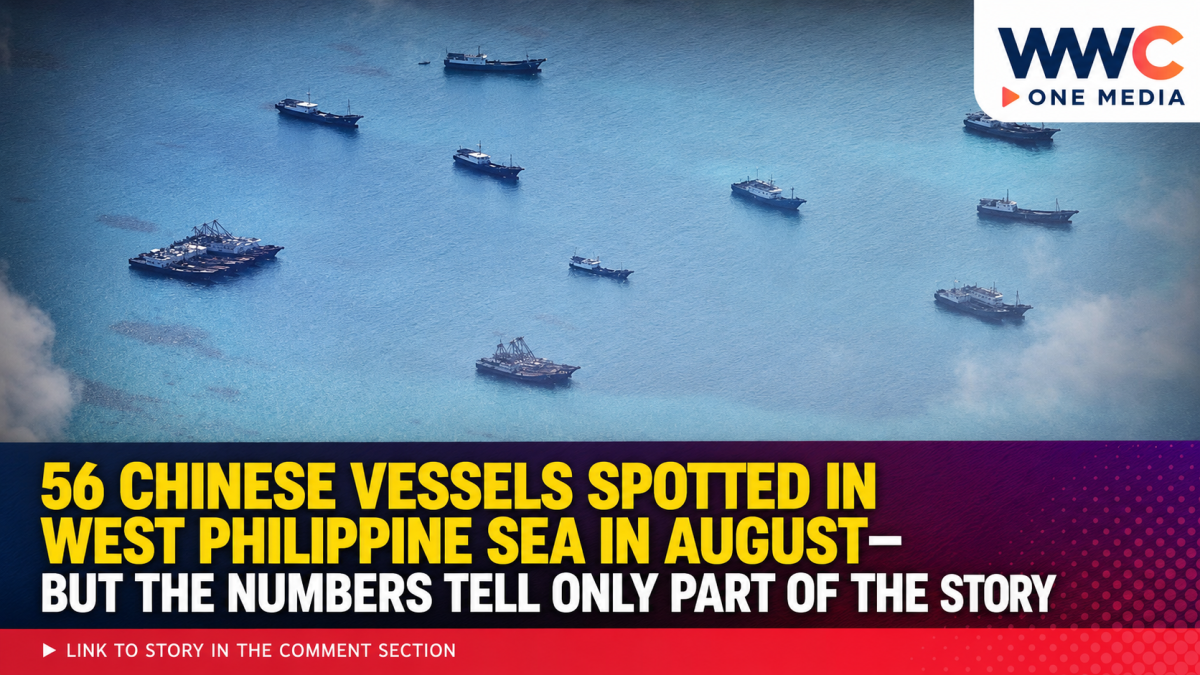
MANILA, Philippines — The presence of Chinese vessels in the West Philippine Sea increased in August, with the Armed Forces of the Philippines (AFP) monitoring 56 Chinese naval and coast guard vessels during the month.
The figure represents an increase from the 48 Chinese vessels recorded in July, highlighting the continued presence of Chinese maritime forces around key Philippine-claimed features in the West Philippine Sea.
The latest AFP monitoring covers Chinese vessels from the People’s Liberation Army Navy (PLAN) and the China Coast Guard (CCG). The vessels were observed operating around strategic areas including Ayungin Shoal, Bajo de Masinloc, Escoda Shoal and Pag-asa Island.
The increase comes amid continuing tensions between Manila and Beijing over activities in the disputed South China Sea.
From 48 vessels in July to 56 in August
AFP data released earlier in August showed that 48 Chinese vessels were monitored across four West Philippine Sea features during July.
Of those, 14 were recorded around Ayungin Shoal, 22 around Bajo de Masinloc, four around Escoda Shoal and eight near Pag-asa Island. The July total was already lower than the 74 Chinese vessels monitored in June.
But activity continued throughout August.
The AFP reported that 18 Chinese vessels were monitored from August 4 to 10, followed by 23 vessels from August 11 to 17. During the following week, from August 18 to 24, another 16 Chinese vessels were monitored.
These weekly figures show that Chinese maritime activity remained persistent even as the number of vessels fluctuated from week to week.
Most of the recent activity involved the China Coast Guard
Recent AFP monitoring indicates that the China Coast Guard has played a particularly prominent role in the West Philippine Sea.
From August 18 to 24, for example, the AFP recorded 11 China Coast Guard vessels at Ayungin Shoal, four at Bajo de Masinloc and one at Pag-asa Island. No Chinese vessel was recorded at Escoda Shoal during that particular week.
The AFP has also previously reported a broader shift in Chinese maritime activity.
In August, AFP and Philippine Coast Guard officials said the number of Chinese Coast Guard and research and survey vessels had increased during the first half of 2026 compared with the same period in 2025, even as the number of maritime militia and PLAN vessels had declined.
The AFP has described China’s activities using the term “illegal, coercive, aggressive and deceptive” (ICAD), saying such activities challenge Philippine sovereign rights and jurisdiction within the country’s maritime domain.
Tensions continue around key Philippine maritime features
The rising vessel count comes after a series of confrontations and maritime incidents involving Philippine and Chinese forces.
In July, tensions escalated around Ayungin Shoal, where the AFP reported a confrontation involving China Coast Guard personnel and Philippine Navy personnel.
There have also been continuing encounters around Bajo de Masinloc, where Philippine authorities have monitored Chinese vessels and other structures.
The Philippine Coast Guard has separately reported continued monitoring of Chinese activity around Bajo de Masinloc, including floating buoys and other objects in the area.
The developments have prompted Manila to continue diplomatic and security responses.
The National Maritime Council said the Philippines filed 27 diplomatic protests against China during the first semester of 2026, citing what Philippine authorities described as Chinese ICAD activities in the West Philippine Sea.
Philippines maintains position on international law
The Philippines continues to invoke the 2016 arbitral ruling in its dispute with China.
The Permanent Court of Arbitration tribunal in The Hague ruled in 2016 that China’s expansive claims to historic rights within the so-called nine-dash line were incompatible with the maritime entitlements provided under international law.
China has rejected the ruling and continues to assert its claims over much of the South China Sea.
For Manila, the ruling remains a key legal basis for asserting Philippine maritime rights in areas covered by the country’s exclusive economic zone.
President Ferdinand Marcos Jr. has also maintained that arrangements intended to prevent confrontations during Philippine rotation and resupply missions to the BRP Sierra Madre do not amount to surrendering Philippine sovereign rights or territorial claims.
Why the 56-vessel figure matters
The August figure does not, by itself, mean that 56 Chinese vessels were simultaneously operating in the West Philippine Sea.
Rather, it represents vessels monitored over the course of the month, meaning individual ships may have moved in and out of the monitored areas.
Still, the increase from July’s 48 vessels demonstrates that Chinese maritime presence remained substantial during August.
And while the number of vessels is an important indicator, Philippine officials have increasingly focused on what types of ships are being deployed, where they are operating and what activities they are conducting.
That distinction is significant because a larger presence of China Coast Guard vessels can create sustained pressure without necessarily involving conventional naval forces.
For the Philippines, the challenge now goes beyond simply counting ships.
The bigger question is what those vessels will be doing in the months ahead—and whether the increased presence becomes the new normal in the West Philippine Sea.




Leave a Reply