
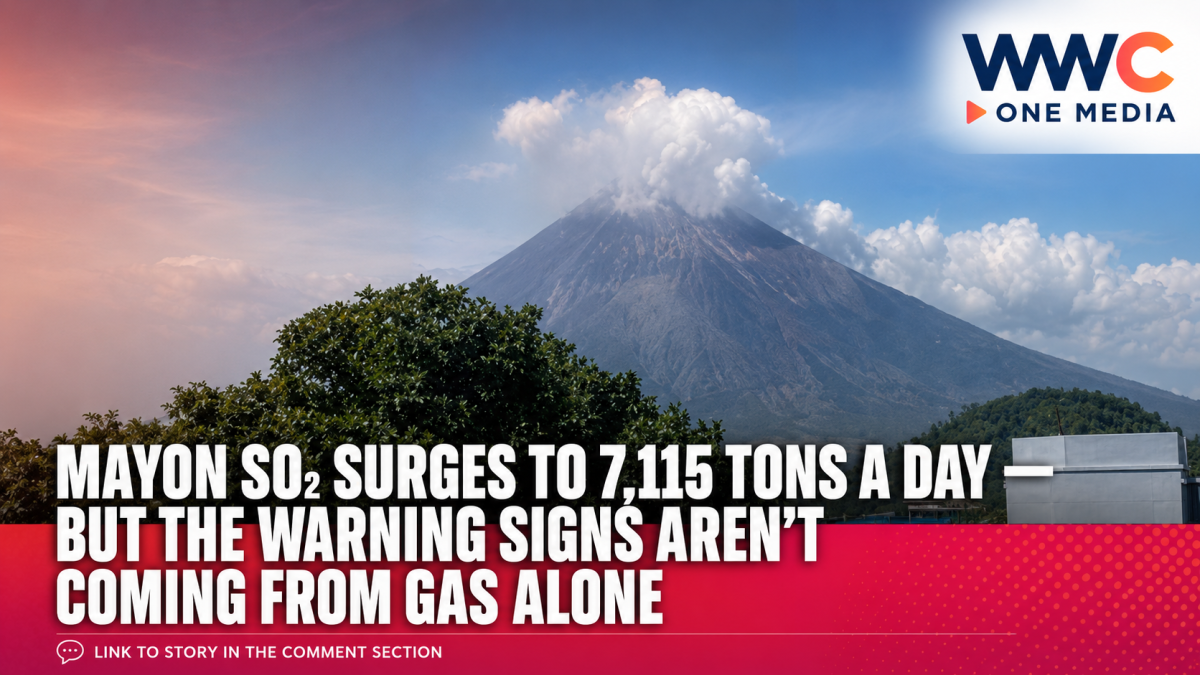
LEGAZPI CITY, Albay — Mayon Volcano is showing another combination of warning signals just weeks after authorities lowered its alert status, with sulfur dioxide emissions surging to 7,115 tonnes per day and instruments detecting renewed signs of pressure beneath parts of the volcano.
The Philippine Institute of Volcanology and Seismology said the Aug. 31 measurement was the second-highest sulfur dioxide emission recorded since Mayon’s volcanic gas concentrations began declining on July 16. It was also roughly 85 percent higher than the 3,844-tonne daily average recorded since Mayon was downgraded to Alert Level 2 on Aug. 5.
The number alone does not mean that a major eruption is about to happen. But scientists are paying attention because the gas spike is occurring alongside other changes inside one of the Philippines’ most active volcanoes.
PHIVOLCS recorded 12 low-frequency volcanic earthquakes, or LFVQs, as of midnight Sept. 1. These earthquakes are associated with volcanic degassing. At the same time, electronic tilt instruments detected a short-term trend of swelling or pressurization in Mayon’s northern and eastern sectors. Real-time seismic energy release, however, remained at background levels — an important sign that the monitoring data are not yet pointing uniformly toward a major escalation.
That distinction matters. PHIVOLCS is not saying that an eruption is certain or imminent. Its warning is more measured: elevated sulfur dioxide emissions could signal a potential shift toward renewed eruptive activity at the summit crater.
Mayon has already produced several warning episodes
The latest surge is not an isolated development.
On Aug. 17, Mayon emitted an even higher 8,393 tonnes of sulfur dioxide per day, then the highest reading recorded since gas concentrations began falling in mid-July. PHIVOLCS also detected swelling in the volcano’s northern and eastern sectors at the time.
And earlier in the year, the numbers climbed far higher.
On July 11, sulfur dioxide emissions soared to 13,128 tonnes per day, which PHIVOLCS described as Mayon’s highest SO₂ emission in 26 years and only slightly below levels measured during the volcano’s explosive activity in 2000. At the time, 97 low-frequency volcanic earthquakes and 304 rockfall events were also recorded.
More recently, Mayon has also produced intermittent ash emissions and weak explosions. On Aug. 26, an ash event sent a gray plume as high as 1,500 meters, while a weak ash explosion on Aug. 27 generated a roughly 500-meter plume. Another ash emission on Aug. 28 produced a 150-meter plume. Alert Level 2 remained in effect throughout those events.
Why Mayon is still under Alert Level 2
Mayon entered its current eruptive episode on Jan. 6, 2026, when new lava extrusion, rockfalls and pyroclastic density currents prompted PHIVOLCS to raise the volcano to Alert Level 3. PHIVOLCS’ eruption database lists the Jan. 6 activity as the beginning of Mayon’s ongoing 2026 eruption.
After months of lava effusion, rockfalls and PDCs, activity generally declined from late July. PHIVOLCS consequently lowered the volcano from Alert Level 3 to Alert Level 2 on Aug. 5, citing reductions in eruptive activity, volcanic earthquakes and other monitoring parameters.
But Alert Level 2 does not mean Mayon has returned to normal.
The Sept. 1 PHIVOLCS bulletin still reports an inflated volcanic edifice, 12 volcanic earthquakes and the 7,115-tonne sulfur dioxide reading. The agency continues to prohibit entry into Mayon’s six-kilometer-radius Permanent Danger Zone.
What happens if activity escalates?
PHIVOLCS warned that a renewed eruptive phase could produce pyroclastic density currents or “uson,” rockfalls, ballistic fragments and extensive ashfall. Communities inside predetermined PDC hazard zones have been told to remain prepared in case conditions require the alert status to be raised again to Alert Level 3.
Heavy rain creates another danger. Loose volcanic material deposited around Mayon can be remobilized into lahars and sediment-heavy streamflows, particularly along river channels draining the volcano.
Pilots are likewise being told to stay away from Mayon’s summit because sudden ash emissions and ballistic fragments can pose serious hazards to aircraft.
For residents of Albay, the key question is therefore not whether one unusually high sulfur dioxide measurement guarantees another eruption — it does not.
The bigger question is whether the gas surge, continuing ground inflation, recent ash events and low-frequency earthquakes will begin moving together strongly enough for PHIVOLCS to conclude that Mayon is entering a new phase of eruptive unrest.
For now, Alert Level 2 remains in effect, but Mayon is far from quiet.




Leave a Reply