
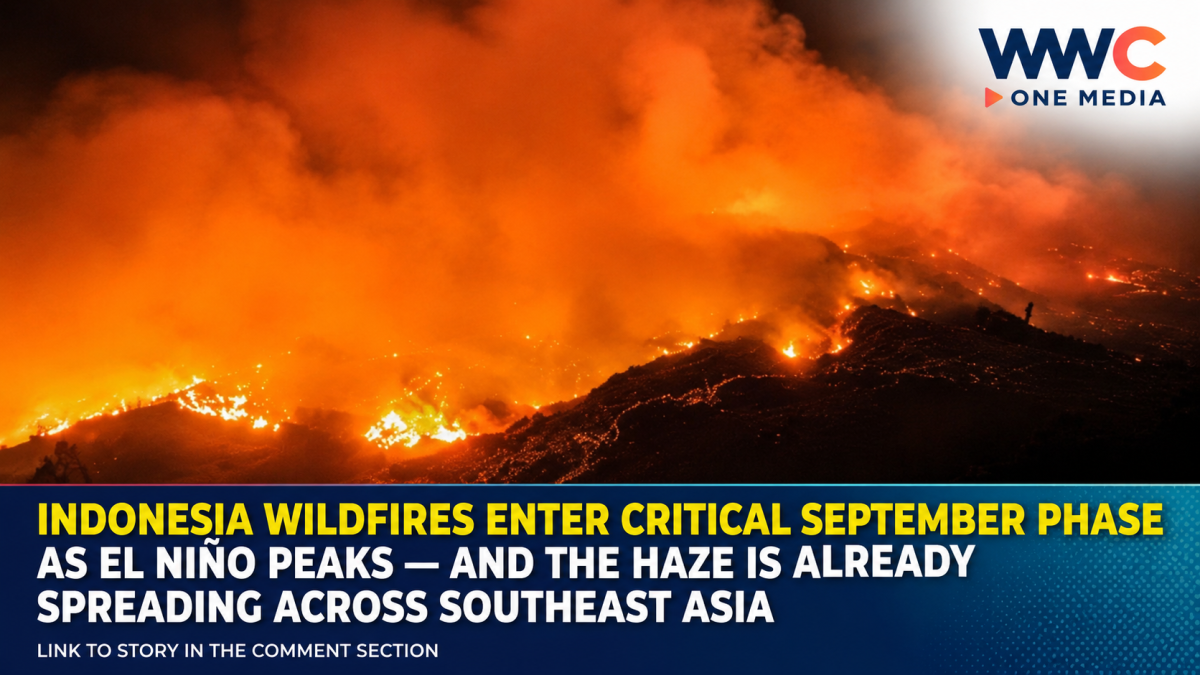
JAKARTA — Indonesia is entering what officials describe as the most critical phase of its 2026 wildfire crisis, with Forestry Minister Raja Juli Antoni warning that September will be the main battle as a powerful El Niño event reaches its peak.
Despite a reduction in fire hotspots across parts of Sumatra and Kalimantan toward the end of August, authorities are warning that the crisis is far from over.
“Our problems are not over. September is the peak of El Niño,” Raja Juli said Tuesday. “September is the main fight for us.”
The warning comes as forest and land fires continue to generate thick smoke across parts of Indonesia, while haze has crossed national borders and affected Malaysia, Singapore and the Philippines.
More than 200,000 hectares burned
Indonesia’s Forestry Ministry estimates that approximately 202,000 hectares of land were burned between January and July, a sharp increase from 107,465 hectares recorded through June.
Reuters reported that nearly 95,000 hectares were burned in July alone, showing how rapidly the situation deteriorated as the dry season intensified.
The scale of the fires is particularly concerning in Borneo, where extensive peatlands can remain smouldering underground and reignite even after surface flames appear to have been extinguished.
Experts say El Niño is not itself setting the fires. Instead, the climate pattern brings hotter and drier conditions that can turn vegetation and peatlands into highly combustible fuel, allowing fires to spread faster and making suppression more difficult.
Indonesia says many fires are man-made
Raja Juli has described a significant portion of the fires as being deliberately started by individuals or companies, particularly for land-clearing and agricultural activities.
Indonesia has strengthened enforcement against illegal burning, but authorities continue to face difficulties in preventing fires in remote and fire-prone areas.
The government has identified 42 company concessions considered at high risk of wildfires. Reuters reported that fires covering about 11,047 hectares were identified within concessions connected to 19 companies currently being inspected.
The forestry ministry has also begun legal proceedings in dozens of fire-related cases, while six forestry permit holders have already faced sanctions, according to Indonesian authorities.
Firefighting operation expands
Indonesia is deploying a combination of ground teams, aircraft, water bombing and weather-modification operations to slow the spread of the fires.
Reuters reported that authorities had deployed 34 aircraft for water-bombing operations, although thick smoke, poor visibility and limited access to water have complicated aerial firefighting.
Indonesia has also used cloud seeding to encourage rainfall over fire-affected areas.
But experts caution that cloud seeding is not a guaranteed solution. The technique requires suitable clouds and atmospheric conditions and cannot simply create rain when the atmosphere is too dry.
CNA reported that Indonesia has substantially expanded its weather-modification operations, while researchers and environmental groups continue to stress that prevention, peatland protection and stopping illegal land clearing are essential to addressing the underlying problem.
Health impact is growing
The wildfire crisis is no longer only an environmental story.
Indonesia’s Health Ministry said more than 50,000 cases of acute respiratory infection were recorded across seven provinces between July and August.
Officials warned that smoke can affect communities far from the actual fires because prevailing winds can transport haze across provincial and national borders.
Thousands of students in affected areas have also been shifted to online learning as air quality deteriorates.
The consequences are extending to wildlife as well. Reuters reported that an orangutan rescued near a fire zone in West Kalimantan suffered hypoxia after being exposed to heavy smoke. Wildlife rescuers said seven orangutans had been rescued because of the fires.
Malaysia faces hazardous haze
The smoke has already created a serious air-quality problem across the border in Malaysia.
On Tuesday, six areas in Sarawak recorded hazardous Air Pollutant Index readings above 300, according to Malaysia’s Bernama. Serian recorded 408, while Kuching reached 407.
Al Jazeera reported that hazardous air conditions affected multiple parts of Malaysian Borneo, with Kuching’s index reaching 407 and Serian reaching 408. The haze has also affected parts of peninsular Malaysia, Brunei and Singapore.
Sarawak authorities are considering cloud-seeding operations in an attempt to improve conditions, although officials have stressed that the technique depends on suitable cloud formations.
Indonesia haze reaches the Philippines
The regional impact has now reached the Philippines.
On September 1, several Metro Manila monitoring stations recorded acutely unhealthy PM2.5 levels, with readings including 296 in Parañaque, 241 in Quezon City and 237 in Las Piñas during the morning monitoring period.
The Philippine Department of Health urged residents in affected areas to reduce prolonged outdoor exposure and use N95 masks when going outside.
Quezon City also suspended in-person classes in public schools amid deteriorating air quality, while city officials linked the pollution to haze potentially carried from fires in Kalimantan, Indonesia.
Philippine authorities say weather and wind patterns will play an important role in determining how long the haze remains over the country.
The September test
Indonesia’s immediate objective is to prevent the current wildfire season from developing into another disaster on the scale of the country’s worst previous fire seasons.
The comparison with 2015, when Indonesia experienced devastating fires during a major El Niño event and severe transboundary haze affected Southeast Asia, is increasingly difficult to ignore.
Reuters reported that Indonesian fire hotspots exceeded 9,000 in August 2026, above the 5,077 recorded in August 2015, although the current situation has not yet reached the historic peak of 17,302 hotspots recorded in October 2015.
The Singapore Institute of International Affairs had already warned in June that Southeast Asia faced a high risk of severe transboundary haze during the second half of 2026, with conditions expected to be particularly challenging around August and September.
For Indonesia, however, the message from the government is now clear: the crisis has not passed.
Hotspots may have declined in some areas, but with El Niño reaching its expected peak in September, authorities face another critical test — preventing existing fires from spreading, stopping new fires from being started and keeping toxic smoke from moving across borders.
And as haze continues to travel beyond Indonesia, the consequences of the country’s wildfire season are increasingly being felt by millions of people across Southeast Asia.
WWC ONE MEDIA MJE



Leave a Reply