
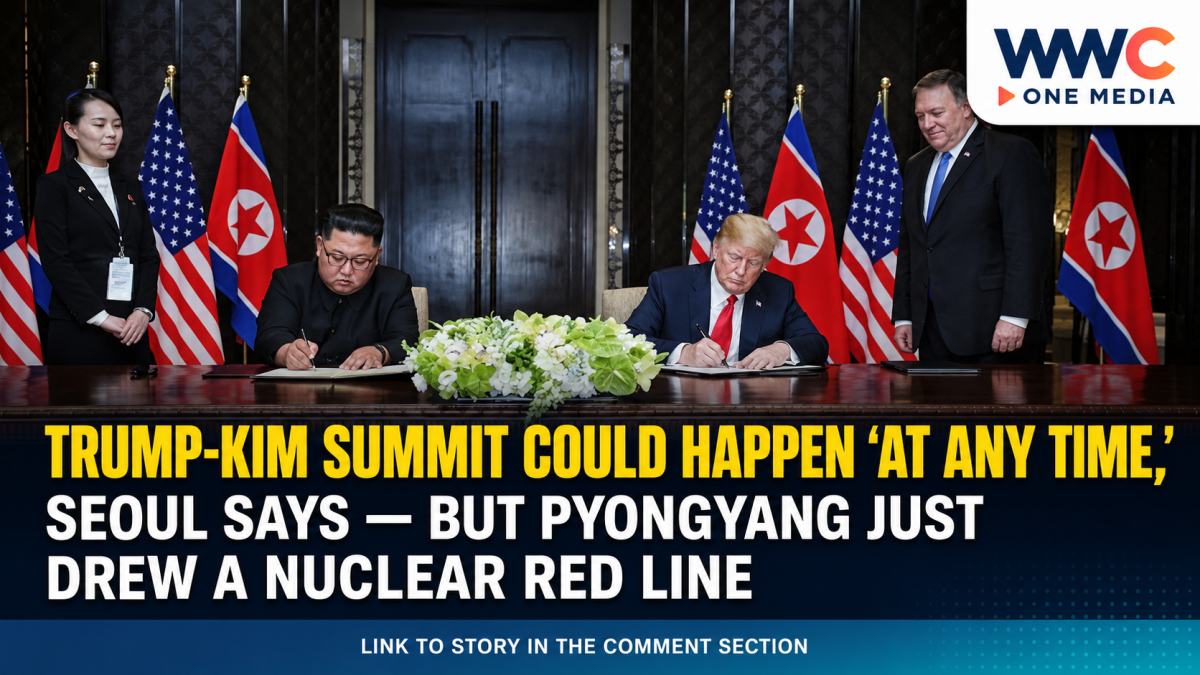
SEOUL — Nearly seven years after Donald Trump and Kim Jong Un last met face-to-face, speculation about another extraordinary US-North Korea summit is suddenly back — and South Korean intelligence officials believe the possibility should no longer be dismissed.
South Korea’s National Intelligence Service told lawmakers on September 1 that a meeting between US President Donald Trump and North Korean leader Kim Jong Un should be considered possible “at any time”, pointing to what it described as signs that dialogue may be developing between Washington and Pyongyang.
There is, however, one crucial caveat: Seoul has not confirmed that the United States and North Korea are actually in direct negotiations.
South Korean lawmaker Youn Kun-young, speaking after a closed-door NIS briefing, said intelligence officials had presented no verified evidence of concrete contacts between Washington and Pyongyang. Instead, the agency believes there are indications that the diplomatic environment may be shifting.
That distinction matters — because publicly, North Korea is sending a much tougher message.
Trump Wants Kim Back at the Table
Trump has repeatedly signalled that he wants another meeting with Kim.
In August, the US president said he expected to meet the North Korean leader again later in 2026. He has continued highlighting his personal relationship with Kim, arguing that maintaining a workable relationship with the North Korean leader could help reduce tensions.
Trump also claimed in August that Kim had responded to his outreach, although he offered no details about what that response involved. Neither the White House nor North Korea immediately provided confirmation explaining whether formal communication had actually taken place.
Washington has meanwhile taken a step that immediately caught Pyongyang’s attention.
Trump ordered a substantial reduction in major US-South Korea military exercises in August, arguing that the drills were expensive and sent an unnecessarily hostile signal to North Korea. Pyongyang has long condemned such exercises as rehearsals for invasion, while Washington and Seoul describe them as defensive.
The decision fuelled speculation that Trump was trying to recreate part of the diplomatic formula he used during his first presidency.
But North Korea has not responded with the breakthrough Washington may have hoped for.
Pyongyang’s Message: Personal Chemistry Isn’t Enough
Kim Yo Jong, Kim Jong Un’s influential sister and one of Pyongyang’s most prominent voices on relations with Washington, has acknowledged the positive personal relationship between Trump and her brother.
But North Korea has repeatedly warned that personal ties will not automatically translate into negotiations.
Kim Yo Jong dismissed the reduction in US-South Korea exercises as insufficient, arguing that the drills remained provocative despite being scaled back. North Korea also disputed suggestions that Trump and Kim had already made direct contact.
Then came an even sharper warning.
On August 31 — just one day before South Korean lawmakers revealed the NIS assessment — North Korea’s Foreign Ministry declared that Washington’s underlying policy remained hostile and vowed to continue strengthening the country’s nuclear forces.
Pyongyang specifically criticised Washington’s continued demand for the complete denuclearisation of North Korea, US criticism of North Korea’s human-rights record and military cooperation involving the United States, South Korea and Japan.
That exposes what may become the central obstacle to any Trump-Kim summit.
The Nuclear Question Could Decide Everything
The United States continues to officially support the complete denuclearisation of North Korea.
North Korea, meanwhile, increasingly portrays its nuclear arsenal as permanent and essential to its national survival.
Analysts cited by Reuters say Pyongyang could demand major changes in US policy before returning to serious negotiations — potentially including Washington abandoning denuclearisation as its ultimate objective or accepting North Korea’s nuclear status in some form. The US State Department has maintained that it remains committed to North Korea’s complete denuclearisation.
That is a dramatically different negotiating environment from the one Trump faced during his first term.
Trump and Kim met three times between 2018 and 2019.
Their first summit in Singapore in June 2018 generated global attention and broad commitments toward improving relations and working toward denuclearisation.
A second summit in Hanoi in February 2019 collapsed without an agreement after the two sides failed to bridge differences over sanctions relief and nuclear dismantlement.
Trump and Kim met once more at the Korean Demilitarized Zone in June 2019, but substantive negotiations eventually stalled.
This time, Kim may enter any negotiations with considerably more leverage.
Kim Jong Un Is in a Stronger Position Than in 2018
Since the collapse of the earlier diplomatic process, North Korea has expanded its nuclear and missile capabilities while dramatically deepening its strategic relationship with Russia.
North Korean troops have fought alongside Russian forces in the Ukraine war, while Pyongyang has also supplied military equipment and missiles to Moscow, according to Western, South Korean and Ukrainian assessments.
North Korea’s relationship with China also gives Kim another economic and diplomatic lifeline.
Reuters notes that these strengthened ties with Moscow and Beijing may reduce Kim’s urgency to seek the kind of sanctions relief that helped motivate diplomacy during Trump’s first term.
That means another summit could still happen — but Kim may feel far less pressure to make concessions simply to secure one.
Specialists are therefore divided over whether Trump’s renewed outreach will produce genuine negotiations or another highly publicised leaders’ meeting without a lasting nuclear agreement. Specialist outlet NK News noted that Trump’s reduced military exercises and emphasis on his relationship with Kim have revived diplomatic speculation, while experts remain cautious about whether Pyongyang is ready to return to meaningful negotiations.
Another Signal Seoul Is Watching Closely
The NIS briefing also contained another significant assessment about the future of North Korea itself.
South Korean intelligence officials believe Kim Jong Un’s daughter, Kim Ju Ae, may effectively have entered the stage of being designated as his successor.
According to lawmakers briefed by the NIS, her increasingly prominent appearances alongside her father appear intended to establish her leadership credentials in the eyes of North Koreans.
That remains an intelligence assessment rather than a publicly announced succession decision by North Korea, and analysts have previously disagreed about whether Ju Ae will ultimately inherit power.
The NIS also assessed that the likelihood of North Korea sending another major deployment of troops to support Russia in Ukraine is currently low, although officials stressed that circumstances could change.
A Summit May Be Possible — A Deal Is Another Matter
For now, the biggest development is not evidence that Trump and Kim have agreed to meet.
It is that South Korea’s intelligence community believes the political conditions have shifted enough that a summit could potentially materialise with relatively little warning.
Trump clearly wants another encounter.
Kim has avoided completely shutting the diplomatic door.
And Seoul says there are signs worth watching.
But North Korea’s latest statements reveal the enormous distance that remains between the two sides.
Washington still talks about denuclearisation. Pyongyang says its nuclear arsenal is non-negotiable and essential to its security. Upcoming US-South Korea-Japan military exercises are also likely to keep tensions elevated, with North Korea already condemning trilateral drills as threatening.
So the question is rapidly shifting from whether Trump and Kim can meet again to something much more consequential:
If they do sit across the table from each other, what is either leader actually prepared to give up this time?
WWC ONE MEDIA MJE




Leave a Reply