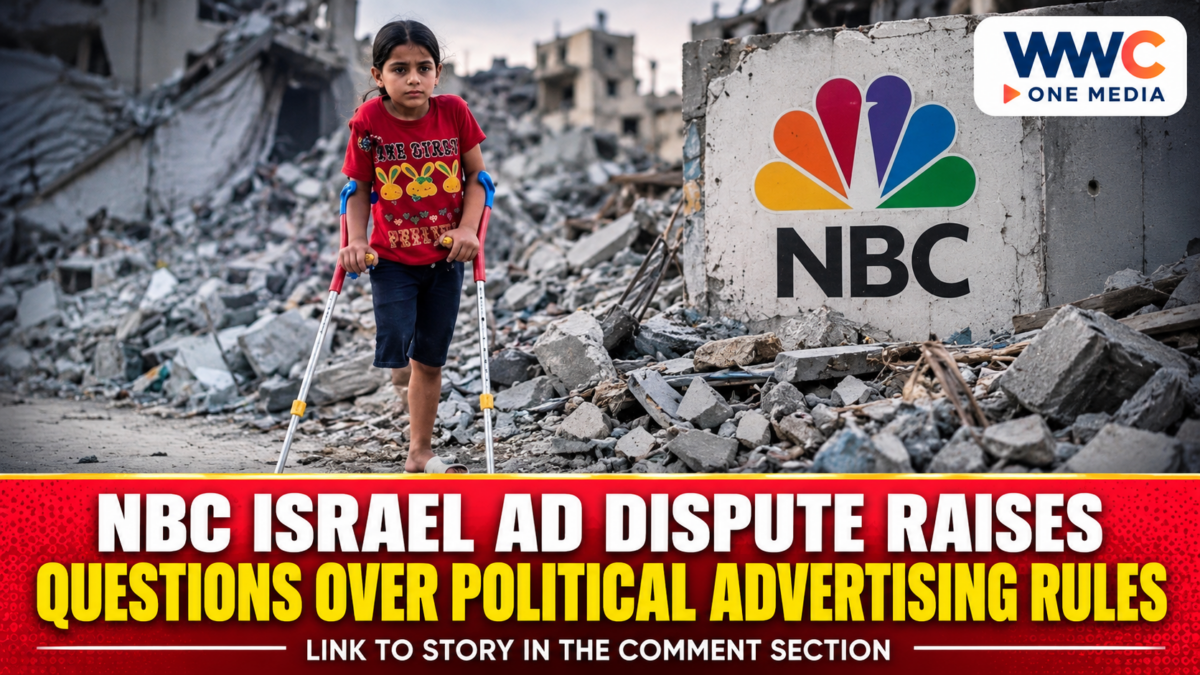
A campaign opposing US military assistance to Israel has put the boundaries of issue-based television advertising under renewed scrutiny after the Institute for Middle East Understanding Policy Project announced a national advertisement titled “Every Three Seconds” for NBC’s November 25 broadcast schedule. The dispute has also drawn attention to the difference between the campaign’s presentation of US aid and the figures contained in the existing US-Israel security assistance agreement.
The central question is not simply whether a broadcaster should carry a controversial political message. It is whether the claims in an advertisement are adequately supported, how a network applies its published standards and what can be established about any decision to stop future broadcasts.
As of November 29, the publicly accessible primary records reviewed for this report include the campaign’s own announcement, NBCUniversal’s advertising guidelines and the 2016 US-Israel memorandum of understanding. They do not include a public NBC statement confirming that the advertisement has been withdrawn.
NBC Israel ad controversy puts issue advertising rules in focus
The IMEU Policy Project’s campaign page identifies the advertisement as “Every Three Seconds” and says it was scheduled to air on Wednesday, November 25, during the Saturday Night Live Thanksgiving Eve special.
The organisation describes the spot as an effort to challenge a potential new US-Israel military assistance agreement. It directs viewers to a campaign website where they can contact members of Congress and oppose the proposed arrangement.
That makes the advertisement an issue-based political message rather than a commercial promoting a consumer product. Its purpose is to influence public discussion and encourage action on a government policy.
NBCUniversal’s published March 2026 advertising guidelines recognise that category. The document says the network accepts advertisements expressing different viewpoints on controversial issues, including political, religious and ideological positions, subject to stated conditions.
The guidelines also reserve the network’s right to require substantiation for factual claims. They say advertisements generally will be accepted when claims have a factual basis and fall within reasonable debate.
The policy therefore does not promise automatic acceptance of every political advertisement. It sets out a review framework that gives the broadcaster room to assess both factual support and content.
What NBCUniversal’s published standards actually say
The advertising guidelines identify several grounds on which an issue advertisement may be rejected.
These include material considered grossly offensive on racial, religious or ethnic grounds, personal attacks, certain direct attacks on organisations, and violent, graphic or potentially offensive content deemed incompatible with the network’s viewing environment or standards.
The document also addresses the use of NBCUniversal material. It says the company does not grant permission for its footage to be used in issue advertisements, explaining that such material could mislead viewers into thinking the network endorses the advertiser’s position.
Sponsor identification is another requirement. The guidelines state that issue advertisements must identify the party that paid for the advertisement for at least four seconds, using readable and contrasting text of a specified minimum size.
These provisions matter because they show that political advertising is assessed through more than one test. A claim may have a factual basis while the overall presentation raises separate questions about tone, imagery, disclosure or suitability for a particular programme.
The public guidelines do not reveal how NBC assessed this specific advertisement, who reviewed it, what substantiation was submitted or whether any internal challenge took place.
The US$400 claim needs to be read against the existing aid agreement
The campaign’s title and message draw attention to the scale of US military assistance to Israel. Its announcement describes the current arrangement as a 10-year, US$38 billion agreement and presents the flow of taxpayer money as US$400 every three seconds.
The underlying 2016 memorandum of understanding gives a more precise breakdown.
It sets out US$3.3 billion annually in Foreign Military Financing for fiscal years 2019 through 2028. It separately provides for US$500 million annually for cooperative missile and rocket defence programmes over the same 10-year period.
Together, those two amounts total US$3.8 billion annually, or US$38 billion across the decade.
That distinction is important when evaluating the advertisement’s numerical framing. Spread evenly across a 365-day year, US$3.8 billion works out to approximately US$361.64 every three seconds—not US$400. The campaign’s figure is therefore a rounded-up presentation rather than the exact annual amount in the memorandum.
The agreement also does not describe money being transferred in literal three-second instalments. It establishes annual funding levels, subject to the appropriation and availability of funds.
Readers should distinguish between the agreement’s actual funding structure and the campaign’s shorthand. The latter may communicate scale quickly, but it should not be mistaken for the precise wording or payment mechanism of the government-to-government document.
Why the agreement remains politically significant
The 2016 memorandum covers fiscal years 2019 to 2028. It combines military financing with cooperative missile-defence funding and sets out expectations for how assistance is to be used and reported.
The document says the Foreign Military Financing is intended primarily to help Israel acquire advanced capabilities available from the United States. It also describes transparency and reporting arrangements between the two governments.
The agreement is relevant to a wider political debate over US involvement in Israel’s security and the future of American assistance after the current framework expires.
WWC previously examined the funding arrangement and the political questions surrounding a proposed early end to US assistance in its report on Trump’s stated plan to end nearly US$4 billion in annual aid to Israel.
The debate also intersects with scrutiny of the conduct of the war in Gaza. In its coverage of the documentary NAZA, WWC reported on allegations concerning Israeli military targeting practices and the Israeli military’s rejection of the film’s conclusions. Those claims remain disputed and should be assessed separately from the question of US funding.
The humanitarian consequences of the conflict are another part of the wider public discussion. WWC’s report on Gaza’s continuing health crisis and shortages affecting medical services examines a different dimension of the conflict: the condition of civilian services and the obstacles to recovery.
These subjects are connected by the broader debate over US policy, but they are not interchangeable. Evidence about aid allocations does not, by itself, prove how a particular weapon was used in a specific incident.
What is known — and what remains unconfirmed
The campaign’s own page establishes that the IMEU Policy Project announced the advertisement and identified its intended broadcast date and programme. NBCUniversal’s published guidelines establish the standards the network says it applies to controversial issue advertising.
However, the primary records reviewed do not establish whether NBC made a final decision to cancel future airings, the precise reason for any such decision or whether the network concluded that the advertisement breached a specific provision.
Nor do the public guidelines establish whether the advertisement passed every internal review stage before it was scheduled. A published policy is not the same as a record of how that policy was applied to an individual advertisement.
This distinction is essential. A network’s decision to accept, restrict or reject an issue advertisement can have consequences for public debate, but an explanation of that decision should come from an attributable statement or documented review record—not an assumption based on the controversy surrounding the spot.
What happens next
The next meaningful development would be a direct statement from NBCUniversal explaining whether the advertisement will be carried again and, if not, identifying the basis for that decision.
The campaign organisation could also clarify whether it has received formal notice from the network and whether it intends to challenge or revise the advertisement.
For viewers, advertisers and advocacy groups, the broader issue is transparency. Clear explanations of advertising decisions help distinguish a factual-substantiation dispute from a content-standard decision or a scheduling restriction.
The US-Israel funding debate will continue independently of the advertisement’s broadcast status. The existing memorandum remains a public document with defined annual funding components and an end date of fiscal year 2028.
The lasting test for broadcasters is whether their published rules are applied consistently and explained clearly when politically sensitive advertisements become contentious.