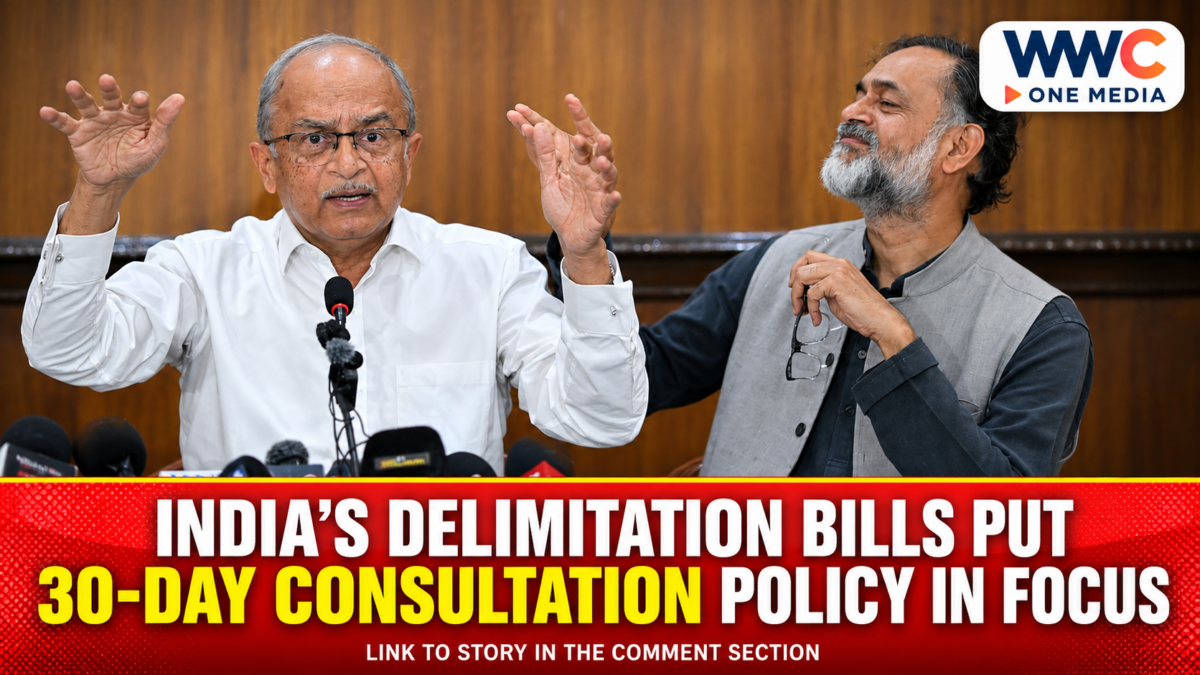
NEW DELHI, INDIA — India’s proposed constitutional and delimitation reforms are bringing renewed attention to the government’s 30-day consultation policy as Parliament prepares to consider a new legislative package on electoral representation and women’s reservation. The Constitution (One Hundred and Thirty-Second Amendment) Bill, 2026, and the proposed Delimitation (Second) Bill, 2026, outline changes that could increase legislative seats and alter how constituencies are determined.
The debate is about more than the size of the Lok Sabha. The proposals would affect state representation, constituency boundaries, the timing of women’s reservation and the authority responsible for carrying out delimitation. India’s own pre-legislative policy sets out a public-consultation framework, making transparency and the opportunity for scrutiny important questions as the legislation moves forward.
India’s 30-day consultation policy sets a public-scrutiny standard
India’s Pre-Legislative Consultation Policy, issued by the Ministry of Law and Justice in 2014, establishes a framework for public participation before legislation is finalised.
Under the policy, government departments should publish proposed legislation or information about it. The information may include the reason for the proposed law, its essential provisions, broad financial implications and an assessment of its possible effects on the environment, fundamental rights, lives and livelihoods.
The policy says the draft legislation or relevant information should generally remain in the public domain for a minimum of 30 days so citizens and affected stakeholders can provide feedback. Legislative.gov.in
It also requires an explanatory note written in simple language to accompany draft legislation placed through the pre-legislative process. A summary of feedback received from the public and other stakeholders should also be published on the relevant department’s website. Legislative.gov.in
The framework is not simply about making draft documents available. It is designed to help the government assess policy choices, identify potential consequences and consider public input before legislation is finalised.
There is, however, an important qualification. The policy provides that when a ministry considers consultation infeasible or undesirable, it may record its reasons in the Cabinet note. This means the 30-day provision should not be presented as an unconditional legal guarantee that every bill must undergo an identical public process. Legislative.gov.in
The proposed constitutional amendment would change parliamentary representation
The Constitution (One Hundred and Thirty-Second Amendment) Bill, 2026, is listed as Bill No. 158 of 2026 and marked “TO BE INTRODUCED IN LOK SABHA.”
Its proposed amendments include raising the maximum number of elected Lok Sabha members from states from 530 to 815 and from Union territories from 20 to 35. It also proposes raising the maximum strength of state legislative assemblies from 500 to 650. Digital Sansad+1
Another major provision would replace existing census-related references in relevant constitutional articles with the latest published census figures available when the proposed amendment commences.
The bill also proposes extending specified constitutional restrictions on seat readjustment until 2051. Its proposed wording would link the first delimitation after commencement of the amendment to a 50% increase in the number of seats allocated to each state and Union territory in the Lok Sabha, as well as a 50% increase in the total number of seats in the relevant legislative assemblies. Digital Sansad
These provisions are significant because they would affect both the overall size of elected institutions and the process through which electoral representation is organised.
However, the bill is still a proposal. Its provisions cannot be treated as operative constitutional rules unless the required parliamentary process is completed and the amendment takes effect.
The Delimitation Commission would have a central role
The proposed Delimitation (Second) Bill, 2026, is intended to work alongside the constitutional amendment.
The government’s statement of reasons says the new legislation would provide for the readjustment of seat allocations and the division of states and Union territories into territorial constituencies. It also proposes that the Central Government constitute the Delimitation Commission as soon as possible after the legislation commences. Digital Sansad
The commission’s work would have direct consequences for electoral geography. It would determine how constituencies are divided and how legislative seats are allocated under the new framework.
The government’s statement also says the revised proposal defines “latest census figures” by reference to the figures published on the date the proposed legislation commences. The statement identifies this as one of the substantial changes from the earlier delimitation proposal. Digital Sansad
That makes the timing of commencement important. The figures available at that point would influence the basis for the subsequent delimitation exercise.
The commission’s responsibilities, appointment arrangements and decision-making process therefore deserve close examination. The public-interest question is not only how many seats will be added, but also how the rules governing constituency boundaries will be applied.
Women’s reservation is tied to the new delimitation process
The proposed amendment also seeks to change Article 334A, the constitutional provision governing women’s reservation in the Lok Sabha and specified legislative assemblies.
The bill proposes that reservation for women take effect after the first delimitation exercise undertaken following the commencement of the proposed amendment. It includes the Lok Sabha, state legislative assemblies and the assemblies of Delhi, Puducherry and Jammu and Kashmir. Digital Sansad
The proposed text also links the implementation of the reservation to the 50% increase in seats allocated to each state and Union territory.
This makes the delimitation exercise central to the proposed timetable for women’s representation. The legislative package is not simply an exercise in increasing the number of lawmakers. It also seeks to establish the mechanism through which reserved seats would be allocated.
The proposal provides for reserved seats to be allotted by rotation under the proposed delimitation framework. The precise constituency arrangements would depend on the legislation and the commission’s subsequent work. Digital Sansad
For readers following the earlier parliamentary developments, WWC’s report on the failed delimitation bills and their legislative status explains why the revised package is not simply a continuation of legislation that already passed.
The April defeat explains why the government revised its approach
The new package follows the failure of the earlier Constitution (One Hundred and Thirty-First Amendment) Bill, 2026.
The government’s own statement of reasons records that the earlier bill was considered in the Lok Sabha on April 16 and 17, 2026, but did not secure the special majority required under Article 368(2) of the Constitution. The two related bills were consequently not proceeded with after introduction. Digital Sansad
The statement identifies concerns raised during the earlier debate about the possible effects of delimitation on the representation of different states, particularly because population growth has varied across the country.
The revised package introduces a uniform 50% increase in seat allocations as part of its approach to maintaining the existing relative distribution of seats among states while expanding overall representation. Digital Sansad
That change is important to the policy debate. It shows that the government has revised the proposal in response to concerns recorded during the previous parliamentary process.
WWC previously examined the wider parliamentary timetable in its report on India’s Parliament and the renewed delimitation debate. The new documents provide a more concrete basis for assessing the revised legislative framework.
Why public consultation matters beyond the 30-day period
The consultation policy is relevant because the proposed reforms could affect several groups in different ways.
Voters may be affected by changes to constituency boundaries. States may be affected by the rules governing seat allocation. Political parties and candidates may need to adjust to a new electoral structure. Women seeking representation may be affected by the eventual allocation and rotation of reserved constituencies.
An explanatory note and public feedback process could help make the legal and administrative consequences easier to understand before the legislation is finalised.
The policy also provides for a summary of feedback to be published. That creates a potential public record of the concerns raised and the government’s response. Legislative.gov.in
This is particularly relevant when legislation involves constitutional provisions and changes to the composition of elected institutions. Public scrutiny can help identify ambiguities, implementation difficulties and questions that lawmakers may need to address.
At the same time, the existence of the 2014 policy does not by itself establish whether the government complied with it in preparing the current bills. The policy refers to a process before a legislative proposal is submitted to the Cabinet, and it expressly allows reasons to be recorded when consultation is considered infeasible or undesirable. The public documents reviewed here do not establish the complete internal consultation history of the current package.
WWC’s report on Parliament’s scheduled reconvening and the delimitation debate provides additional background on the legislative timetable surrounding the proposals.
What happens next?
The immediate test is the parliamentary process for the proposed constitutional amendment and its supporting legislation.
The 132nd Amendment Bill must secure the special majority required for constitutional amendments under Article 368. The supporting delimitation legislation must also complete the applicable legislative process before the proposed commission and constituency changes can take effect.
The next stages will determine whether the proposed seat expansion, census reference, commission arrangements and women’s reservation mechanism become part of India’s operative constitutional and statutory framework.
The consultation question remains distinct from the parliamentary vote. The government’s 2014 policy sets out a process for publishing draft legislation or relevant information, allowing feedback and recording reasons where consultation is not considered feasible or desirable.
The public record reviewed for this report does not establish the full consultation history of the new bills. It does, however, establish that the proposed reforms are substantial enough to make transparency, clear explanations and parliamentary scrutiny important to the debate.
Frequently asked questions
What is India’s 30-day consultation policy?
It is the 2014 Pre-Legislative Consultation Policy, which says proposed legislation or relevant information should generally be made public for at least 30 days to allow feedback from citizens and stakeholders.
Does every Indian bill legally require a 30-day public consultation?
The policy establishes a general framework, but it also allows a ministry that considers consultation infeasible or undesirable to record its reasons in the Cabinet note. It should not be described as an unconditional requirement applying identically to every bill.
What is the Constitution (132nd Amendment) Bill, 2026?
It is a proposed constitutional amendment that would change provisions concerning legislative seat limits, census references, delimitation and the implementation of women’s reservation.
How many Lok Sabha seats could India have under the proposal?
The proposed amendment would raise the maximum number of elected members from states to 815 and from Union territories to 35, giving a combined maximum of 850 elected seats.
Has the new delimitation framework become law?
No. The documents reviewed identify the amendment and supporting legislation as proposed bills. They must complete the required legislative process before their proposed provisions can take effect.