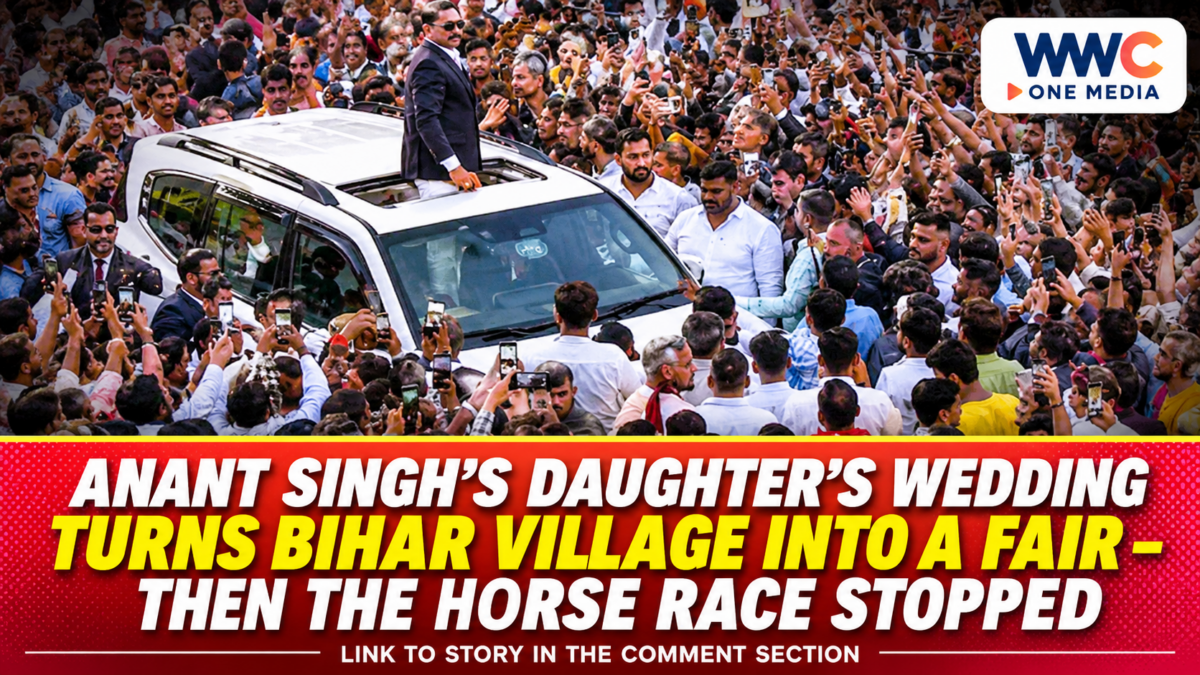
A wedding in Bihar became a public spectacle after thousands of people descended on the ancestral village of Mokama MLA Anant Singh, turning the celebrations for his daughter into an event that overwhelmed roads, attracted political figures and disrupted a planned horse-racing competition.
The wedding of Shivangi Singh and Rishikesh Kumar took place on Nov. 25, 2026, in Nadwan, in Patna district. What was planned as a large family celebration expanded into a gathering that drew guests, supporters and curious spectators from different parts of Bihar and neighbouring states.
The scale was striking. Organisers had prepared food for several lakh people, a large wedding venue and a horse-racing competition featuring riders from multiple states. But as spectators crowded around the racing ground, the competition was halted before its final round could take place.
The event has since drawn attention not only for its lavish arrangements but also for the practical challenges created by a crowd of that size.
Nadwan wedding brings traffic to a standstill
Anant Singh’s ancestral village became the centre of the celebrations, with visitors arriving by cars, motorcycles, tractors and on foot.
Local estimates cited in coverage placed attendance at around five lakh people. That figure should be treated as an estimate rather than an officially verified headcount.
The influx reportedly caused serious congestion on roads leading to Nadwan. Traffic queues were described as stretching several kilometres, with nearby routes and access roads affected.
The Indian Express reported that vehicle queues extended up to eight kilometres from the venue. Other coverage placed the congestion at between five and 10 kilometres. The differing figures underline why the exact length of the traffic disruption should not be treated as a confirmed official measurement.
The wedding arrangements were extensive. The venue covered more than 10 bighas, with separate areas for ceremonies, dining and guests. A large pavilion inspired by Jaipur architecture was among the main attractions.
Preparations also included a procession expected to involve 151 vehicles and dedicated arrangements for VIP visitors.
The celebrations followed several days of pre-wedding functions. These included a tilak ceremony on Nov. 20, haldi and kalash ceremonies on Nov. 23, and mehendi and sangeet events on Nov. 24.
Horse race becomes the biggest attraction — until the crowd intervenes
The horse-racing competition became one of the most talked-about features of the wedding.
Reports said 52 horses and riders from Bihar, Uttar Pradesh, Jharkhand, Rajasthan and other states took part. The racing ground covered approximately 12 bighas, and a new Mahindra Thar was displayed as the top prize.
The second- and third-place finishers were also expected to receive vehicle prizes.
But the event encountered a major problem when spectators moved beyond the designated viewing areas and spilled onto the track. Some people reportedly climbed electricity structures and nearby trees to get a better view.
The organisers halted the competition to clear the ground. The final round was postponed and rescheduled for Thursday, Nov. 26.
The incident highlights a practical challenge for large public gatherings: an event can have extensive preparations and still face serious crowd-management problems when spectators exceed the available viewing space.
It also raises questions about the safety of people watching from elevated electrical structures and the risks created when spectators enter a racing area.
Animal welfare scrutiny adds another dimension
The horse race also brought animal-welfare concerns into the public discussion.
A complaint reportedly raised questions about the participating horses’ registration, veterinary fitness, transportation and conditions before racing. Reporting on the issue also described an inspection direction attributed to the Animal Welfare Board of India and Bihar’s animal husbandry authorities.
The important distinction is that a request for inspection is not proof that organisers or participants violated animal-welfare laws.
India’s animal-welfare framework includes the Prevention of Cruelty to Animals Act, 1960, and rules governing the registration of performing animals and the transportation of animals. The Animal Welfare Board of India publishes these rules and related guidance.
Whether particular requirements applied to this specific competition, and whether the horses met them, depends on the event’s arrangements and the findings of the competent authorities. No final inspection report establishing a violation was available for this article.
The issue matters because horses brought from different locations for a public competition require appropriate transport, veterinary assessment and safe conditions. Large crowds also make it important to keep spectators away from animals and the racing track.
A wedding that drew political attention
The celebrations also attracted political figures and visitors from outside the immediate area.
Among those reported at the event were Union Minister Rajiv Ranjan Singh, popularly known as Lalan Singh, and former BJP MP Brij Bhushan Sharan Singh.
The gathering became a highly visible public event, with the scale of the arrangements and Anant Singh’s arrival drawing attention across social media and news coverage.
For context, Bihar’s political environment has been the subject of wider scrutiny, including debates over electoral administration and voter-list revision. WWC previously examined the controversy surrounding India’s voter-roll revision and what official records establish. That issue is separate from the wedding, but it illustrates the importance of distinguishing documented developments from political claims.
The event also adds to a broader stream of unusual wedding stories attracting international attention. WWC has previously covered a couple who went ahead with their wedding inside a flooded church in the Philippines, as well as the concerns raised by brides waiting for customised wedding shoes from a Singapore business. The circumstances differ, but each story shows how weddings can become public-interest news when logistics, businesses or safety become part of the story.
What happens next?
The immediate question surrounding the horse-racing event is whether the postponed final took place as planned on Nov. 26. A confirmed result or official statement from the organisers was not available for this report.
The animal-welfare question also requires a documented answer. The inspection findings, if completed, would help establish whether the horses had the required registration and veterinary clearances and whether the event complied with applicable rules.
For local authorities, the gathering offers a reminder that large public celebrations need more than elaborate venues and food arrangements. Traffic management, crowd control, emergency access and safe viewing areas are essential when an event attracts visitors on this scale.
Anant Singh’s daughter’s wedding may have been planned as a family celebration, but its size turned it into a public event with consequences beyond the wedding venue.
The spectacle brought attention to Nadwan. The halted horse race, however, left a more important question: can large celebrations be organised safely when the crowd becomes bigger than the arrangements can handle?
Frequently asked questions
Who is Anant Singh’s daughter?
Shivangi Singh is the younger daughter of Bihar politician Anant Singh.
Who did Shivangi Singh marry?
She married Rishikesh Kumar on Nov. 25, 2026.
Where was the wedding held?
The wedding celebrations took place in Nadwan, Anant Singh’s ancestral village in Patna district, Bihar, India. Some reports spell the village name as Nadawan.
How many people attended the wedding?
Local estimates reported attendance of around five lakh people. This is not an official, independently verified attendance count.
Why was the horse race stopped?
The competition was halted after spectators reportedly moved onto the racing track. Its final round was postponed and rescheduled for Nov. 26.
Was animal cruelty established at the event?
No final finding establishing animal cruelty was available for this report. Concerns were reportedly raised about horse registration, veterinary fitness and transportation, but those concerns should not be treated as proof of a violation.