
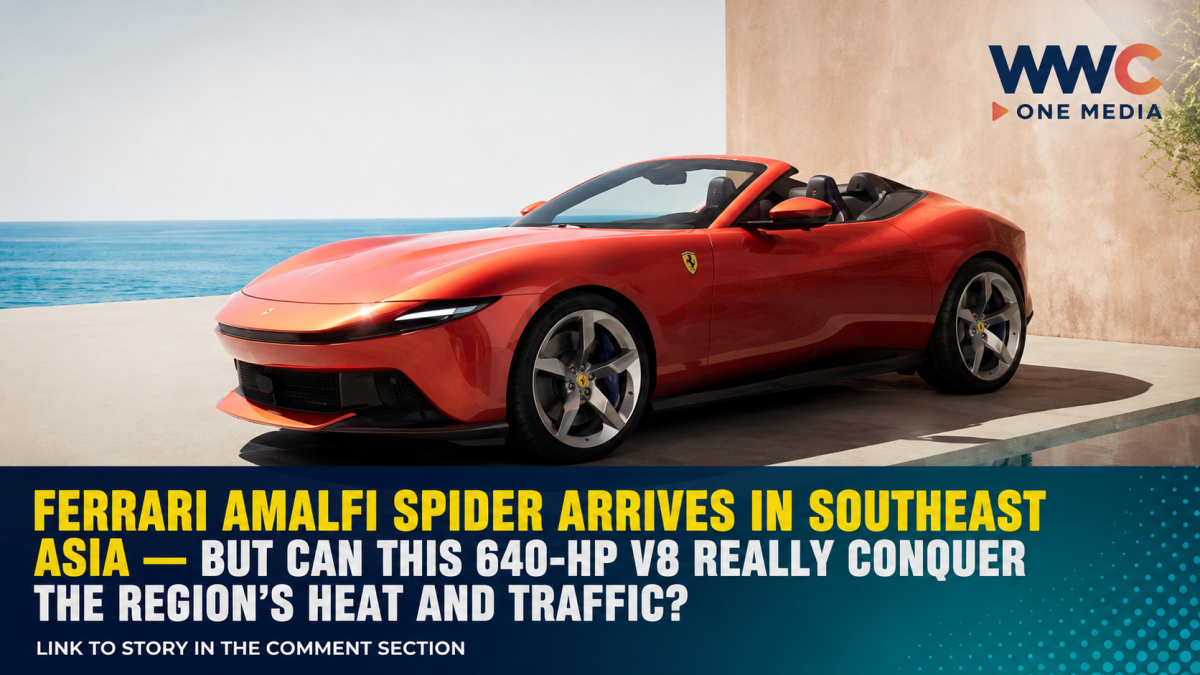
KUALA LUMPUR — Ferrari has brought its newest open-top grand tourer to Southeast Asia, unveiling the Ferrari Amalfi Spider in Kuala Lumpur as the marque looks to make high-performance convertible motoring more practical for the region’s demanding roads and tropical climate.
The regional arrival comes just months after the Amalfi Spider’s global debut and follows the introduction of the Amalfi coupe to ASEAN earlier this year. The Kuala Lumpur presentation was also the model’s ASEAN debut, according to automotive publication Paultan.
But Ferrari is not simply selling the Amalfi Spider as another exotic convertible.
The company is positioning it as a Ferrari that can be enjoyed beyond weekend drives — an important proposition in Southeast Asia, where extreme heat, sudden rain, heavy traffic, road conditions and exceptionally high vehicle ownership costs can make traditional convertibles challenging to live with.
A 640-horsepower Ferrari designed for everyday driving
At the heart of the Amalfi Spider is a 3.9-liter twin-turbocharged V8, producing 640 horsepower, paired with Ferrari’s eight-speed dual-clutch transmission.
The result is serious supercar performance: Ferrari says the Spider can accelerate from 0 to 100 km/h in 3.3 seconds.
Yet the Amalfi Spider is deliberately positioned as more than a straight-line performance machine.
Ferrari has equipped it with multiple driving modes, including Comfort, Wet, Sport and Race, allowing the car’s character to change depending on conditions. Its electronic chassis systems include Side Slip Control 6.1, a 6D sensor and brake-by-wire technology designed to maintain stability and driver confidence.
Independent reviews have reinforced that point.
Top Gear described the Spider as remarkably approachable despite its enormous performance, while Road & Track found that the convertible retains much of the dynamic character of the hardtop despite the structural changes required to remove the roof.
The roof is Ferrari’s answer to tropical weather
For Southeast Asian buyers, however, perhaps the most important technology isn’t the V8.
It’s the roof.
The Amalfi Spider uses a five-layer fabric soft top designed to provide insulation against noise and temperature while preserving the elegant proportions of the coupe.
It can open or close in approximately 13.5 seconds, even while the vehicle is moving at speeds of up to 60 km/h.
Ferrari has also integrated an electronically activated wind deflector into the rear seat area.
When deployed, the system is designed to reduce turbulence inside the cabin, making conversations easier when the roof is down. That’s a particularly relevant feature for a car intended to operate not just on scenic coastal roads but also on highways and urban streets.
Ferrari didn’t forget luggage space
Convertible practicality normally comes with a penalty, and the Amalfi Spider is no exception.
Ferrari lists luggage capacity at 255 liters with the roof closed, falling to 172 liters when the roof is lowered.
Top Gear similarly identified luggage capacity with the roof down as one of the car’s compromises, alongside its considerable price.
Still, compared with the highly specialized nature of many performance convertibles, Ferrari appears to be deliberately giving the Amalfi Spider a stronger grand-touring focus.
More than a Roma Spider replacement
The Amalfi Spider effectively continues Ferrari’s front-engine V8 grand-touring formula after the Roma Spider.
MotorTrend notes that Ferrari’s modern entry-level front-engine V8 lineage has evolved through models including the California T, Portofino and Roma before arriving at the Amalfi.
That evolution is important because Ferrari’s goal isn’t necessarily to make the fastest car in its lineup.
Instead, the Amalfi is designed to deliver a combination of performance, comfort, design and usability — a formula that could make it particularly attractive to wealthy buyers who want a Ferrari they can actually use regularly.
Southeast Asia is becoming an important luxury market
Ferrari’s regional strategy also provides important context.
According to CNA Luxury, Ferrari has placed Southeast Asia and India under a newly structured regional territory, reflecting the growing importance of these luxury markets.
Ferrari Southeast Asia head Charles-Antoine Geneste said markets such as Singapore and Malaysia remain complicated because of ownership costs, while demand for luxury performance vehicles across the region remains resilient.
That makes the Amalfi Spider an interesting test for Ferrari.
The challenge isn’t convincing Southeast Asian buyers that Ferrari is desirable. The bigger question is whether the brand can make a high-performance convertible sufficiently comfortable and practical for daily life in cities where traffic congestion, humidity and unpredictable weather are unavoidable.
The Amalfi Spider appears engineered specifically around that problem.
Reviews are impressive — but there is one catch
Early international reviews have generally been positive.
Auto Express praised the car’s performance and described it as a genuine supercar despite its position as Ferrari’s more accessible open-top model.
Top Gear reached a similar conclusion, noting that the Spider is approximately 70 kg heavier than the coupe depending on specification, yet testers found little meaningful impact on its performance.
There is, however, one recurring criticism: the soundtrack isn’t as dramatic as some enthusiasts might expect from a Ferrari V8 convertible.
Road & Track specifically noted that emissions and noise regulations contribute to a more restrained exhaust note, potentially diminishing some of the sensory excitement when driving with the roof down.
For buyers seeking the ultimate auditory experience, that could make the fixed-roof Amalfi more appealing.
How much will it cost in Southeast Asia?
The Malaysian debut gives an indication of just how exclusive this Ferrari will be in the region.
Paultan reports that the Amalfi Spider’s Malaysian price is above RM3 million, before considering the extensive personalization options available to Ferrari customers.
Pricing in other Southeast Asian markets will vary substantially because of local taxes, duties and registration structures.
Singapore, in particular, presents a radically different cost environment for luxury automobiles, meaning the final price there cannot simply be converted from the Malaysian figure. CNA notes that Singapore pricing will depend heavily on the country’s tax structure.
The bigger Ferrari story
The Amalfi Spider arrives at an interesting moment for Ferrari.
The company is developing combustion-engine, hybrid and fully electric vehicles simultaneously, allowing it to adapt to different regulations and customer preferences around the world.
Against that backdrop, the Amalfi Spider represents something increasingly distinctive: a traditional front-engine V8 Ferrari with a fabric roof, but one engineered with modern expectations of comfort and everyday usability.
For Southeast Asian buyers, that may ultimately be its biggest selling point.
It’s not simply a Ferrari designed to be admired in a showroom.
It’s Ferrari’s attempt to answer a much harder question:
Can a 640-horsepower Italian convertible become an everyday luxury car in one of the world’s hottest, busiest and most challenging driving environments?
WWC ONE MEDIA MJE




Leave a Reply