
The United States is turning to an unusual solution to one of its biggest military-industrial challenges: asking allied shipbuilders to help close the widening naval shipbuilding gap with China.
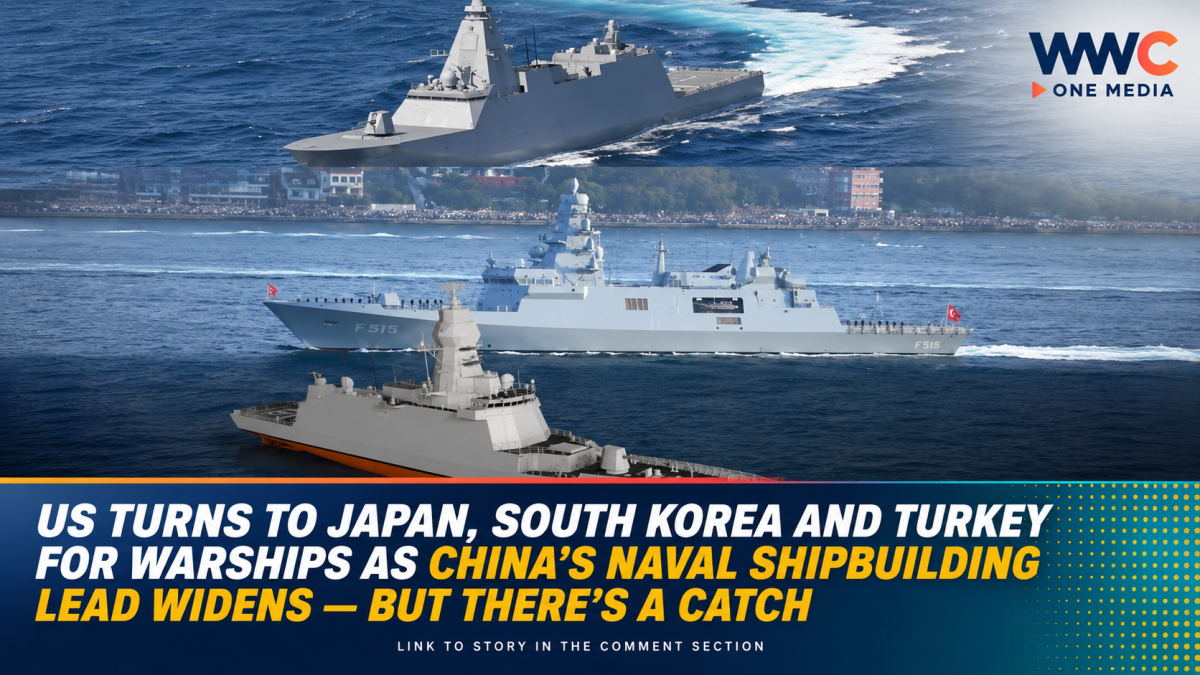
The U.S. Navy is examining frigate designs from Japan, South Korea and Turkey as Washington searches for a faster way to expand its surface fleet while rebuilding an American shipbuilding industry that has struggled with delays, rising costs and limited capacity.
The effort follows an August 13 presidential memorandum directing the U.S. government to use proven foreign shipbuilding capabilities in the near term while simultaneously expanding production capacity inside the United States.
The designs being considered include Japan’s Mogami-class, South Korea’s Chungnam-class and Turkey’s Istanbul-class guided-missile frigates.
The proposal could initially allow up to two ships to be constructed at an allied shipyard, before production shifts to U.S. facilities.
That would represent a major departure from America’s longstanding policy of building its naval combatants domestically.
Why Washington is looking abroad
The underlying problem is not simply the number of ships in the U.S. fleet. It is the industrial capacity required to build and replace those ships at scale.
China has developed an enormous commercial shipbuilding sector alongside its rapidly expanding navy. A 2025 RAND analysis argued that China, South Korea and Japan together dominate global commercial shipbuilding capacity, while U.S. commercial shipbuilding represents only a small fraction of global output. RAND specifically recommended deeper U.S.-Japan-South Korea cooperation to rebuild American maritime capacity.
The disparity has become a strategic concern because shipbuilding capacity determines how quickly a country can expand its fleet, replace damaged vessels and sustain maritime operations during a prolonged crisis.
A U.S. congressional hearing document citing Congressional Research Service estimates said China’s Navy had more than 370 battle-force platforms in 2024 and was projected to reach about 395 ships by 2025. The same document put the U.S. Navy at 296 battle-force ships in August 2024.
The Mogami, Chungnam and Istanbul options
The three foreign designs offer Washington different approaches.
Japan’s Mogami-class is particularly attractive because it was designed around automation and relatively low crew requirements. South Korea’s Chungnam-class represents another modern guided-missile frigate option, while Turkey’s Istanbul-class offers a smaller platform with indigenous weapons and sensors.
The U.S. Navy is not simply shopping for an existing hull, however.
Any foreign design entering American service would have to work with U.S. communications, weapons, logistics, maintenance and operational requirements. Excessive modifications could undermine the very advantage Washington is seeking: getting a mature design into production quickly.
That lesson is particularly important after the troubled Constellation-class frigate program.
Constellation became a warning sign
The Constellation-class was intended to give the Navy a relatively affordable, capable surface combatant that could supplement larger destroyers.
Instead, the program encountered design changes, weight growth, cost increases and construction delays.
The August presidential memorandum explicitly criticized the Navy’s history of overly complicated designs and repeated design changes, saying they had contributed to cost growth, delays and cancellations.
The new strategy therefore places heavy emphasis on mature designs rather than starting another clean-sheet program.
The White House’s “Finland Model” is central to that approach.
Under the model, an allied shipbuilder could initially construct up to two vessels overseas while simultaneously investing in a U.S. shipyard, training American workers and transferring relevant shipbuilding technology. Subsequent ships would then be built in the United States.
The goal isn’t supposed to be permanent foreign dependence
That distinction is crucial.
Washington’s plan is not simply to purchase foreign warships indefinitely.
The presidential memorandum specifically calls for foreign suppliers participating in the model to establish or acquire a U.S. shipyard, train an American workforce, license shipbuilding techniques and technologies, and develop a U.S.-based supply chain for subsequent construction and maintenance.
In theory, that creates a bridge:
Allied shipyards → faster initial production → U.S. investment and technology transfer → American mass production.
The objective is to buy time while rebuilding America’s industrial base.
But Congress could still block the strategy
The proposal faces an important political hurdle.
U.S. law generally restricts the construction of naval vessels in foreign shipyards. The August memorandum invokes a national-security authority to create a pathway around that restriction, but it also requires congressional notification before contracts can proceed under the waiver.
That means the foreign-frigate strategy is not guaranteed to become reality.
There is also a deeper question: Can Washington actually prevent a repeat of the problems that plagued previous naval programs?
If an imported frigate is heavily redesigned to satisfy U.S. requirements, the advantage of using a mature foreign design could disappear.
China isn’t standing still
That may be the biggest concern for U.S. planners.
China continues to build modern surface combatants at a pace that puts enormous pressure on American shipbuilding.
The Type 054 family, for example, has become one of the People’s Liberation Army Navy’s principal frigate designs. Newer Chinese frigates such as the Type 054B incorporate updated sensors, weapons and anti-submarine capabilities.
This creates a difficult strategic equation for Washington.
The United States can design a highly capable warship—but a technologically sophisticated ship that takes years longer and costs substantially more to build may provide less fleet mass than a somewhat simpler design that can be produced rapidly.
That is why the debate has increasingly shifted from simply asking which ship is better? to asking which country can build enough ships fast enough?
America’s shipbuilding dilemma is bigger than frigates
The White House’s August memorandum goes beyond frigates.
It calls for rebuilding U.S. shipbuilding capacity, creating a fifth public Navy shipyard, expanding submarine and aircraft-carrier repair capacity, strengthening the maritime supply chain and reforming Naval Sea Systems Command.
The broader strategy reflects a recognition that naval power ultimately depends on more than weapons and technology.
It requires shipyards, engineers, welders, suppliers, dry docks, maintenance facilities and a workforce capable of producing vessels repeatedly and predictably.
The U.S. Navy has world-class combat systems and some of the most capable warships in the world. The challenge is producing enough of them—and keeping them operational—without allowing costs and schedules to spiral.
The bigger battle may be industrial, not naval
For Washington, the proposed allied frigate strategy could therefore become much more than a procurement decision.
Japan, South Korea and Turkey already possess established naval shipbuilding industries capable of producing modern warships. Bringing their expertise into the U.S. industrial base could accelerate American production while strengthening cooperation among key U.S. partners.
But if the arrangement becomes a substitute for rebuilding America’s own capacity, it could create another strategic vulnerability.
The real test will be whether Washington can use allied shipyards as a bridge rather than a permanent crutch.
For now, the United States is effectively racing against time: China continues expanding its maritime industrial capacity, while Washington is attempting to rebuild its own.
And the decision over whether America’s next frigate is built first in Japan, South Korea, Turkey—or the United States—could reveal just how urgently Washington believes that race has become.
WWC ONE MEDIA MJE




Leave a Reply