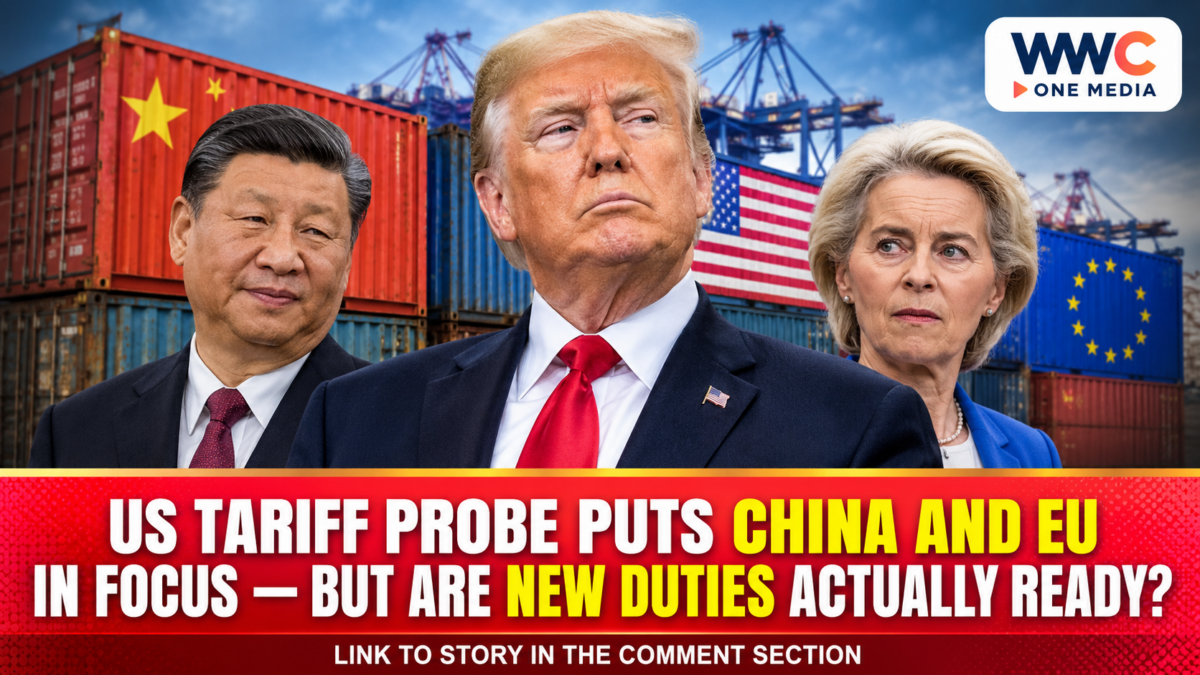
The United States has an ongoing US tariff probe covering China, the European Union and 14 other trading partners, after the Office of the US Trade Representative opened a Section 301 investigation on March 11, 2026. The inquiry examines whether manufacturing policies linked to alleged structural excess capacity and production in those economies are unreasonable or discriminatory and restrict US commerce.
The investigation could provide a legal basis for additional import duties, but the distinction between a probe and an enacted tariff is critical. The USTR’s public investigation page reviewed for this report lists the original notice, public hearing records and comment dockets; it does not list a final determination or tariff schedule for this specific case. New duties should therefore not be treated as already in force.
For manufacturers, exporters and importers, the immediate issue is not simply whether Washington wants to raise tariffs. It is whether the investigation produces a formal finding, what products are covered and how any resulting action interacts with existing trade arrangements.
What the US tariff probe is investigating
The March 11 USTR announcement identifies 16 economies: China, the European Union, Singapore, Switzerland, Norway, Indonesia, Malaysia, Cambodia, Thailand, Korea, Vietnam, Taiwan, Bangladesh, Mexico, Japan and India.
The investigation is being conducted under Section 301(b) of the Trade Act of 1974. That provision allows the US Trade Representative to examine foreign government acts, policies or practices that may be unreasonable or discriminatory and burden or restrict US commerce.
The formal notice describes the concern as manufacturing capacity that may be disconnected from domestic and global demand. It points to possible overproduction, persistent trade surpluses and manufacturing facilities that are underused or unused.
These are the US government’s stated grounds for investigating, not final findings that every named economy has violated trade rules. The investigation is intended to assess the relevant policies and determine whether action is justified. United States Trade Representative+1
The USTR’s March fact sheet lists a broad range of illustrative sectors, including automobiles, batteries, chemicals, electronics, machinery, semiconductors, ships, solar modules and steel. That list signals the potential breadth of the review, but it does not establish that every product in those industries will face a new duty. United States Trade Representative
Why China and the European Union are included
China and the EU are among the 16 economies named in the investigation, but the official notice does not treat the inquiry as a China-only measure.
The USTR’s stated concern is that government policies and other interventions may encourage production beyond what market demand can absorb. Its fact sheet identifies examples of practices it intends to examine, including subsidies, state-owned enterprise activity, subsidized lending, market-access barriers and policies that may suppress domestic demand.
Those descriptions are the administration’s investigative framework. Whether a particular policy meets the legal test under Section 301 requires a determination based on the investigation’s record.
For China, the issue sits alongside other trade disputes that have their own legal histories and timelines. Washington has separately extended certain exclusions from existing China-related Section 301 duties through January 9, 2027, citing ongoing discussions between the two governments. That extension concerns specified product exclusions under an earlier investigation; it is not a decision in the new manufacturing-capacity probe. GovInfo
The distinction matters for companies. A product may be covered by one tariff action, excluded from another or subject to separate customs conditions. A general headline about new tariffs cannot tell an importer what rate applies to a specific shipment.
The investigation has a public record, but no published tariff schedule
The formal process began in March. USTR opened public comment dockets on March 17, with an April 15 deadline for submissions. Public hearings were scheduled from May 5 through May 8, 2026, at the US International Trade Commission.
The USTR investigation page continues to list the hearing transcripts, hearing schedule, original notice and comment information. The public page reviewed does not display a final determination or a new tariff schedule for the structural excess-capacity investigation. United States Trade Representative+1
That does not mean the investigation has no consequences. It means the public record reviewed does not yet establish the final legal outcome or the product-level rates businesses would need to apply.
Section 301 investigations can lead to responsive measures, including duties, but the existence of an investigation is not the same as an effective customs instruction. Importers need the actual notice, product classifications, applicable rates, exemptions and effective dates before calculating landed costs.
Existing tariffs are separate from the new probe
Another source of confusion is that the United States already has other Section 301 measures in force.
In July 2026, USTR announced a separate action concerning economies’ failure to impose and effectively enforce prohibitions on imports of goods produced with forced labour. That action established different duty categories and product exemptions. It is not the same investigation as the manufacturing-capacity review.
China also remains subject to earlier Section 301 actions involving technology transfer and intellectual property, while a separate maritime, logistics and shipbuilding action has been suspended through January 10, 2027. These measures have distinct legal bases and should not be combined into a single tariff rate. United States Trade Representative+2
WWC has previously explained why US–Philippines tariff arrangements need to be checked against the actual published rules. The same principle applies to China and European suppliers: the legal instrument and product coverage matter more than a broad political announcement.
Why the outcome matters to Philippine businesses
The Philippines is not among the 16 economies named in this particular structural excess-capacity investigation. Nevertheless, a new round of duties affecting major manufacturing economies could influence sourcing decisions, supply-chain costs and competition in third-country markets.
Philippine manufacturers may buy components or materials from China, the EU and other affected economies. If duties change the relative cost of importing into the United States, suppliers may reassess where they sell, where they manufacture and how they structure distribution. Those are possible commercial responses, not confirmed outcomes.
For Philippine exporters, the effect could vary by product and market. A shift in global trade flows might create opportunities for alternative suppliers, but it could also expose local businesses to stronger competition from goods redirected to other destinations.
WWC’s coverage of the US tariff issue facing Philippine exporters explains why businesses need to distinguish one US trade action from another. The ongoing US-China trade discussions also show why negotiated arrangements and formal customs rules must be assessed separately.
Analysis: The most important question for Philippine businesses is whether any eventual US action changes actual product-level costs. Until the United States publishes the findings and implementing details, companies should avoid assuming that a new tariff rate has already been set or that existing trade preferences have been cancelled.
What happens next
The next decisive evidence would be a USTR determination or other formal government notice explaining the investigation’s findings and any responsive action. If duties are proposed or imposed, businesses will need the relevant product codes, rates, exemptions and effective dates.
Until then, the defensible conclusion is limited but significant: Washington has formally investigated 16 economies over alleged structural excess capacity in manufacturing, but the USTR public investigation page reviewed does not establish a final tariff schedule for this case.
For importers and exporters, monitoring the official notice matters more than relying on reported rate estimates. The commercial impact will become clearer only when the government publishes the actual terms.
Frequently Asked Questions
1. Which countries are covered by the US tariff probe?
The investigation covers 16 economies, including China, the European Union, Japan, South Korea, India, Mexico, Vietnam, Taiwan, Thailand, Malaysia, Indonesia, Switzerland, Norway, Singapore, Bangladesh and Cambodia.
2. Have the new tariffs on China and the EU already taken effect?
The USTR public investigation page reviewed does not list a final determination or tariff schedule for this structural excess-capacity investigation. Existing tariffs from other legal actions remain separate.
3. What is Section 301 of the US Trade Act?
Section 301 gives the US Trade Representative authority to investigate foreign government practices that may be unreasonable or discriminatory and burden or restrict US commerce. It can lead to responsive trade measures.
4. What industries could be affected?
The USTR’s illustrative list includes automobiles, batteries, chemicals, electronics, machinery, semiconductors, ships, solar modules and steel. The list does not mean every product in those industries will automatically face additional duties.
5. Could the investigation affect Philippine businesses?
Potentially. Changes to US import costs could influence suppliers, sourcing and competition across global markets. The actual impact on Philippine companies will depend on any final tariff rates, covered products and implementation dates.