
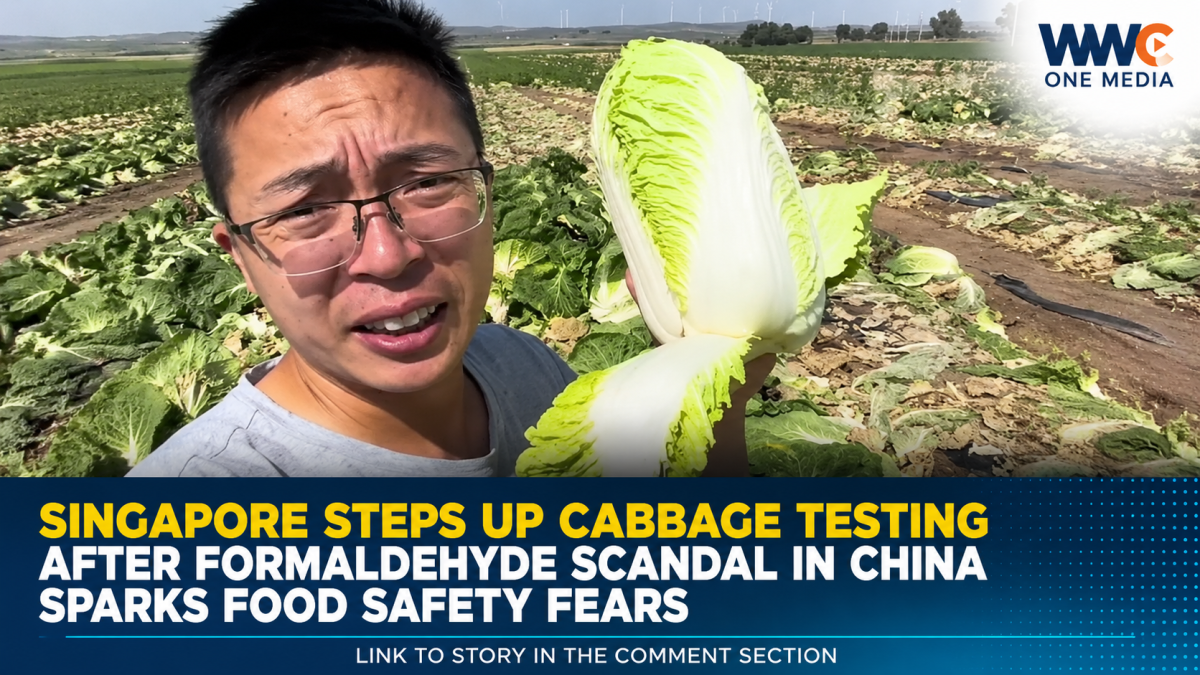
Singapore has stepped up surveillance and testing of cabbages following reports that formaldehyde was illegally used to preserve Chinese cabbage during transportation in China.
The Singapore Food Agency (SFA) confirmed on Sept. 1 that it is closely monitoring the situation and has increased cabbage surveillance and testing under its food safety monitoring programme.
The move comes after a viral video in China showed workers allegedly dipping cabbage into a formaldehyde solution before loading the vegetables for transport.
What happened in China?
The controversy began after a Chinese environmental content creator posted footage showing cabbage being treated with a liquid allegedly containing formaldehyde in Kangbao county, Hebei province.
Chinese authorities subsequently confirmed that the practice shown in the video had occurred and described the use of formaldehyde for transport preservation as illegal. Police took legal measures against people and vehicles involved, while authorities began tracing the distribution of the affected vegetables.
China’s food-safety authorities also ordered nationwide spot checks and market inspections of perishable vegetables, including cabbage, following the incident.
Importantly, this does not mean that all Chinese cabbage is contaminated. The investigation concerns specific produce connected to the reported illegal treatment.
Why is formaldehyde causing concern?
Formaldehyde is an industrial chemical used in products including resins, plastics, adhesives and other materials. The International Agency for Research on Cancer classifies formaldehyde as carcinogenic to humans.
Chinese authorities have stated that formaldehyde cannot legally be used as a food-processing aid or added to food.
At the same time, consumers should not interpret the word “formaldehyde” as meaning every cabbage or vegetable containing naturally occurring trace amounts is dangerous. The WHO has noted that formaldehyde can occur naturally in some foods, while food-safety risk depends heavily on exposure levels and circumstances.
The concern in this case is the intentional illegal use of formaldehyde as a preservation treatment.
Singapore is increasing its checks
SFA has not announced that Singapore’s cabbage supply is contaminated.
Instead, the agency said it is increasing surveillance and testing because of the reports from China. Singapore already operates an integrated food-safety system covering imported and locally produced food, including inspections and laboratory testing.
That distinction is important: Singapore’s increased testing is a precautionary food-safety measure, not confirmation that contaminated cabbage has entered the country.
South Korea also tested Chinese cabbage
Singapore is not the only country responding.
South Korea increased inspections of Chinese cabbage and related products after the Chinese incident attracted regional attention.
South Korea’s Ministry of Food and Drug Safety reported that tests conducted on imported Chinese cabbage found no formaldehyde, while testing of Chinese-made kimchi and related products also found no formaldehyde. On Aug. 31, South Korean authorities said the cabbage implicated in the Chinese incident had not been exported to South Korea.
Taiwan has also investigated whether affected produce could have entered indirectly through imported products, although its authorities said there were no records of Chinese cabbage being directly imported from China this year.
China is tracing where the cabbage went
Chinese authorities have been working to determine the distribution route of the cabbage involved in the incident.
Some of the produce was reportedly intended for markets outside Hebei, prompting authorities to conduct broader inspections of production, purchasing and transportation channels. Beijing’s major Xinfadi wholesale market said the implicated cabbage had not entered the market as of the date of its investigation.
The incident has therefore become a wider test of China’s food-supply traceability and enforcement system.
What consumers should know
For consumers in Singapore and elsewhere in Asia, the latest developments do not mean they should stop eating cabbage.
There is currently no evidence from the SFA reports that Singapore’s cabbage supply as a whole is unsafe.
The agency’s decision to increase testing is intended to identify any potential problems before they reach consumers.
The bigger issue is whether the investigation in China can fully establish how much produce was treated, where it was distributed and whether any affected batches crossed international borders.
As Singapore tightens its checks, the question many consumers will be watching is: Could any cabbage linked to the China incident have entered regional food markets?
WWC ONE MEDIA J.M.D




Leave a Reply