
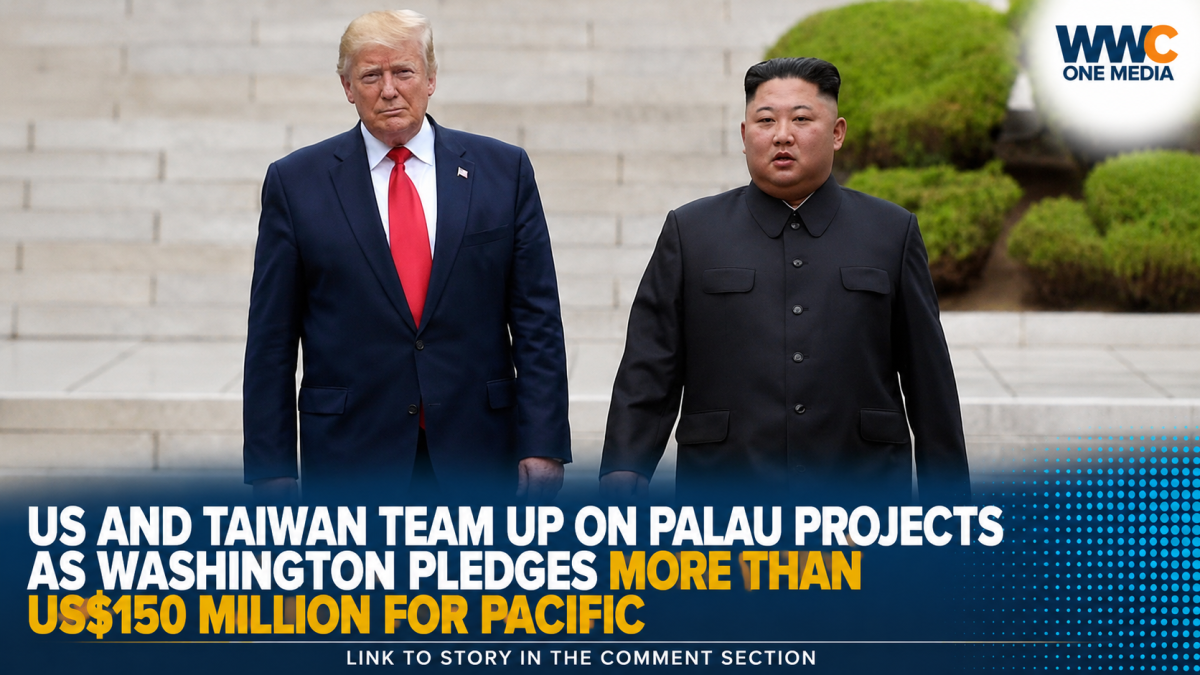
The United States and Taiwan are deepening cooperation in Palau as Washington announces more than US$150 million in new support for Pacific Island nations, putting infrastructure, energy security and regional development at the center of a growing geopolitical contest.
US Deputy Secretary of State Christopher Landau announced the funding on Sept. 1 during the Pacific Islands Forum Partners Dialogue in Palau. The US Department of State said the package is intended to strengthen economic prosperity and security across the Pacific.
But two projects stand out because they directly involve cooperation with Taiwan.
New hospital project puts US, Taiwan and allies on the same team
The first is a proposed relocation and development of a modern hospital in Palau.
The United States, Australia, Japan, New Zealand, South Korea and Taiwan are identified as partners supporting the project, which is designed to address Palau’s long-term healthcare and infrastructure needs.
However, the project is not yet a completed construction commitment. The US State Department says it remains subject to the outcome of a feasibility study.
The project builds on Taiwan’s longstanding development relationship with Palau, including cooperation in healthcare, agriculture, fisheries and public infrastructure.
Taiwan’s Vice President Hsiao Bi-khim visited Palau in June and highlighted Taiwan-supported projects, including Palau’s national hospital, as examples of the two countries’ cooperation.
Taiwan also joins drinking-water project
The second initiative involves water security.
The US Environmental Protection Agency, working with Taiwan, plans to help Palau conduct comprehensive sampling of drinking-water sources and wells.
The project also includes training for Palau’s drinking-water operators and environmental laboratory staff on sampling and logistical procedures.
That makes the announcement more than simply a diplomatic gesture: Washington and Taipei are cooperating on practical infrastructure and public-health projects in a Pacific island nation.
US puts US$150 million on the table
The broader US package exceeds US$150 million and includes a proposed US$60 million Regional Energy Security Initiative aimed at expanding fuel-storage capacity and improving grid stability.
Washington is also backing initiatives involving illegal, unreported and unregulated fishing, infrastructure, digital connectivity, law enforcement and regional security.
The announcement comes as Pacific nations face rising energy costs and other economic pressures, while China has expanded its own infrastructure, economic and security relationships throughout the region.
Australia has also announced A$600 million, roughly US$430 million, to help Pacific nations combat drug trafficking through measures including aerial surveillance and law-enforcement training. Together, the US and Australian announcements amount to about US$580 million in new support.
China-Taiwan tensions overshadow the summit
The development cooperation is unfolding against a sensitive diplomatic backdrop.
Taiwan has participated in the Pacific Islands Forum as a development partner since 1993, but China strongly opposes its participation.
Beijing warned of unspecified “consequences” after Taiwan’s Foreign Minister Lin Chia-lung attended events connected with this year’s forum in Palau. Australia and New Zealand have said the Pacific bloc should determine its own guest arrangements.
Palau is particularly significant because it is one of only three Pacific Islands Forum members — alongside the Marshall Islands and Tuvalu — that maintain formal diplomatic relations with Taiwan.
The United States has also openly backed Taiwan’s continued participation, calling Taiwan a reliable and democratic development partner that contributes to prosperity across the Pacific.
Why this matters
The projects show how competition in the Pacific is increasingly being fought through healthcare, water, energy, infrastructure and development assistance — not just military power.
For Palau and other island nations, the growing involvement of the US, Taiwan, Australia, Japan, New Zealand and South Korea could bring additional resources for critical projects.
For Washington and its partners, meanwhile, deeper engagement offers a way to maintain influence in a region where China’s presence has expanded rapidly.
The question now is whether these new partnerships will remain focused on development — or become another major front in the escalating US-China-Taiwan competition for influence across the Pacific.
WWC ONE MEDIA J.M.D


Leave a Reply