A Pennsylvania appeals court has reversed a lower court’s decision involving the tax sale of a family home in Delaware County, ruling that officials failed to make required inquiries after notices were returned with the notation “Deceased.” The Commonwealth Court issued its decision on November 19, 2026, and sent the case back for an order setting aside the sale. pacourts.us
The property had been purchased for $109,000 by CJD Group, LLC at a September 2023 tax auction. The dispute reached the appellate court after the estate of Kevin Wilson challenged the sale, arguing that the county’s Tax Claim Bureau had not properly followed the notice requirements under Pennsylvania’s Real Estate Tax Sale Law. pacourts.us
The decision highlights an important distinction in property enforcement: sending correspondence is not necessarily enough when official records show that the intended recipient may be deceased. The court focused on whether the bureau took reasonable steps to identify the people whose interests could be affected before allowing the sale to proceed.
How the property passed from mother to son
The court’s opinion states that Bonnie Wilson purchased the property at 5103 Poplar Street in Garnet Valley, Delaware County, in June 2017. She lived there until her death in December 2019.
Under her will, the property was devised to her son, Kevin Wilson, who also lived there. Kevin died on or about August 7, 2023, before the property was sold at auction. pacourts.us
The property had outstanding real estate taxes for 2021 and 2022. The Delaware County Tax Claim Bureau proceeded with an upset tax sale on September 21, 2023, at which CJD Group, LLC became the successful bidder for $109,000.
The court record identifies Kelli A. Barth as executrix of Kevin’s estate and the appellant who challenged the sale. The lower court had denied her petition to set it aside, prompting the appeal.
The appellate decision did not dispute that taxes were delinquent. Its central question was whether the bureau had complied with the legal steps required to notify the appropriate parties before the property was sold.
The returned notices became central evidence
The court examined the bureau’s attempts to notify the person it still regarded as the property’s owner.
In 2022, a notice concerning the delinquent taxes was sent by certified mail to Bonnie at the property address. It was returned marked unclaimed and unable to be forwarded.
In July 2023, the bureau sent another notice concerning the upcoming tax sale, again addressed to Bonnie. The returned green card carried an illegible signature and was dated July 19, 2023.
A deputy sheriff’s affidavit also stated that the property was posted and Kevin was personally served with a sale notice on July 24, 2023. Kevin died on or about August 7.
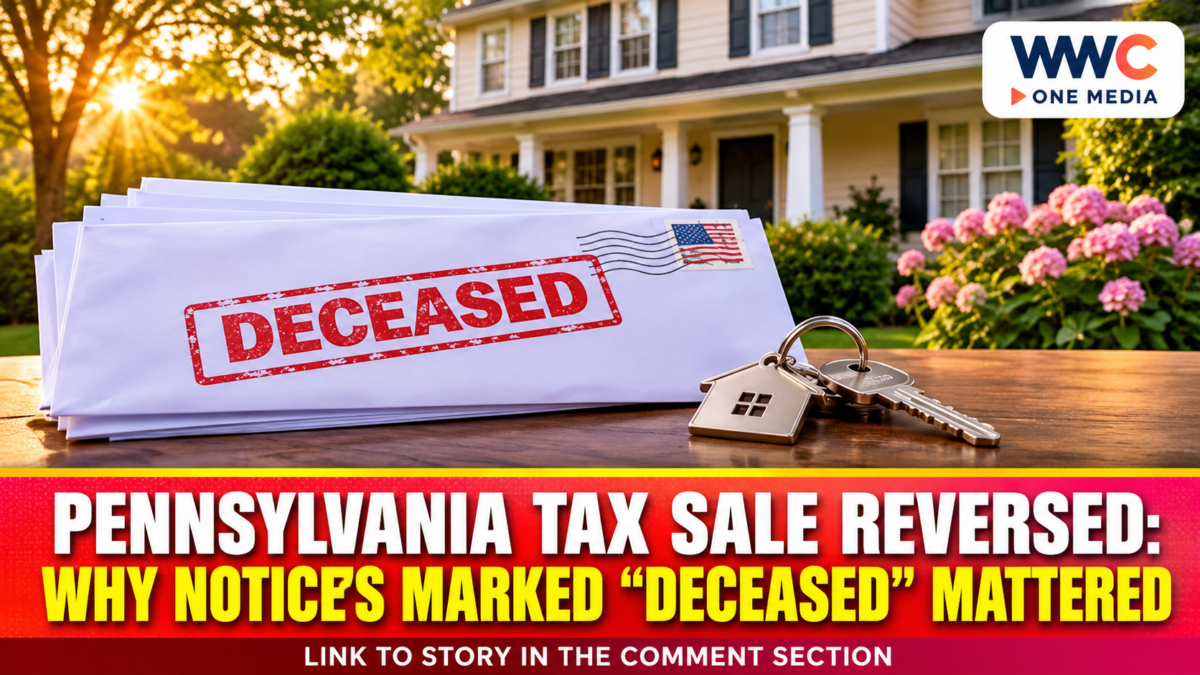
The critical development came with the final notice sent to Bonnie by first-class mail in August. The court record says that this correspondence was returned on August 29 with the handwritten notation “Deceased” — almost a month before the scheduled auction. pacourts.us
After the sale, another notice addressed to Bonnie was returned with the same notation. The appellate court considered both the pre-sale and post-sale returns in assessing whether the bureau had taken the additional steps required by law.
What Pennsylvania law requires after a notice fails
The case turned on Section 607.1 of Pennsylvania’s Real Estate Tax Sale Law, cited in the opinion as 72 P.S. § 5860.607a.
In practical terms, the provision requires a tax claim bureau to make reasonable efforts to locate and notify an affected person when a mailed notice is returned without the required personal signature or when other circumstances create significant doubt that the intended recipient actually received it.
The law identifies possible steps, including checking county telephone directories, tax assessment records, the recorder of deeds and the prothonotary’s office. It also refers to contacting apparent alternative addresses or telephone numbers found in the property’s file. pacourts.us+1
The court concluded that the returned correspondence should have triggered further inquiry. It noted that the record contained no evidence that the bureau had made reasonable efforts to determine whether Bonnie had died, whether a will had been probated or who owned the property.
The opinion also pointed to the Register of Wills as a relevant source of information that the bureau could have contacted.
This was not simply a dispute over whether a letter had been mailed. The court examined what officials did after information emerged that the correspondence might not have reached the person named on it.
Why the court rejected the buyer’s argument
CJD Group argued that the deputy sheriff’s personal service of the sale notice on Kevin overcame defects in the bureau’s notification process.
The Commonwealth Court rejected that position. Kevin had died more than a month before the September auction, while the bureau had continued to operate on the assumption that Bonnie remained the owner.
The buyer also challenged aspects of Barth’s testimony and raised questions about her administration of Bonnie’s estate. The court said those issues did not resolve the statutory question.
Its reasoning was that the validity of the tax sale depended on whether the bureau complied with its legal obligations, rather than on alleged neglect by the former property owner or the estate representative. pacourts.us
The ruling therefore did not establish that delinquent taxes were never owed. It addressed the bureau’s failure to demonstrate that it had carried out the additional notification efforts required under the circumstances.
For readers interested in the wider relationship between inherited assets and government obligations, WWC has also examined the difficulties Filipino families face when settling estate taxes on inherited property. The legal systems and tax rules are different, but both situations illustrate how inheritance paperwork and property obligations can become complicated after an owner’s death.
What the ruling means — and what it does not
The Commonwealth Court reversed the lower court’s order and remanded the case for entry of an order setting aside the upset tax sale. The appellate ruling therefore directs the next procedural step; it should not be confused with a separate finding that all outstanding tax obligations have disappeared. pacourts.us
The opinion is identified by the Pennsylvania court system as non-precedential. That means it resolves the dispute before the court but should not be presented as a binding statewide precedent in the same way as a precedential appellate decision. Unified Judicial System of Pennsylvania
The case also raises a broader public-interest question about safeguards when government action affects property rights. A tax authority has a legitimate role in collecting unpaid taxes, but that process must operate alongside legal protections for owners, estates and other people whose interests may be affected.
WWC has explored a related issue in its coverage of Indonesia’s proposed asset-forfeiture framework and protections for legitimate property owners. That legislation concerns a different legal process, but it likewise demonstrates why property enforcement needs clear procedures and meaningful safeguards.
What happens next
The Delaware County Court of Common Pleas must carry out the appellate court’s remand by entering an order setting aside the upset tax sale.
The opinion does not provide a date for that further order. Nor does it establish the final outcome of every possible issue involving the property’s ownership, estate administration or unpaid taxes.
The next relevant development will be the lower court’s action following the appellate ruling. Any later report should distinguish the order setting aside the sale from separate questions about the estate’s administration and the underlying tax obligations.
For now, the central legal finding is clear: when official notices raise serious doubts that the named property owner received them, the tax authority must take the additional reasonable steps required by law before proceeding.
Frequently asked questions
Why did the Pennsylvania court reverse the property tax sale?
The Commonwealth Court found that the Delaware County Tax Claim Bureau failed to make reasonable additional efforts after notices were returned with the notation “Deceased.”
How much did the buyer pay for the property?
CJD Group, LLC purchased the property for $109,000 at the September 21, 2023, upset tax sale.
Who inherited the property from Bonnie Wilson?
The court’s opinion states that Bonnie devised the property to her son, Kevin Wilson, under her will.
What does Section 607.1 of Pennsylvania’s tax sale law require?
It requires tax claim bureaus to make reasonable efforts to locate and notify affected people when returned notices or other circumstances create significant doubt that the intended recipient received the notice.
Has the property sale already been formally cancelled?
The November 19 appellate decision reversed the lower court and remanded the case for entry of an order setting aside the sale. The appellate opinion itself directs that next step.