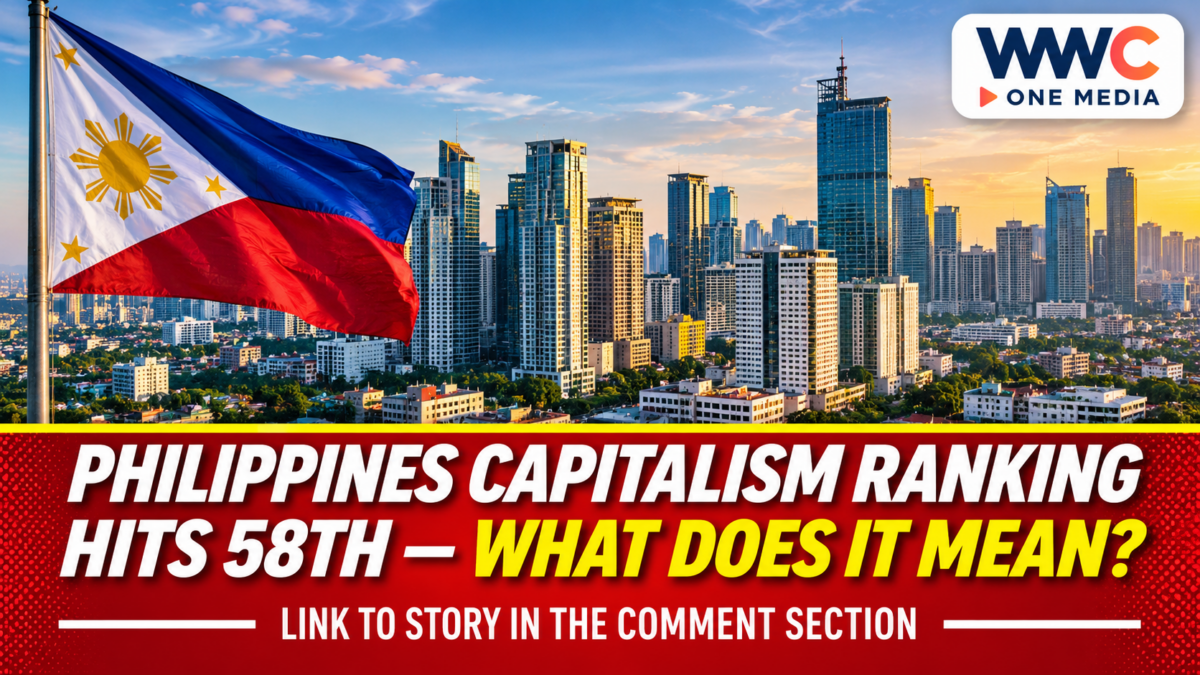
MANILA, Philippines — Nov. 21, 2026. The Philippines placed 58th among 161 economies in the University of Virginia’s 2025 Global Capitalism Index, with a composite score of 70.2 out of 100. Its score increased from approximately 67.9 in the preceding edition, but the published methodology cautions that the index measures market institutions rather than GDP growth, investment arrivals or the financial position of ordinary households.
The result offers a way to examine how the country’s economy supports enterprise, finance and commerce. It is not a verdict that Philippine living standards improved by the same amount, and it does not automatically establish whether a new business is easier to start or run today.
Philippines Capitalism Ranking: What the Figures Show
The university’s published table places the Philippines at No. 58 with a rounded score of 70.2 in the 2025 edition. The index’s original downloadable dataset records a more precise 70.2253, up from 67.8604 in its 2024 series. Those values are calculated scores, not percentages of Filipinos participating in capitalism.
The index covers 161 economies with a complete composite score in 2025. Switzerland topped the ranking, followed by the United States, Hong Kong, Canada and Singapore. These comparisons place the Philippines in the broader distribution without suggesting the economic systems are identical.
The year labels also need care. The index’s technical documentation states that a 2025 edition score reflects institutional conditions during calendar year 2024. A movement between the 2024 and 2025 editions therefore cannot be presented as a measure of reforms enacted this month.
Eight Measures, Not a Single Economic Freedom Score
Researchers grouped their evidence into eight dimensions: property rights and private ownership, market-supporting policy, market competition, capital-market sophistication, banking, new-business formation, labour-market openness, and the free flow of goods and capital.
This structure matters because market activity depends on more than low taxes or fewer regulations. Contracts, competition rules, bank access and the ability to establish a company can shape the environment in which investors and entrepreneurs operate.
An aggregate score inevitably compresses differences. A country might perform better in banking than in the ease of cross-border transactions, for example. The overall Philippine score does not, by itself, identify which of its eight categories improved most or tell the owner of a small enterprise what a particular permit will cost.
WWC’s earlier explanation of Philippine AI readiness and infrastructure gaps concerns a different index. It illustrates why a ranking should be evaluated against the exact capabilities that its authors chose to measure.
Why a Higher Score Requires Interpretation
The underlying index is assembled from numerous datasets, and the researchers acknowledge that gaps must sometimes be estimated. Published scores carry confidence intervals, recognising that the measured level may vary depending on available observations and the statistical approach.
For the Philippines, the dataset lists a 2025 score range of 69.3678 to 71.073 and a 2024 range of 66.896 to 68.8123. These ranges do not overlap in the published data, making the score increase worth examining. Nevertheless, the methodology says normalisation is performed each year, so the broader distribution can also affect a country’s numerical result.
Analysis: The best interpretation is a documented improvement within this research framework, not a claim that every market institution became stronger. A rise in a composite measure should prompt examination of the individual component results and of official domestic indicators before anyone attributes the change to a particular reform.
The often-cited five-place improvement from 63rd was not separately recalculated from the full 2024 country ranking during this review. The confirmed 2025 placement and the underlying two-year scores are sufficient to explain the new data without claiming an independently checked previous rank.
The Business Questions the Index Cannot Answer Alone
For businesses, the practical stakes include investment rules, access to finance, market competition and the cost of transacting with customers and suppliers. The index considers the institutional conditions supporting these activities; it does not count new Philippine jobs created as a direct consequence of a better score.
Analysis: Policymakers can use the component framework as a diagnostic tool. A weakness in financial access may require a different response from a weakness in business formation or property-rights enforcement. But a national aggregate ranking is too broad to identify the best intervention without more detailed evidence.
Cross-border activity provides one example. WWC’s examination of regional trade and business integration explores the operational steps that companies need before a diplomatic trade framework becomes useful. This regional discussion is separate from the university’s index, although both concern the environment for commerce.
A potential investor also needs sector-specific rules, credible financial information and an assessment of actual commercial demand. None of those can be replaced by a single position in a global league table.
Why Rankings Should Not Be Mixed Together
The Global Capitalism Index is not the same as a competitiveness ranking, an economic-freedom index or a survey of digital skills. Those projects use different indicators, samples and methods. Their results therefore cannot be combined into a universal judgment about the Philippines.
WWC has separately reviewed the Philippine digital and AI competitiveness ranking. That assessment focuses on digital and technological capabilities rather than the full set of market institutions examined in the capitalism index.
Analysis: A stronger investment environment should ultimately be tested against observable outcomes such as business formation, reliable services, productive employment and competitive access to markets. The university’s results provide one research perspective, not an official government report card or a promise of future economic growth.
What Happens Next
The index creators intend to update the series annually. Future releases could reveal whether the Philippine score continues to improve and which dimensions contribute most to any change.
For now, the verified result is a 58th-place ranking and a 70.2 score in the index’s 2025 edition. The more useful follow-up is to examine the detailed components and compare them with relevant Philippine agency data, while remembering that the index measures an earlier observation period.
Frequently Asked Questions
What is the Philippines’ Global Capitalism Index ranking?
The Philippines ranked 58th out of 161 economies with a score of 70.2 in the index’s 2025 edition.
Did the Philippines improve from the previous edition?
Its underlying composite score increased from 67.8604 in the 2024 series to 70.2253 in the 2025 series. The previously reported rank change requires separate verification against the complete earlier country ranking.
Does 58th place mean the Philippines is the world’s 58th richest economy?
No. The index measures institutional conditions for market systems, not national wealth, GDP per person or average household income.
What year does the 2025 index actually measure?
The authors specify that the 2025 edition reflects underlying calendar-year 2024 conditions. The release date and the observation year should not be confused.