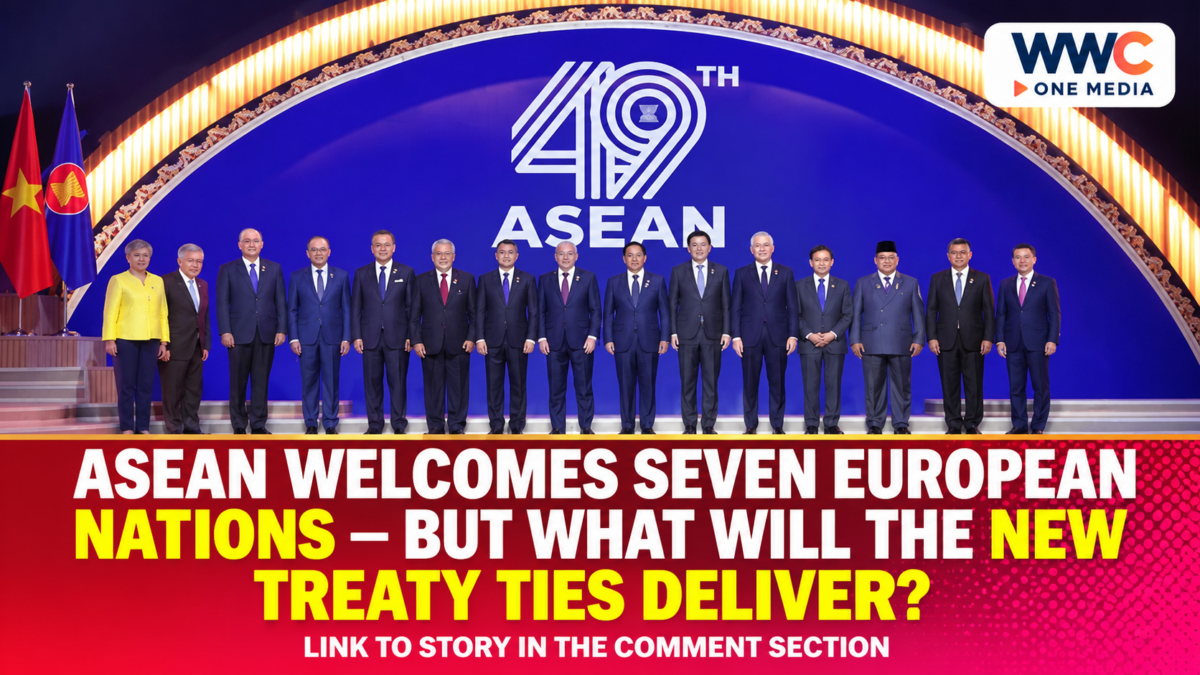
MANILA, Philippines — ASEAN treaty expansion brought seven additional European countries into Southeast Asia’s diplomatic framework during the Philippines’ 2026 chairmanship. Four signed accession instruments in Manila on July 24, while three others joined through a ceremony on Nov. 14.
The developments widen the group of governments committed to the Treaty of Amity and Cooperation in Southeast Asia (TAC), a framework centred on peaceful dispute settlement, sovereignty and cooperation.
For the Philippines, the outcome strengthens the diplomatic dimension of its ASEAN leadership year. The bigger question is what these new relationships can achieve beyond the formal signing ceremonies.
ASEAN Treaty Expansion Unfolds in Two Stages
The seven European countries are Lithuania, Poland, Romania, Sweden, Cyprus, Slovakia and Slovenia.
Their accessions did not happen at a single meeting.
Lithuania, Poland, Romania and Sweden signed their instruments on July 24, during events associated with the 59th ASEAN Foreign Ministers’ Meeting and the treaty’s 50th anniversary.
ASEAN’s official treaty register records that date for all four countries.
Cyprus, Slovakia and Slovenia subsequently participated in an accession ceremony on Nov. 14, during the 49th ASEAN Summit and related meetings in Manila.
The ASEAN Secretariat separately confirmed the ceremony and announced diplomatic engagements involving the three governments.
The distinction matters because ASEAN’s online legal register, as reviewed for this article, still lists the July entrants but has not yet incorporated the November group.
That is a documentation issue requiring clarification, rather than proof that the November ceremonies did not take place.
What the Treaty Actually Requires
The Treaty of Amity and Cooperation was signed in Bali, Indonesia, on Feb. 24, 1976.
It establishes principles governing relations among its parties, including respect for national sovereignty, non-interference, peaceful settlement of disputes and rejection of the threat or use of force.
The treaty also encourages cooperation in economic, scientific, technical, cultural and administrative fields.
Its importance lies in creating shared diplomatic expectations among countries with different political systems, geographic interests and economic priorities.
However, accession does not automatically create a free-trade agreement, investment guarantee, military alliance or unrestricted market access.
The treaty contains provisions for consultation and peaceful dispute resolution. Its dispute-settlement mechanism also depends on the agreement of the countries directly involved before it can apply to a particular dispute.
This makes the TAC a political and diplomatic foundation, not a substitute for detailed commercial agreements or binding project contracts.
That distinction is essential when evaluating whether an expanded network will deliver benefits to Southeast Asian economies.
Why Europe’s Growing Interest Matters to ASEAN
European engagement with ASEAN is not starting from zero.
The European Union itself became a party to the treaty in July 2012, while several individual European governments joined in earlier years.
The latest accessions deepen that established relationship by bringing additional governments into ASEAN’s framework of diplomatic principles.
For ASEAN, the potential advantage is a larger group of partners that formally accept its approach to interstate relations.
For European governments, participation provides another basis for engaging Southeast Asian countries on regional priorities.
Economic opportunities may emerge through separate trade negotiations, investment initiatives and institutional partnerships, but accession alone does not establish those arrangements.
WWC ONE MEDIA previously examined
.
Those negotiations illustrate why diplomatic engagement and commercial integration must be assessed separately.
The treaty can support constructive relations, while trade agreements require additional negotiations, commitments and implementation.
The Philippines’ Diplomatic Opportunity
The expansion occurred during a year when the Philippines placed peace, economic connectivity and people-centred cooperation among its ASEAN chairmanship priorities.
At the January ASEAN Foreign Ministers’ Retreat, governments reaffirmed the importance of the TAC and its continuing role in maintaining regional stability.
They also discussed pending accession applications, including those of Slovenia and Slovakia, and procedures for admitting additional partners.
The subsequent November ceremonies demonstrate movement from that preparatory agenda into formal diplomatic participation.
For Manila, the achievement highlights its role in hosting negotiations and ceremonies that connect ASEAN with governments outside Southeast Asia.
The Philippines has also pursued broader external engagement through ASEAN’s multilateral partnerships.
WWC’s earlier examination of
shows another part of that diplomatic programme.
Both initiatives involve cooperation beyond ASEAN’s membership, although their legal foundations and institutional functions differ.
The wider challenge is ensuring that diplomatic commitments contribute to programmes and policy decisions that can survive changes in ASEAN’s rotating leadership.
What This Could Mean for Philippine Businesses
The immediate economic effect of the new treaty accessions should not be overstated.
The available accession records do not establish new tariffs, investment amounts, government procurement opportunities or guaranteed benefits for Philippine exporters.
However, stronger diplomatic relationships may create conditions for more frequent dialogue on trade, technology, infrastructure and other shared interests.
That possibility matters to businesses seeking partnerships across Europe and Southeast Asia.
The distinction between a political framework and a commercial agreement is especially relevant for smaller enterprises, which need clear regulations and practical market-access arrangements rather than broad statements of cooperation.
In a separate regional initiative, ASEAN has also been advancing digital economic integration.
WWC previously examined
.
Unlike treaty accession, a dedicated economic agreement is designed to address operational rules affecting trade and digital transactions.
The two initiatives may complement each other diplomatically, but they should not be treated as interchangeable.
The relevant business test will be whether the new European relationships produce identifiable cooperation programmes with clear responsibilities and measurable outcomes.
What Happens Next
The next stage is less about the number of countries joining and more about what governments do with their participation.
ASEAN’s publication of updated treaty records would help establish a complete, current register reflecting the November ceremonies.
Further diplomatic meetings could also clarify which fields of cooperation the new parties intend to prioritise.
There is no basis in the verified accession records to promise immediate investment flows, new trade concessions or specific commercial deals.
For the Philippines and its ASEAN partners, continued engagement could create opportunities for cooperation, but their substance will depend on subsequent decisions.
The seven European accessions represent a wider diplomatic network. Whether that network produces tangible results is a separate question that future agreements and implementation records must answer.
Frequently Asked Questions
Which seven European countries joined the ASEAN treaty in 2026?
Lithuania, Poland, Romania and Sweden signed accession instruments in July. Cyprus, Slovakia and Slovenia participated in a separate accession ceremony in November.
What is the Treaty of Amity and Cooperation?
It is a treaty first signed in 1976 that sets principles for peaceful relations, respect for sovereignty, non-interference and cooperation among its parties.
Does joining the treaty make a European country an ASEAN member?
No. Treaty accession does not confer ASEAN membership or participation rights equivalent to those of ASEAN member states.
Will the agreement immediately improve trade with the Philippines?
Not automatically. The TAC does not itself establish tariff concessions or commercial contracts. Those outcomes would require separate arrangements.
Why is the treaty important to Philippine diplomacy?
It supports ASEAN’s framework for relations with external partners and provides a platform for continued international engagement during and beyond the Philippines’ chairmanship.