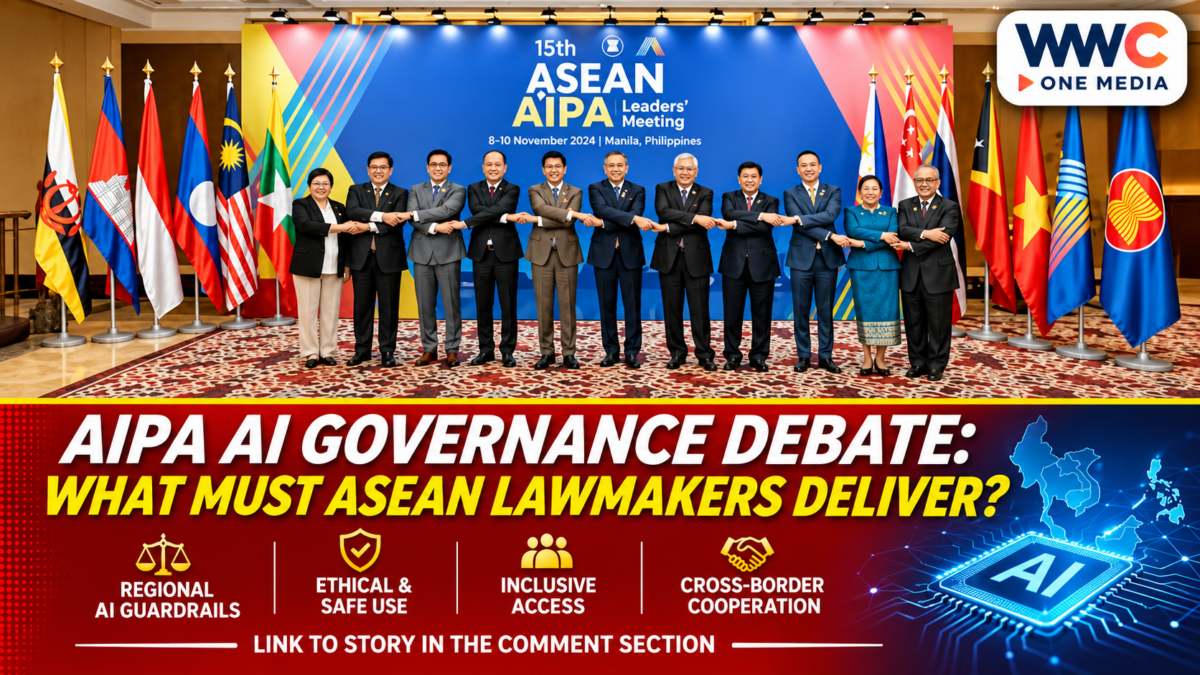
MANILA, Philippines — Nov. 21, 2026. Southeast Asian parliamentarians meeting in Manila have placed technology safeguards within a wider programme of legislative cooperation as the ASEAN Inter-Parliamentary Assembly (AIPA) holds its 47th General Assembly. The AIPA AI governance debate has a practical question at its centre: how can national lawmakers respond to artificial intelligence while protecting people and keeping innovation possible?
The AIPA Secretariat confirms the assembly’s Manila programme and parliamentary committees, as well as an earlier specialised training course on risks posed by AI and other technologies. Those records establish sustained parliamentary attention to the subject. They do not, on their own, demonstrate that a new regional AI regulator, treaty or binding code has entered into force.
AIPA AI Governance Is a Parliamentary, Not Regulatory, Process
AIPA’s first plenary session took place on Nov. 18 under Philippine House Speaker Faustino “Bojie” G. Dy III. The assembly’s programme identified its theme as “Parliaments Securing a Peaceful, Prosperous, and People-centred ASEAN.” Delegations considered agendas and other organisational matters before the work of the committees.
AIPA brings national legislatures into regional policy discussions. It is not a legislature that can automatically replace each country’s domestic laws. That distinction matters when a subject such as AI touches employment, education, cybersecurity and public services at the same time.
Parliamentary cooperation can identify shared concerns, compare legislative approaches and encourage follow-up at home. Enforceable duties still depend on what individual jurisdictions adopt through their own legal processes.
WWC’s existing report on the Philippines handing AIPA’s presidency to Singapore after the Manila assembly discusses the wider outcome. This article focuses on a narrower question: what would responsible AI oversight actually require?
Earlier Training Shows the Issue Predates the Manila Assembly
AIPA’s official record documents a parliamentary training course held in Manila from Feb. 11 to 13, 2026, in partnership with the United Nations Office of Counter-Terrorism. The course addressed legislative and policy measures to prevent the misuse of artificial intelligence and newer technologies for terrorism and violent extremism.
The stated purpose was to improve lawmakers’ understanding of both opportunities and risks. Participants included representatives from ASEAN and parliamentary institutions in other regions.
That earlier programme is relevant because it demonstrates an established capacity-building effort rather than a concern invented during the November gathering. Nevertheless, attendance at training does not establish that participating parliaments passed particular criminal laws or agreed on a universal definition of prohibited AI activity.
Analysis: Lawmakers need enough technical knowledge to assess risks without imposing vague restrictions on ordinary, lawful uses of digital technology. Training is one preliminary step; the harder work is drafting rules that are specific, proportionate and workable.
Education, Privacy and Work Require Different Safeguards
AI governance is not one policy problem. An automated hiring tool may raise questions about employment fairness. A school application may require rules about children’s information and human review. A system used in public administration may need clear appeal procedures and accountability for mistakes.
Treating all those uses as identical could produce rules that are too broad to enforce or too narrow to protect affected people. Parliamentary committees therefore have a reason to examine technology alongside their existing responsibilities for social affairs, education and economic policy.
The AIPA Secretariat records a meeting of its Social Matters Committee on Nov. 19 chaired by Philippine lawmaker Roman T. Romulo. It also records a separate meeting of Young Parliamentarians of AIPA on the same date. Those meetings confirm the structures through which social and youth issues can be debated; the published event listings do not themselves establish the final wording of any AI-specific resolution.
In the Philippines, the domestic discussion is already active. WWC has covered the government’s National Artificial Intelligence Council, a separate Philippine policy development rather than an institution created by AIPA.
Why Cross-Border Cooperation Still Matters
Digital tools, employers and online platforms can operate in several Southeast Asian markets. A consumer may use a service based overseas, while an employee may work with a system designed in another jurisdiction. These situations can complicate questions about oversight and redress.
Greater parliamentary coordination could make it easier to compare standards and identify gaps. But agreement on principles is different from compatible laws, effective supervision or access to remedies when something goes wrong.
Analysis: A useful measure of progress would be whether member parliaments make their proposed safeguards public, consult affected sectors and explain how ordinary people can seek corrections or challenge consequential automated decisions.
Workers also have a stake in that debate. WWC’s coverage of a proposed Philippine bill on AI-related dismissals shows a national legislative approach. It should not be mistaken for a region-wide AIPA employment rule.
What the November Proceedings Establish—and What They Do Not
The AIPA Secretariat lists the 47th General Assembly in Manila from Nov. 16 to 22, including its first plenary and committee meetings. It also confirms that Timor-Leste’s National Parliament became AIPA’s eleventh member parliament during the Nov. 18 plenary.
This broader participation gives lawmakers another forum for exchanging policy approaches. It does not mean every parliament has endorsed identical artificial-intelligence legislation.
A complete evaluation of the November AI proposals requires the adopted resolution texts, any agreed implementation arrangements and later national legislative records. A headline announcing that an AI centre has opened, or that shared AI regulations already apply across ASEAN, would need additional documentary evidence beyond the accessible proceedings reviewed here.
What Happens Next
The next meaningful checkpoints are publication of the relevant AIPA resolutions, any formal proposal for regional technical coordination and follow-up decisions by national legislatures. The strongest outcomes would specify responsibilities, timelines, oversight safeguards and arrangements for reporting progress.
For Philippine businesses, workers and families, the important test is whether proposals eventually clarify obligations and rights, rather than merely add another forum for discussing technology.
The Manila meetings provide an opportunity for regional lawmakers to coordinate. They do not replace the work of drafting, debating and enforcing clear domestic laws.
Frequently Asked Questions
1. Did AIPA create a binding ASEAN artificial-intelligence law?
No such region-wide law is established by the official proceedings reviewed for this article. AIPA provides a parliamentary cooperation forum; domestic legal changes require national action.
2. When was the 47th AIPA General Assembly held?
The AIPA Secretariat lists its Manila programme for Nov. 16–22, 2026, with the first plenary session held on Nov. 18.
3. Has AIPA previously examined AI risks?
Yes. It partnered in a Feb. 11–13, 2026 parliamentary training programme addressing misuse of AI and new technologies for terrorism and violent extremism.
4. What is the practical AI policy challenge for lawmakers?
Balancing innovation with enforceable safeguards for privacy, accountability, education and employment, while recognising that each application has different risks.
5. What would show that AIPA’s discussions produced results?
Published resolution texts, national legislative proposals, defined responsibilities and documented follow-up would offer clearer evidence than summit statements alone.