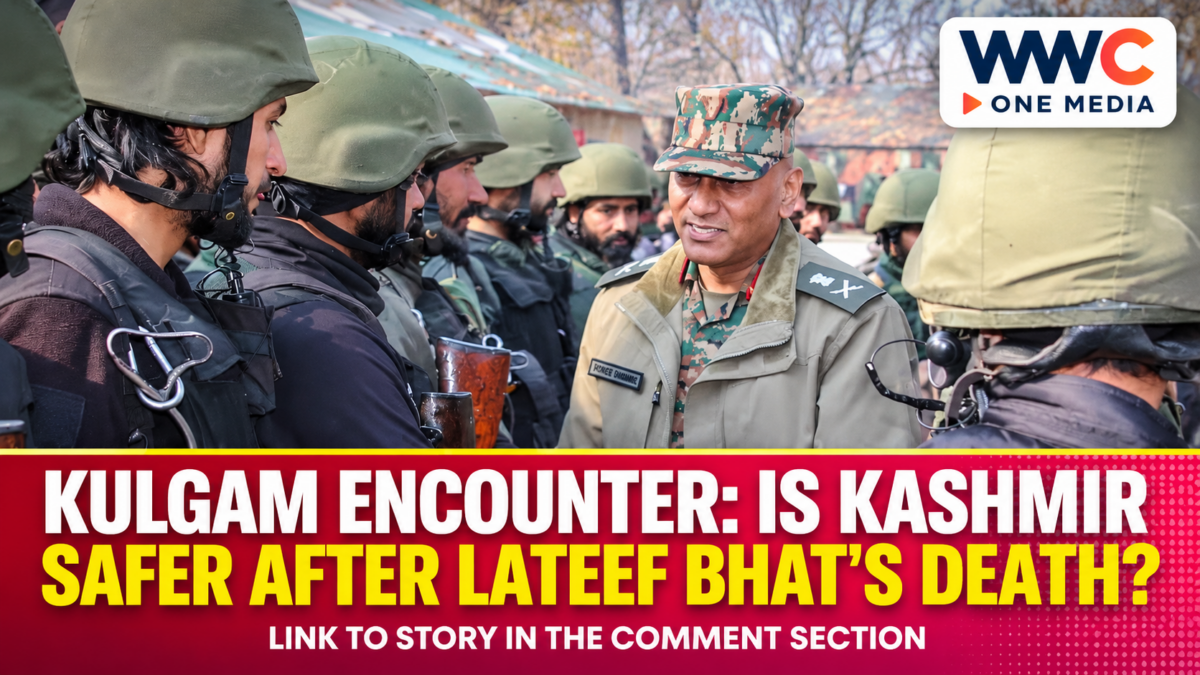
NEW DELHI, India — India’s Home Ministry announced on Nov. 18, 2026, that Lateef Bhat had been killed during a security operation in Kulgam district, Jammu and Kashmir. Union Home Minister Amit Shah described Bhat as Lashkar-e-Taiba’s last known active local militant in the Kashmir Valley and praised the agencies involved in the operation.
The Kulgam encounter marks an important development in India’s continuing counterterrorism campaign. But the government’s announcement raises a larger question: does the removal of one identified militant demonstrate lasting improvement in security, or must progress be measured through broader evidence?
The answer matters because official records show substantial declines in violence over recent years, while also documenting continued civilian and security-force casualties.
Kulgam Encounter: What India Officially Confirmed
The Ministry of Home Affairs released its statement on Nov. 18, reporting that Bhat had been killed during the early morning.
Shah credited the Jammu and Kashmir Police, Indian Army, Central Reserve Police Force and intelligence agencies with conducting a coordinated operation.
The same announcement said Umar Nisar, whom the government described as an associate of Bhat, had been killed in Kulgam the previous day, Nov. 17.
These statements establish the government’s account of the two deaths. They do not, by themselves, provide a full public reconstruction of the encounters, including the underlying intelligence, forensic evidence or circumstances surrounding the use of force.
The distinction is important for accurate reporting. An official operational announcement establishes what authorities have said, but it should not automatically be treated as independent proof of every allegation against the individuals involved.
Why ‘Last Known Active Local Militant’ Needs Context
The government’s description of Bhat is significant, but its wording has limits.
Being identified as the last known active local militant of Lashkar-e-Taiba does not establish that every armed network in the Kashmir Valley has disappeared. Nor does it confirm that infiltration, recruitment or support activities have ended.
The qualification last known refers to the authorities’ available assessment. It is not equivalent to a guarantee about every potential future threat.
India’s security strategy also extends well beyond individual operations.
In a July 2024 parliamentary response, the Home Ministry described measures including intelligence coordination, investigations into support structures, action against terrorist financing and efforts to prevent infiltration.
Those measures suggest that the government itself views counterterrorism as a continuing institutional responsibility.
The wider regional stakes are also important. WWC ONE MEDIA has previously examined how Indian and Pakistani military incidents can create risks of escalation. The Kulgam operation is a separate development, and the reviewed official record does not establish any new cross-border confrontation arising from it.
What India’s Security Figures Actually Show
India’s published security statistics provide a clearer picture of long-term change than any single encounter.
A government review released in 2026 recorded 228 terrorist-initiated incidents in Jammu and Kashmir in 2018, compared with 12 in 2025.
It also recorded 55 civilian deaths in terror-related incidents in 2018, compared with 28 in 2025.
Security-force fatalities declined from 91 to 16 over the same period.
These are meaningful changes. They indicate a substantial reduction in officially recorded incidents and casualties, although they do not establish that violence has ceased.
The measures also describe different aspects of security. Incident counts, civilian deaths and security-force fatalities should not be treated as interchangeable indicators.
They must be interpreted alongside their definitions, reporting periods and limitations.
India’s broader defence posture provides another perspective. WWC ONE MEDIA has also examined India’s military modernisation plans and their strategic implications. Such investments address wider national defence requirements and should not be presented as evidence of the outcome of an individual Kashmir operation.
The Security Strategy Behind the Operation
The Home Ministry’s Jan. 8, 2026, security review offers important context for the latest announcement.
At that meeting, Shah called for continued operations against militant infrastructure and financing networks. He also instructed agencies to maintain coordination and remain alert.
This matters because India’s stated approach combines direct operations with prevention and investigations.
In September, the Home Ministry announced the killing of Musa, also identified as Asif Fauji, whom it described as a senior Lashkar-e-Taiba commander, during an operation in Budgam district.
The ministry said the operation was part of a longer-running security effort and described the deaths of three other commanders in separate encounters.
Together, the statements show how the government presents its campaign: as a series of coordinated operations intended to weaken organisational capacity, rather than an isolated response to one individual.
However, the operational results and the longer-term effects are separate questions. A reported reduction in leadership or membership does not automatically establish that recruitment, financing or violence will remain low.
What This Could Mean for Residents and Regional Stability
Analysis: The latest announcement may strengthen the government’s position that coordination among its security agencies is producing results.
That assessment is consistent with the downward trend in its published incident figures.
Yet the public-interest test remains broader than the outcome of one operation.
Residents need reliable information about threats, civilian protection and the continuity of essential services. Authorities also benefit from explaining how security progress is assessed without disclosing information that could jeopardise lawful operations.
International experience shows why prevention matters alongside immediate enforcement. WWC ONE MEDIA has previously explored Singapore’s approach to monitoring evolving terrorism risks. The circumstances differ, but both cases demonstrate the importance of distinguishing an operational result from an enduring security assessment.
For Kashmir, a stronger evaluation would consider whether reductions in violence continue, whether civilians remain protected and whether authorities can provide consistent, comparable figures.
The announcement concerning Bhat supports a specific claim about a completed operation. It does not alone establish the future security outlook for the region.
What Happens Next
Attention now turns to whether Indian authorities release further operational details and whether the reduction in recorded violence continues.
Additional official information could clarify the sequence of events in Kulgam, any civilian effects and the evidence supporting allegations against those killed.
Future security assessments could also explain how authorities define active local militants and distinguish them from other categories of armed operatives.
The government has reported an operational success and documented a longer-term decline in violence. Whether those gains amount to durable security will depend on developments that extend beyond the Nov. 18 encounter.