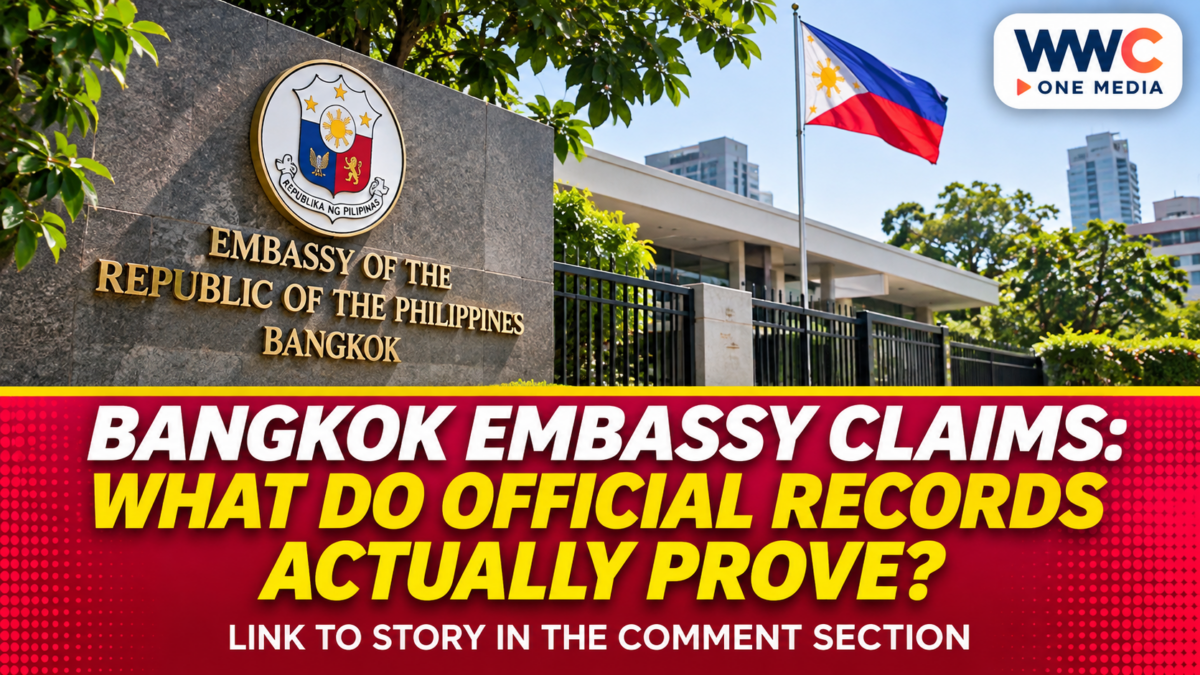
BANGKOK, Thailand — Nov. 21, 2026. Questions about a purported plot targeting Israel’s embassy in Bangkok have renewed attention on security cooperation between Thailand and Israel. Yet the official records examined for this report do not confirm a newly disrupted plot, the alleged recruitment of six Thai religious figures or the identities attributed to them in accounts circulating this week.
The distinction is essential to any assessment of Bangkok embassy claims. Public records establish earlier counterterrorism concerns involving Thailand, a United States sanctions decision affecting an Iranian university and formal Thai–Israeli police engagement. They do not connect those separate facts into proof of the latest allegation.
Bangkok Embassy Claims: What Is Confirmed?
The clearest recent government record is an announcement issued by Israel’s embassy in Thailand describing a Jan. 22, 2026 meeting between Ambassador Alona Fisher-Kamm and Thailand’s police commissioner-general, Kittharath Punpetch. The announcement describes cooperation on matters of shared interest.
It does not identify a specific planned attack on the embassy. Nor does it describe arrests, charges or an investigation involving six alleged recruits. Treating a general diplomatic or security meeting as confirmation of a specific case would go beyond what that document says.
This is also why an assertion that a plot was successfully foiled needs more than an unattributed description. An official account could identify which authority investigated the matter, when action was taken, and whether legal proceedings followed. None of those details has been established through the primary records reviewed here.
What the US Sanctions Record Establishes
A separate and much older record concerns Al-Mustafa International University in Iran. On Dec. 8, 2020, the US Department of the Treasury announced sanctions against the university, alleging that it facilitated recruitment and intelligence activities for Iran’s Islamic Revolutionary Guard Corps-Qods Force.
The department described the university as a channel used to recruit foreign students. It designated the institution under US counterterrorism sanctions authorities. Those are documented US government findings and restrictions, not a court finding concerning any individual Thai student.
Importantly, the 2020 announcement does not identify the supposed November 2026 Bangkok operation. It does not independently establish that Thai clerics were recruited to attack the Israeli embassy or prove that people named in subsequent accounts committed offences.
The distinction matters for individuals, religious institutions and students. Attendance at an institution subject to US sanctions cannot, without specific evidence, establish participation in violent activity. A sanction against an organisation should not be expanded into a collective allegation against everyone connected with it.
Earlier Sanctions Are Not Proof of a New Plot
The 2020 Treasury announcement establishes that US authorities had identified recruitment concerns involving an Iranian institution years before the allegations now circulating about Thailand. It documents an earlier sanctions action, not any new security operation in Bangkok.
A designation issued in 2020 cannot independently verify an allegation made in 2026. Historical sanctions actions and current accusations require separate evidence, even when accounts mention some of the same organisations or locations.
For the same reason, readers should distinguish police investigations, government intelligence assessments, sanctions designations and criminal convictions. Each involves different standards, documents and potential consequences. Collapsing those categories into a single claim of guilt would misrepresent the public record.
Why Bangkok’s Diplomatic Climate Matters
Thailand and Israel have maintained formal engagement while public disagreements involving visitors and protests have attracted attention. The January embassy announcement confirms a working channel between the Israeli diplomatic mission and senior Thai police officials.
That is relevant background to any discussion of embassy security, but it says nothing about the truth of a particular unconfirmed plot. The existence of security cooperation is not evidence that an operation has occurred.
WWC ONE MEDIA has separately examined Israel’s ambassador responding to tensions around Israeli visitors in Thailand. That was a diplomatic and community-relations issue, not confirmation of a terrorism investigation.
Another WWC report described concerns surrounding a cancelled Jewish New Year event in Phuket. Concerns about event security must likewise not be treated as evidence against a religious or national community.
The separate reporting on the broader debate over Israeli tourists and expatriates in Thailand illustrates why careful distinctions are essential. Lawful criticism, peaceful demonstrations, threats and alleged criminal conspiracies are different subjects requiring different evidence.
What Would Make a New Allegation Verifiable?
Analysis: A credible official update would establish the investigating agency, the nature of any alleged offence, the dates of documented action and the procedural status of affected individuals. If charges were filed, readers would need to know what prosecutors alleged rather than being told that allegations were proven.
Evidence might also clarify whether any claimed security operation related to Bangkok, a different location or a historical investigation. Until such documentation is available, combining individual names, religious affiliations and disputed intelligence narratives would create an unjustified risk of reputational harm.
The standard should apply consistently regardless of nationality, religion or political affiliation. Confirmed government actions deserve accurate reporting; unsupported accusations do not become facts merely because they circulate internationally.
What Happens Next
Any further article should be anchored to a dated police statement, official embassy release, prosecution document or publicly available judicial record establishing the specific allegation. Editors should then distinguish evidence, official claims, denials and unresolved questions.
For now, the responsible conclusion is limited: authorities have publicly documented Thai–Israeli cooperation and earlier US concerns about recruitment networks, but the reviewed records do not verify the alleged 2026 Bangkok embassy plot. The next development worth reporting would be a substantive official confirmation or correction, not another repetition of anonymous claims.
Frequently Asked Questions
1. Was a new attack on Israel’s embassy in Bangkok officially confirmed?
No official record reviewed for this article confirms the alleged 2026 operation. This does not prove that no investigation exists; it means the claim remains unverified for publication.
2. Did US authorities sanction Al-Mustafa International University?
Yes. The US Treasury announced sanctions on Dec. 8, 2020, alleging that the institution facilitated recruitment for the IRGC-Qods Force.
3. Does that designation prove Thai students were involved in an embassy plot?
No. The designation did not establish the alleged 2026 Bangkok case or guilt by association for students and graduates.
4. Have Israeli and Thai officials publicly discussed security cooperation?
Yes. Israel’s embassy recorded a Jan. 22, 2026 meeting between its ambassador and Thailand’s police commissioner-general, without confirming the specific allegations under review.
5. What should readers watch for next?
A dated official police statement, filed charges, a court record or an attributable government briefing that clarifies whether a current case exists and what has actually been established.