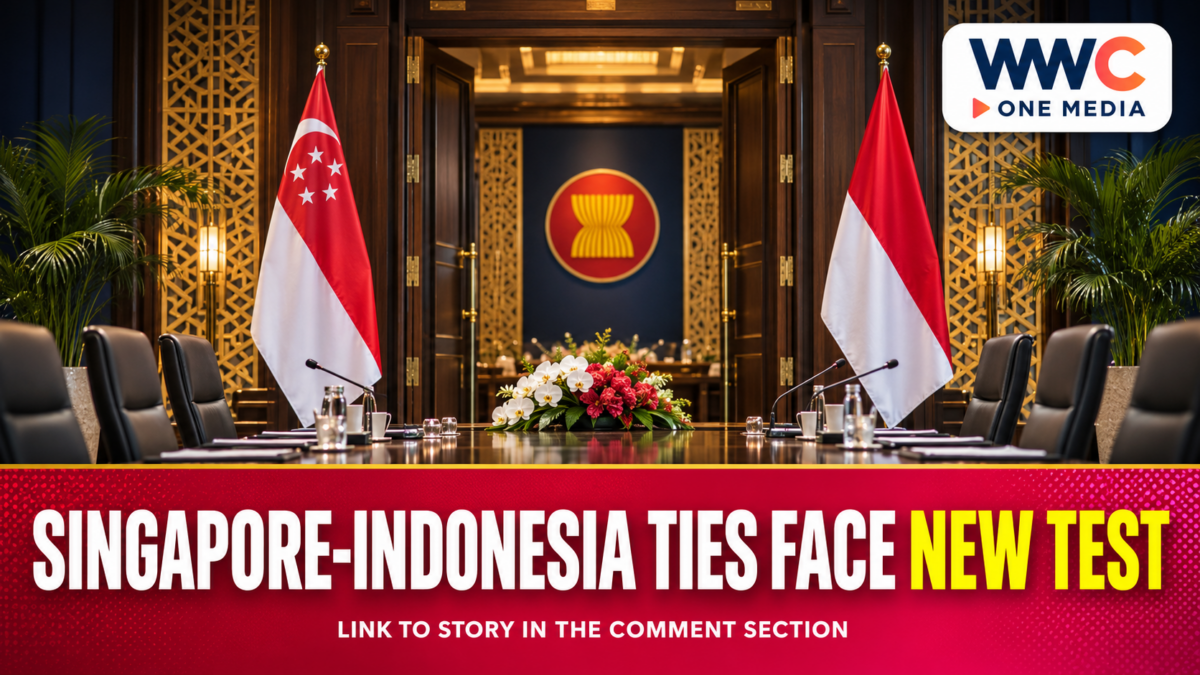
MANILA, Philippines — Singapore Indonesia cooperation entered November’s ASEAN meetings with an agenda set out by Prime Minister Lawrence Wong and President Prabowo Subianto at their July 6, 2026, retreat in Jakarta. Singapore’s government also confirmed that the two countries agreed in October to form a joint task force on transboundary haze, placing environmental enforcement alongside investment and energy links in their relationship.
The central question now is not whether the two neighbours have areas of common interest. It is whether their existing agreements can translate into measurable progress as Singapore prepares to chair ASEAN in 2027.
Singapore Indonesia cooperation goes beyond summit diplomacy
The July leaders’ retreat established a public record of priorities covering industrial investment, electricity connections, transport, education and defence cooperation. Wong’s official remarks identified Batam, Bintan and Karimun as an important digital-investment area and noted a planned 1,000-hectare expansion of Kendal Industrial Park.
These are different kinds of commitments. Industrial expansion needs investors and infrastructure; education and defence cooperation needs continuing institutional work. A successful leaders’ meeting can set direction, but implementation determines whether businesses and communities see benefits.
Singapore’s October diplomacy added another task: managing pollution that crosses national borders. Its foreign ministry confirmed that the two foreign ministers agreed to create a joint task force and a communication hotline to address transboundary haze.
That builds on a debate examined in WWC ONE MEDIA’s coverage of Indonesia’s response to companies suspected of involvement in forest fires. The distinction is important: investigations and suspected links do not establish legal responsibility.
Haze cooperation tests whether governments can act together
Singapore Foreign Minister Vivian Balakrishnan and Indonesian Foreign Minister Arrmanatha Christiawan Nasir met in Jakarta on Oct. 27. Their discussions produced an agreement to strengthen information sharing through a bilateral task force, with direct communication between their ministries.
The arrangement matters because smoke, commercial operations and relevant records may involve more than one jurisdiction. A task force can help authorities exchange information and coordinate their work. It does not by itself prove wrongdoing, deliver a prosecution or prevent a future fire.
In an official Nov. 3 parliamentary reply, Balakrishnan described the ASEAN Agreement on Transboundary Haze Pollution as the region’s principal framework for preventing, monitoring and mitigating forest and land fires and the resulting pollution.
Singapore also stated its intention to work towards establishing the ASEAN Coordinating Centre for Transboundary Haze Pollution Control in Indonesia. The reply said the centre’s establishment agreement required ratification by at least six ASEAN members, and Singapore planned to submit its instrument of ratification shortly afterward.
The practical test is whether governments improve prevention, timely information sharing and lawful accountability, not simply whether they issue another joint statement. WWC’s earlier examination of Singapore’s haze agenda at the Manila summit provides the separate environmental-policy background.
Power projects offer an economic path forward
Energy cooperation provides a different measure of bilateral progress. At the July retreat, Wong identified a joint solar project in Morowali, Central Sulawesi, and memoranda of understanding involving Danantara and Singapore-based energy participants.
He presented prospective cross-border electricity projects as building blocks for the ASEAN Power Grid. Memoranda and negotiations, however, are not the same as completed power lines or electricity deliveries. Commercial terms, financing, technical approvals and transmission infrastructure still matter.
The regional relevance extends to the Philippines. WWC has previously reported on exploratory electricity connectivity between the Philippines and Singapore, an example of why ASEAN energy integration matters beyond any single bilateral relationship.
For companies, stronger cross-border electricity links could eventually widen sourcing options and support renewable-energy investment. Those possible benefits are conditional on projects becoming operational and on participating countries agreeing on workable trading rules.
Investment and connectivity remain long-term priorities
Wong’s July remarks also described Singapore’s continuing interest in Indonesian investment opportunities, including digital industries and the Kendal industrial estate. They pointed to air connections and student exchanges as additional ways to build contacts between the two countries.
These initiatives operate on different timelines. Business parks can take years to expand; airlines respond to demand; educational exchanges build relationships gradually. None should be measured solely by the number of announcements made during a summit.
Capital, infrastructure and movement of people may reinforce each other, but delivery, operating costs and demand remain essential tests.
Singapore’s ASEAN chairmanship raises the stakes
The 49th ASEAN Summit and related meetings took place in Manila from Nov. 15 to 17, 2026. At the closing ceremony on Nov. 17, Wong accepted the ASEAN chairmanship from the Philippines and set out Singapore’s theme for 2027: “Deeper Integration, Wider Partnerships.”
His official remarks called for closer links in finance, digital technologies and energy, alongside stronger relationships with partners outside ASEAN. The direction fits Singapore and Indonesia’s existing investment and electricity agenda, although a regional policy objective does not amount to approval of a particular bilateral project.
The summit also provided a broader setting for economic discussions. WWC’s report on ASEAN Plus Three initiatives in Manila examines the separate regional agenda on trade, logistics, energy and food security.
For Jakarta and Singapore, the coming ASEAN chairmanship offers an opportunity to align bilateral work with regional institutions. It also creates expectations that cooperation will produce results that can be checked independently.
What happens next
The next milestones are operational rather than ceremonial: progress in setting up the haze task force, further steps towards the regional haze coordination centre, and concrete developments in the energy and industrial projects outlined in July.
Official records reviewed for this report do not establish a fresh agreement reached in a private conversation between Wong and Prabowo during the November summit. The verified record is substantial without relying on that unconfirmed detail.
The most meaningful measure of the partnership will be whether its governments and institutions turn existing commitments into cleaner air, workable power links and durable investment opportunities.
Frequently asked questions
Did Lawrence Wong and Prabowo Subianto hold an official leaders’ retreat in 2026?
Yes. They held the Singapore–Indonesia Leaders’ Retreat in Jakarta on July 6, 2026, where bilateral economic, energy and institutional cooperation featured in official remarks.
What did Singapore and Indonesia agree to do about haze?
Their foreign ministers agreed in October to establish a joint task force for stronger information sharing and cooperation, including a direct communications hotline.
Does the joint task force mean companies have been found guilty?
No. Cooperation between authorities is not a legal finding. Responsibility must be determined through applicable investigative and legal processes.
What is the ASEAN Power Grid?
It is a regional effort to improve electricity connections and enable cross-border power trade. The Singapore–Indonesia energy discussions identify potential projects contributing to that wider goal.
Why is 2027 important for Singapore–Indonesia relations?
Singapore will chair ASEAN in 2027, and the two countries will mark 60 years of diplomatic relations, giving them another opportunity to advance established cooperation priorities.